Day 1
Through windows of the train from the airport, I could see the spires of temples emerging out of a green tropical landscape. It was such a textbook definition of exotic, but the hours upon hours of air travel had numbed me to it. The numbness may not have been an entirely bad thing, though, given that I’m pretty sure that plunging into the seething cauldron that is Bangkok would have given me a heart attack otherwise.
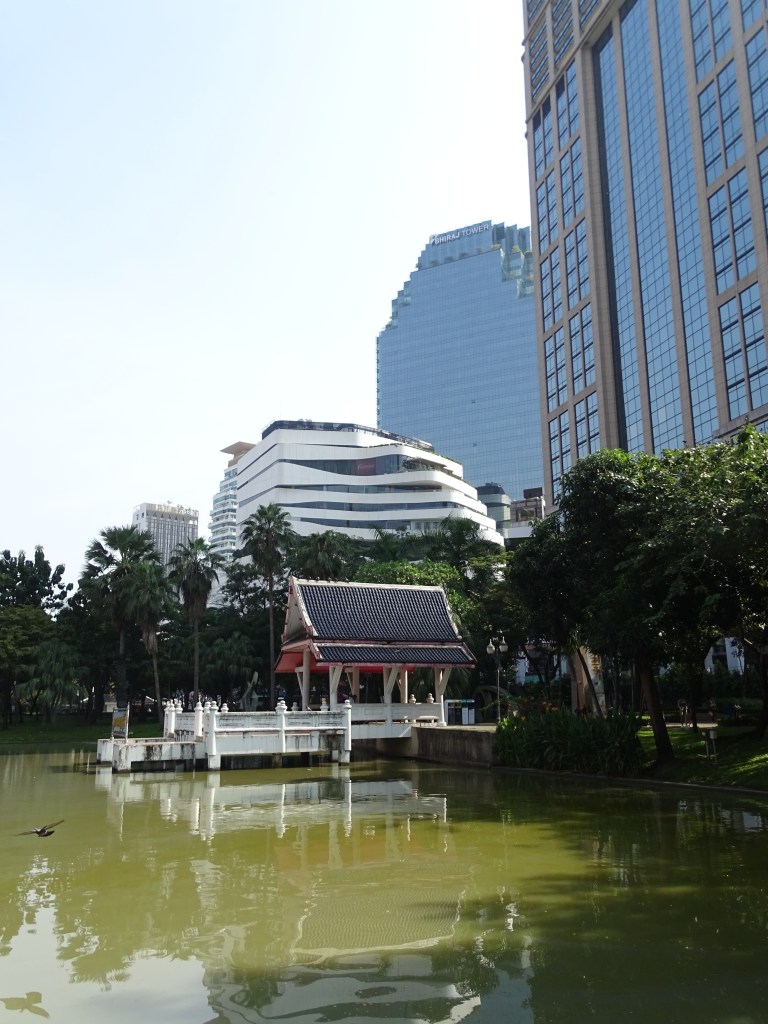
The flight was one of those awkwardly-timed ones that mean that I’ve arrived hours before I can check in at the hotel. Luckily, it’s near a small park nestled between the skyscrapers, so I can wait for check-in time sitting beneath what I think is a mango tree, next to a large pond.
Bangkok’s real name starts with something that sounds something like ‘Krung Tep’ then goes on at some length. The hotel gave me a promotional map of it that referred to it as a city that is full of contradictions, such as being both “vibrant and sleepy”. That’s certainly what went through my head as I tried to cross the road and ended up dodging three mopeds at once: ‘Wow, this city is so sleepy!’. But the fame of Bangkok’s street food demands to be sampled – surely that’s worth risking a little bit of death?
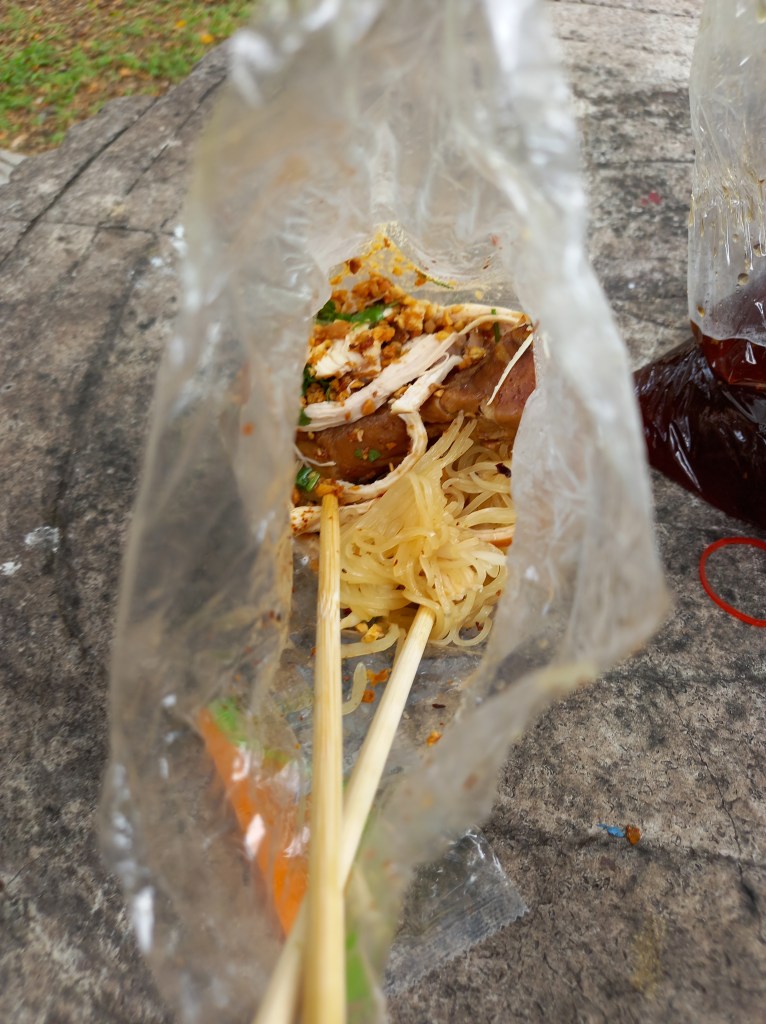
There was tray of chicken’s feet available, but I, perhaps spinelessly, went for the chicken noodles. It’s not quite what I expected. There’s no polystyrene box or tray, just the chicken noodles in a bag, some kind of dark watery soup in another bag, and condiments, including chilli flakes, in little sachets. I can only assume that customers are expected to take it home and put it all in a bowl. I don’t have such a luxury as a bowl, so I have to take it to a picnic table in the park and eat it straight out of the bag with chopsticks. Somehow, I manage it, and it’s good stuff. The soup is more of a challenge, though. I manage to drink some of it out of the bag before realising that I’m drinking out of a bag in a public park, giving up, and discreetly pouring the rest into the ground. I’m sure worms appreciate Thai cuisine as much as anyone else.
Day 2
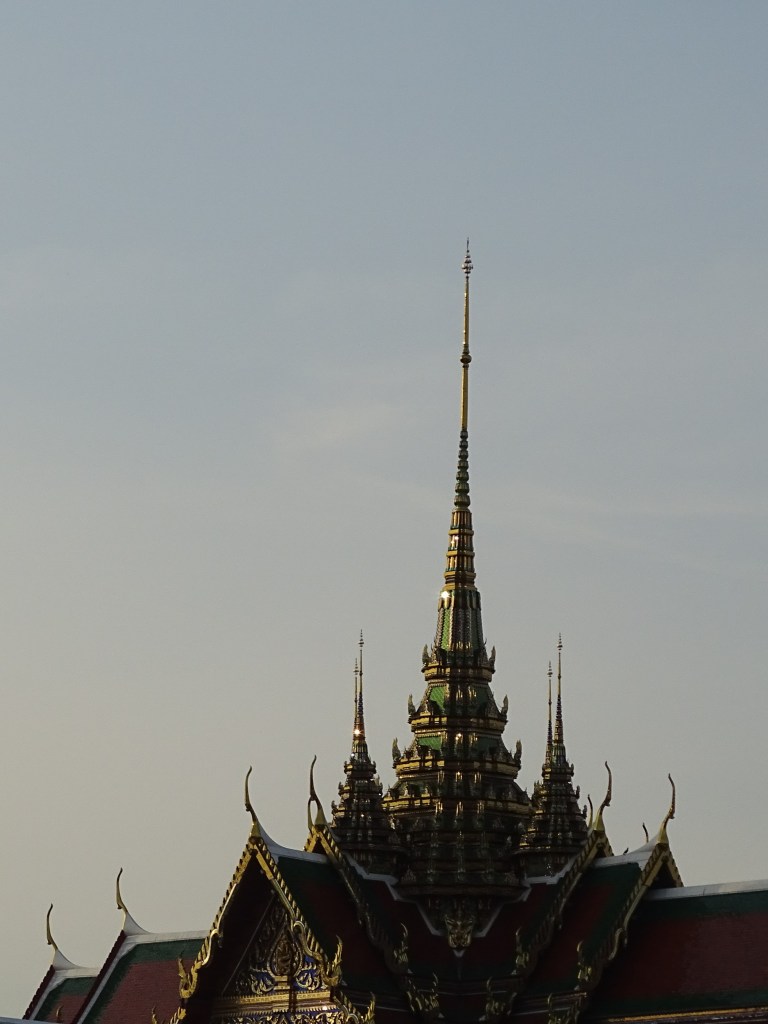
Having spent much of the day wandering the huge shopping malls that had been recommended to me by someone who had failed to understand my lack of interest in luxury shopping, and having given up on finding roast scorpion, I’ve ended up on the streets around the Royal Palace. Its manicured lawns and government buildings are surprisingly quiet. Maybe it’s just relative to the manic city centre, maybe it’s due to the time of day: it’s dusk, and the light of the setting sun is glinting off the palace’s spires. I’ve just seen a tree shrew, scampering over a park wall, and I am content. No roast scorpion, but I had tried one of the localised KFC options. Same kind of thing, technically.
Day 3
The train is rickety and the seats are hard, but, leaning on an open window, I had no objections as it rattled out of Bangkok’s train station and through the suburbs. It is exactly what I had expected of travelling in Southeast Asia. The sense of having travel ambitions fulfilled faded when I realised what the “exotic scenery” actually was: despite the conspicuous wealth on display in Bangkok, what I saw on the outskirts were essentially shantytowns. A demonstration of Thailand’s profound inequality. My mood is souring further as the train goes past industrial zones, and dust is blown into my face. When I try to rub it off, my hand comes away grey.
The train was just the first part of a long and convoluted journey from Bangkok to Khao Yai National Park – a swathe of mountainous jungle in central Thailand. When I disembarked in the town of Pak Chong, I followed vague directions I found online to find a songthaew – a kind of bus-substitute that consists of a truck with two benches at the back. After working out that the “giraffe statue” that the directions mentioned was actually a statue of a deer with a long neck (which made much more sense), I found the songthaew parked in front of a “Khao Yai” sign. The driver’s door was open, and he was eating out of a tray.
‘Khao Yai?’ I asked, just in case.
Barely looking up, he grunted and nodded. I got in the back, and waited with the other passengers. One of them was a Buddhist monk, clad in orange robes. He got up and approached me, and started making cheerful small talk in lightly-accented, but slightly broken English. I was too tired to make much conversation, and gave brief answers. Hopefully he understood that I was tired, rather than thinking that I was rude, as he sat back down. Eventually, after an hour or so, the songthaew finally revved up, and we left Pak Chong.
The scenery became more touristy as we got closer to the national park. For some reason I kept seeing signs referencing fresh strawberries in English. As we passed more hotels, a memory of Chester Zoo surfaced. Specifically its Southeast Asian exhibits, with its facsimiles of Southeast Asian sculptures and architecture, and here I was, in the region itself, and I had just passed an enormous hotel in the form of an English stately home called “Thames Valley”. English customers were being sold the sensation of being in Asia, while Asian customers were being sold the sensation of being in England. Everyone wants to be somewhere else. Suddenly, the elderly lady next to me became agitated, and got the songthaew to stop. She told me something, and, catching the words ‘Khao Yai’, I realised that, being unable to see where we’re going due to the way the songthaew’s benches were arranged, I couldn’t see the entrance to the national park. What this kind lady had done was guess that, given that I’m obvious tourist, I was going to Khao Yai, and stop the songthaew at the right place. I got off, paid for the ride, and thanked the old lady.
This was still not the end of the journey. I had only reached the entrance of the national park – where I was staying was much deeper into the park. After I paid for an entry ticket, one of the park rangers flagged down a car, and exchanged words with the driver. The car then parked, and the driver, a middle-aged man, got out and opened the boot, motioning me to put the bag in. The park ranger had evidently stopped a passing car to ask the occupants if they would mind taking a misbegotten, semi-lost European (a ‘farang’, in Thai) with them. In any case, the family – a couple with a pair of children and a grandmother – were pleasant people. I spent the journey politely talking to the grandmother, who spoke fairly good English. I apparently made enough of an impression on her that when we reached the national park headquarters, she insisted on having a picture taken with me. It was only at that point, seeing the photo, that I realised that the train had left my face covered in dust and my hair looking like it was trying to escape my head.
I had finally arrived at Khao Yai’s check-in desk. But of course, it was never going to be that simple. I received my keys, a quick introduction to the park’s trails, and a map that made it quite clear that I was still some way away from the cabin I would be staying in. Which is how I’ve ended up walking through a rapidly darkening jungle as night falls. At least I was able to have dinner at the headquarters canteen first, and I’m walking on tarmacked road. Nevertheless, I scan the trees and foliage in the failing light, keeping in mind that this time it’s not just my overreactive imagination that populates the darkness with dangerous creatures. Finally, cabins start to appear ahead. One is mine, but the others appear to be deserted, apart from the porcupine that rattles its long quills threateningly as I get too close, and the sambar stag resting against the cabin next door. After travelling by train, songthaew, car, and foot, I finally unlock the door to my cabin. Then I realise that there are eight beds. I had been wondering why hiring the cabin had been so expensive. In my defence, the website had been mostly in Thai.
Day 4
The empty beds already made night in the cabin feel isolating, but the lack of human noise made it more so. It was just me, alone in the wilderness. Although not entirely alone, it turned out, as I later found a tiny gecko in the shower.
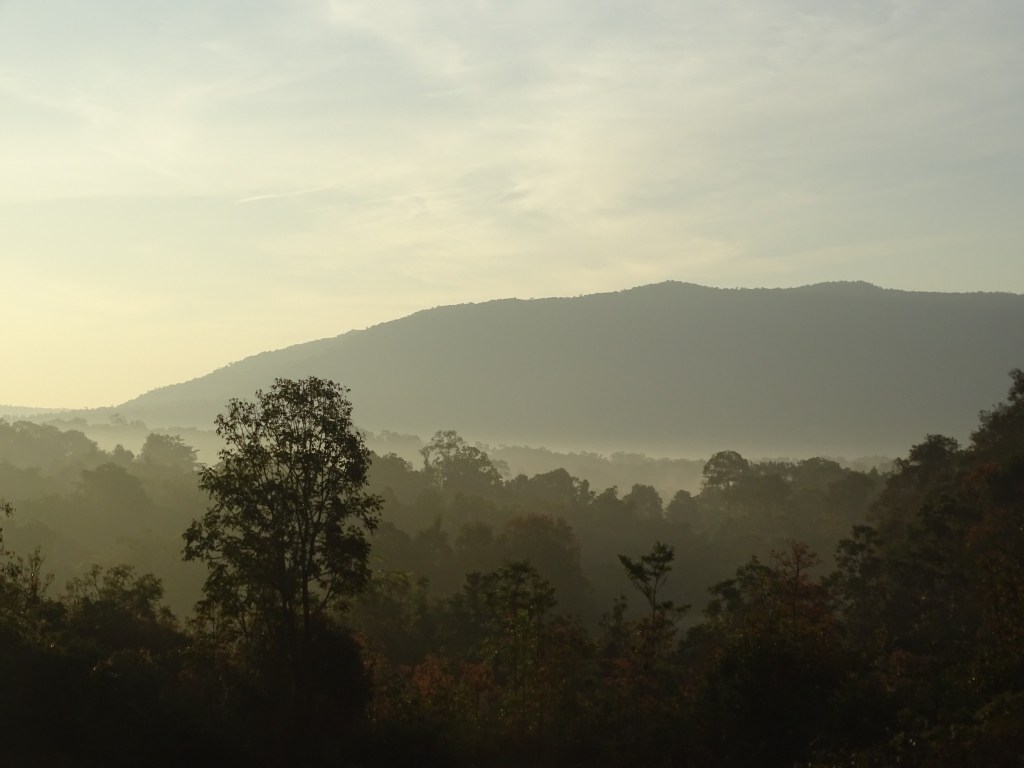
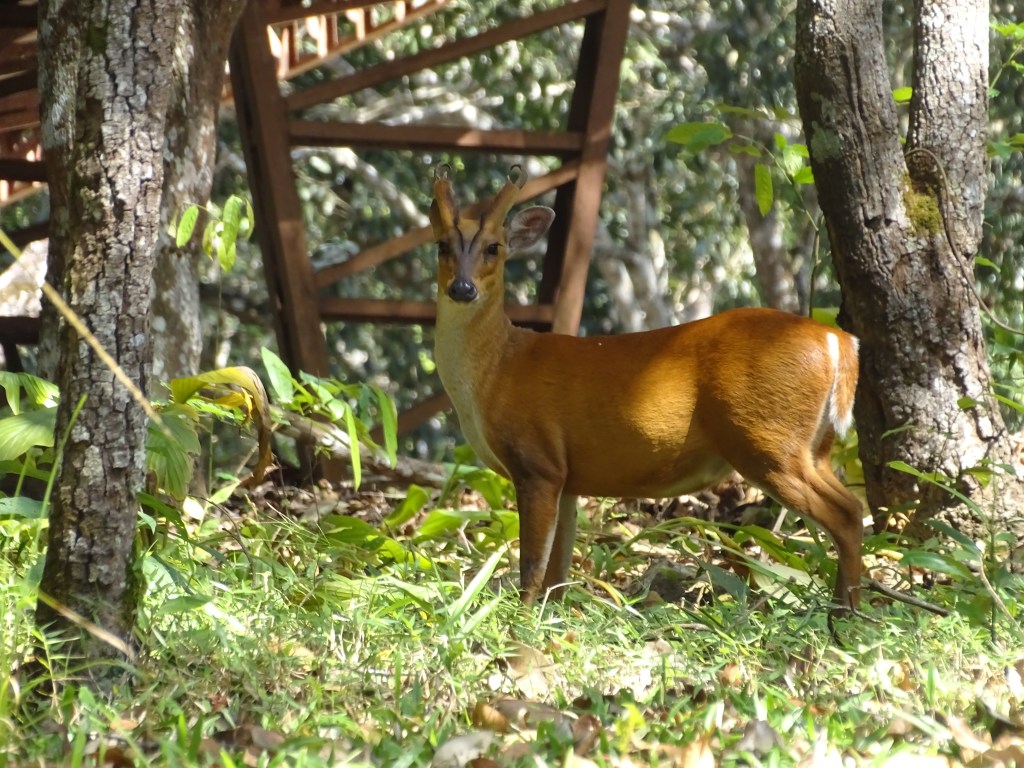
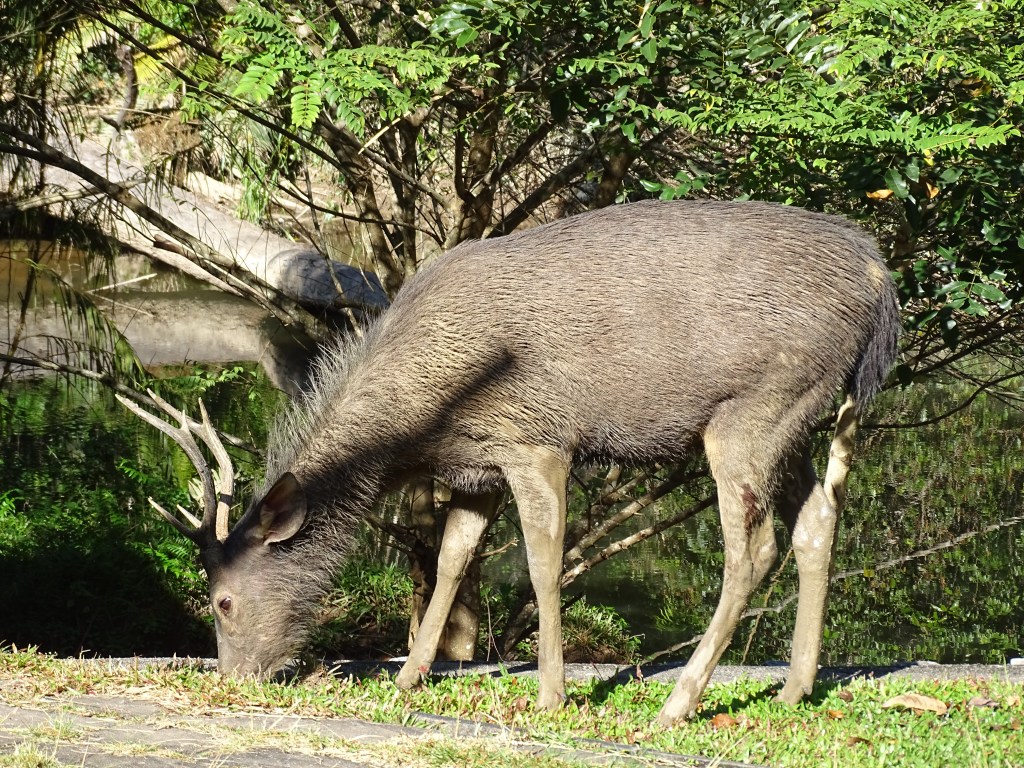
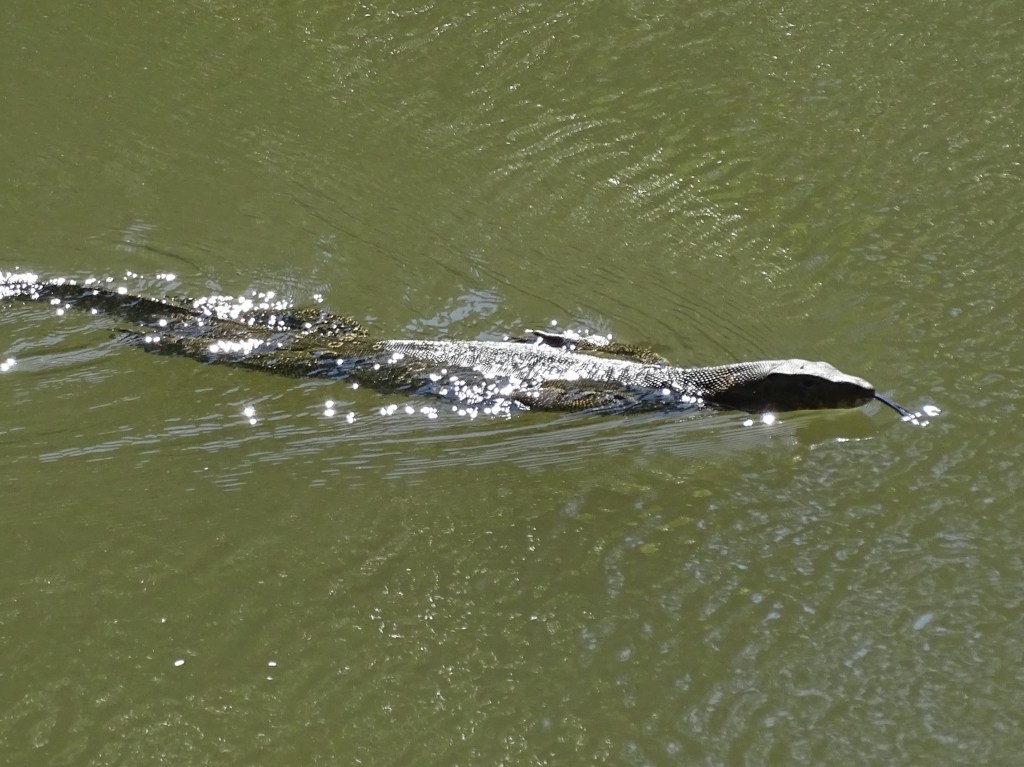
I start wandering the park as the sun rises, having heard that dawn is the best time to find wildlife in jungles. But it takes ages to even reach the trails from my cabin, walking along the roads that undulate up and down over these tropical mountains. The sun is fully up by the time I reach a trail, but nevertheless, sambar deer graze openly without the slightest of fear of people next to the headquarters, more skittish muntjac deer glance at me nervously as they cross the road, and truly massive lizards – water monitors – alternate between the rivers and the undergrowth. The trails I’m allowed to walk on without a guide don’t go very deep into the forest, but still allow me to get some solitude away from the tourists that throng around the headquarters (only a few of them farang, surprisingly). The jungle rattles with sound, but most of the life that produces it is invisible, apart from flashes of something scampering up a tree trunk, or a glimpse of a gibbon swinging through the treetops.
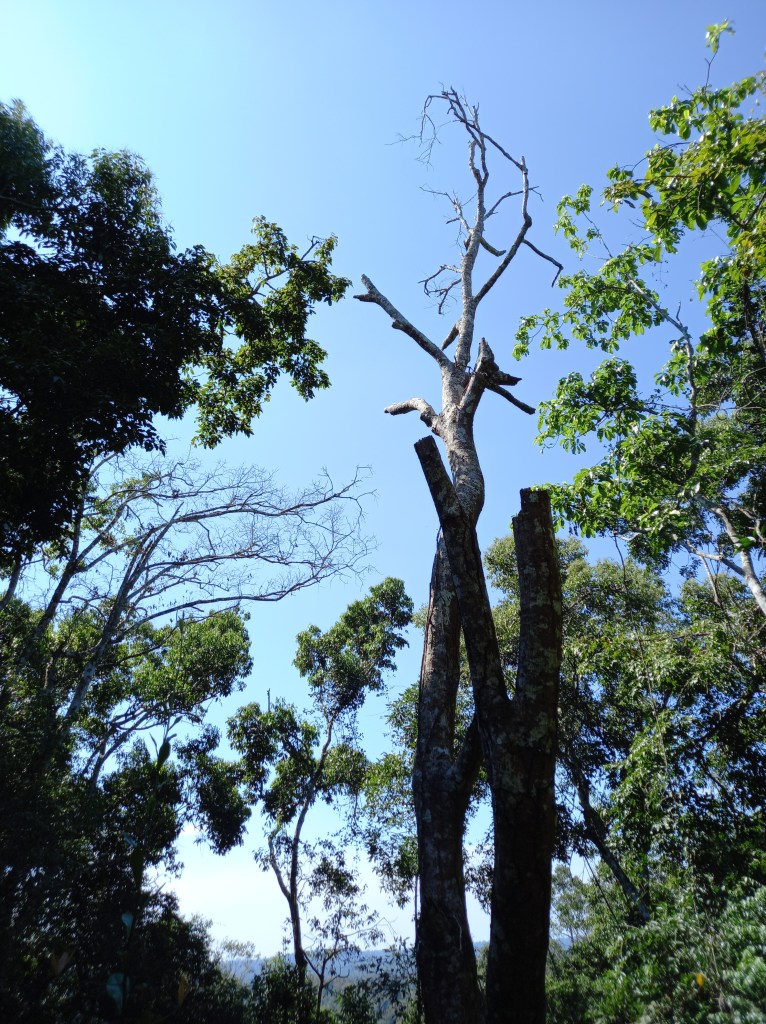
Apropos of nothing, a gloomy mood has descended on me by the time I’m on another trail. This one runs through where there was a US military camp during the Vietnam War, and the trees are smaller, having only recently regrown. Something about the trail’s position – maybe because it’s next to a lake, maybe because it’s on a slope – makes it colder. In my detached, moody state, this colder, less jungly part of the park feels not much different to walking through a forest at home. So when I hear something large crash through the undergrowth nearby, my first thought is, ‘oh, a sheep’, before the rest of my brain catches up and reminds me that I’m not in Gwynedd, and that could have been a bear, or even a tiger. That thought is still not enough to snap me out of my mood, which only lessens when I emerge out into a more open part of the forest, where a leafless tree exposes the perfect blue above. A single iridescent green butterfly flutters across it.
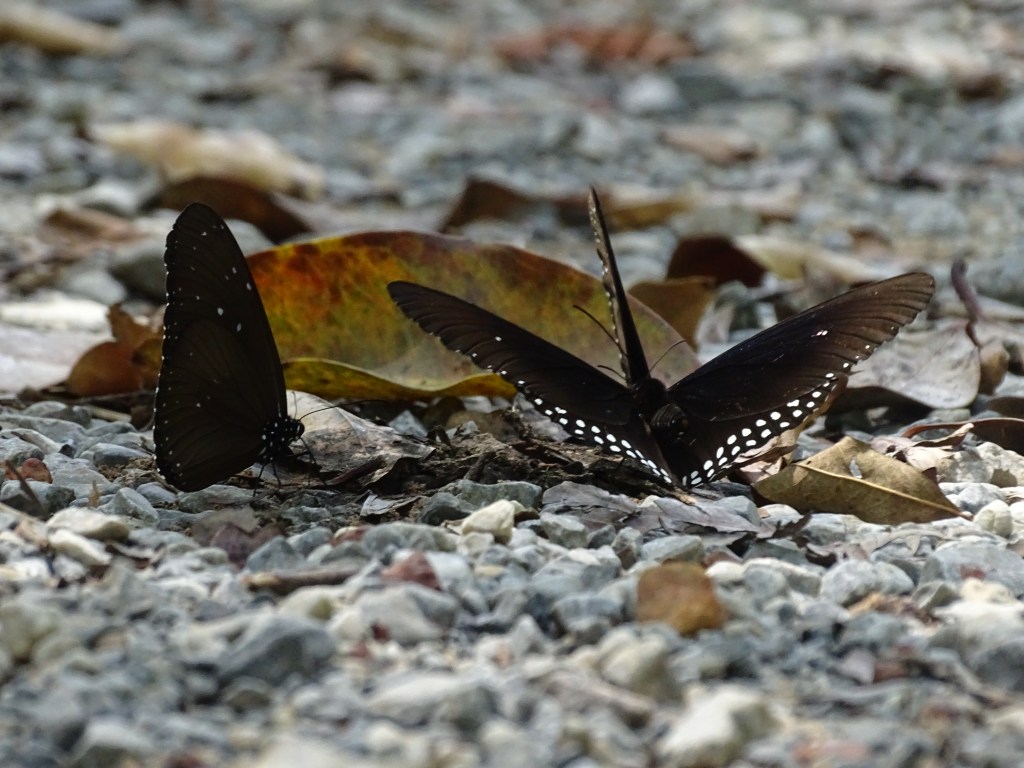
I later see a cluster of butterflies eating some poo.
Day 5
It is evident that, as a national park, Khao Yai is not designed for lone travellers without their own transport. The distances between both the trails and the places to eat are considerable, and I end up tramping on tarmac for miles and miles under a tropical sun, powered by nothing but crisps and fizzy drinks – the only portable food available from the park’s shops. At one point, I avoid stepping in a large pile of dung. Very large. Most likely from either a gaur – a massive variety of Asian buffalo – or an elephant. A reminder of who I’m sharing these roads with.
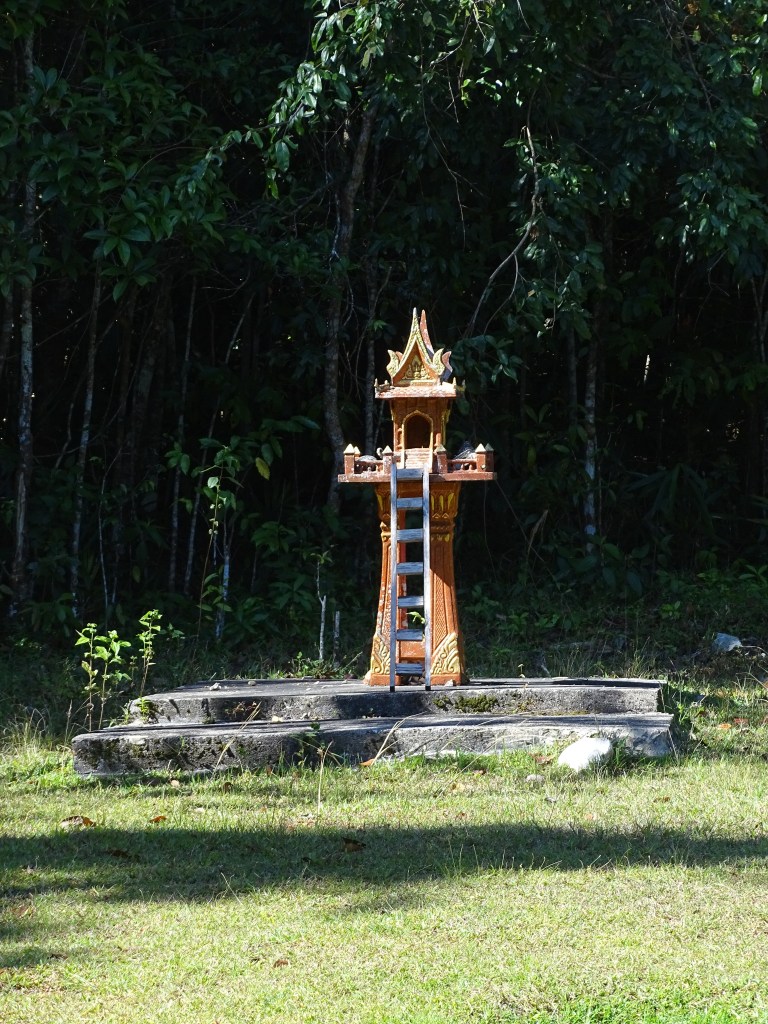
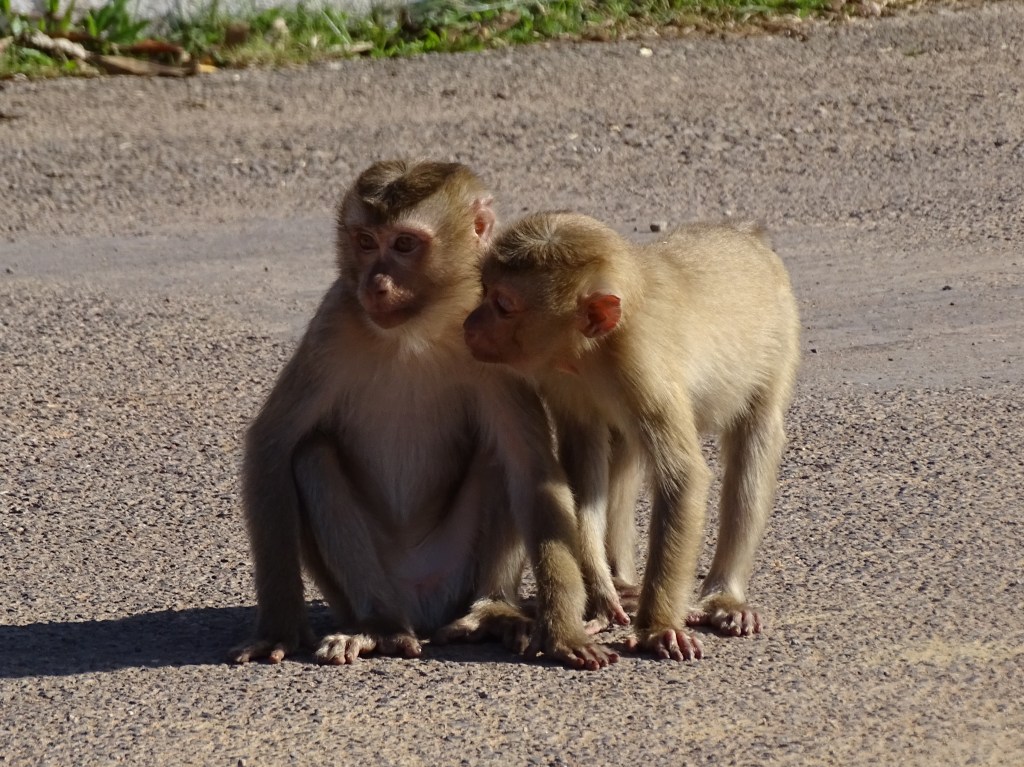
Much of the wildlife is not particularly fussed about being in close proximity to people. At a campsite, I see sambar deer grazing right next to tents. As I’m walking in, a monkey – a pig-tailed macaque, to be precise – follows me closely, close enough for me to keep a wary eye on them and try to work out how to throw off a monkey if they jump on me. They pass by harmlessly, and instead, my eye is drawn to a shrine next to the campsite entrance. It’s small plinth with a little ladder leading up to a kind of mini-facsimile of a temple. The ladder reminds me of jungle shrines I had seen in a documentary – those of the Karen people over the border in Myanmar. Even here, amidst the tarmac of a campsite for tourists, someone – maybe the park rangers – felt the need for a place for offerings to the forest spirits.
The trail starts from a different campsite, and, following a river, promises to end at a waterfall. For some reason, part of the path is covered by a low latticework of sticks, forcing me to take off my backpack and scramble in the dirt underneath.
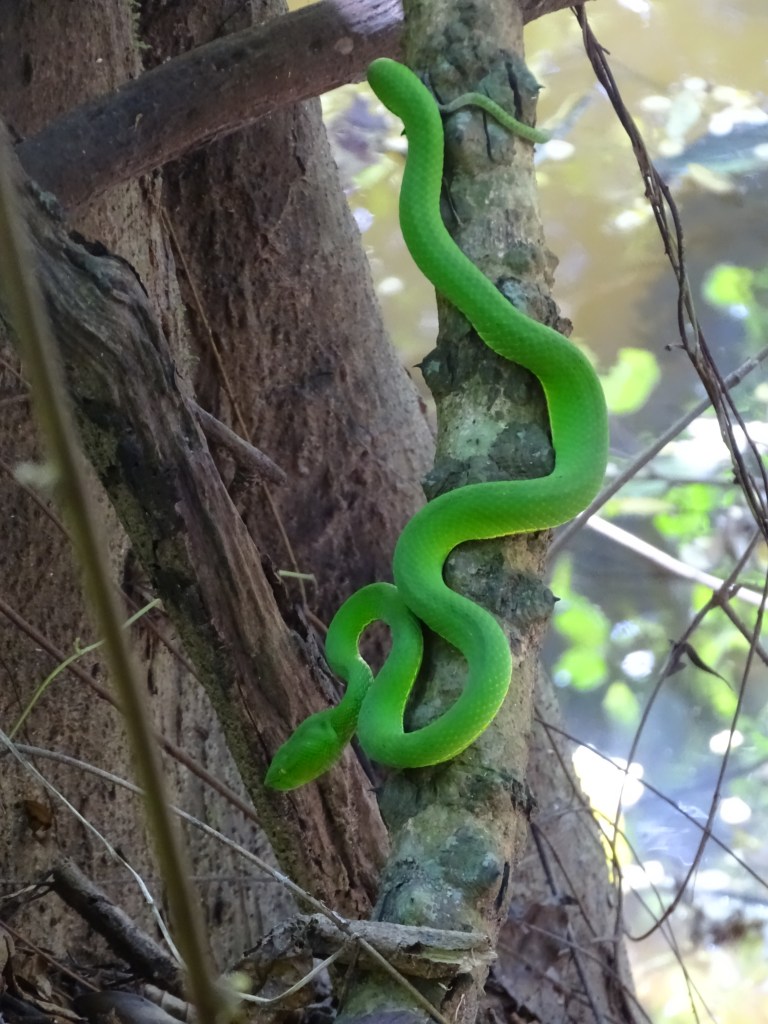
Then there’s a sign, which a part of me can scarcely believe is perfectly serious and not a piece of kitschy décor in someone’s garden, warning of crocodiles in the river. I peer around, but there’s nothing stirring in the brown water. Further along, however, there is, coiled around a tree with that perfect reptilian stillness, a green pit viper. Highly venomous, as I recall.
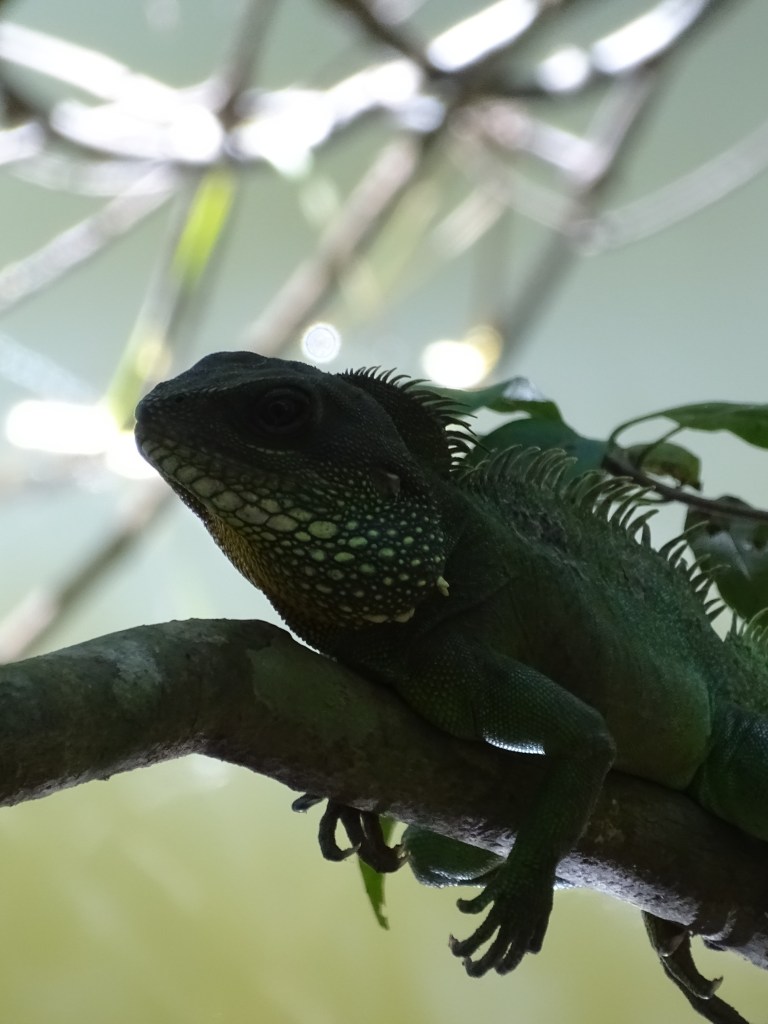
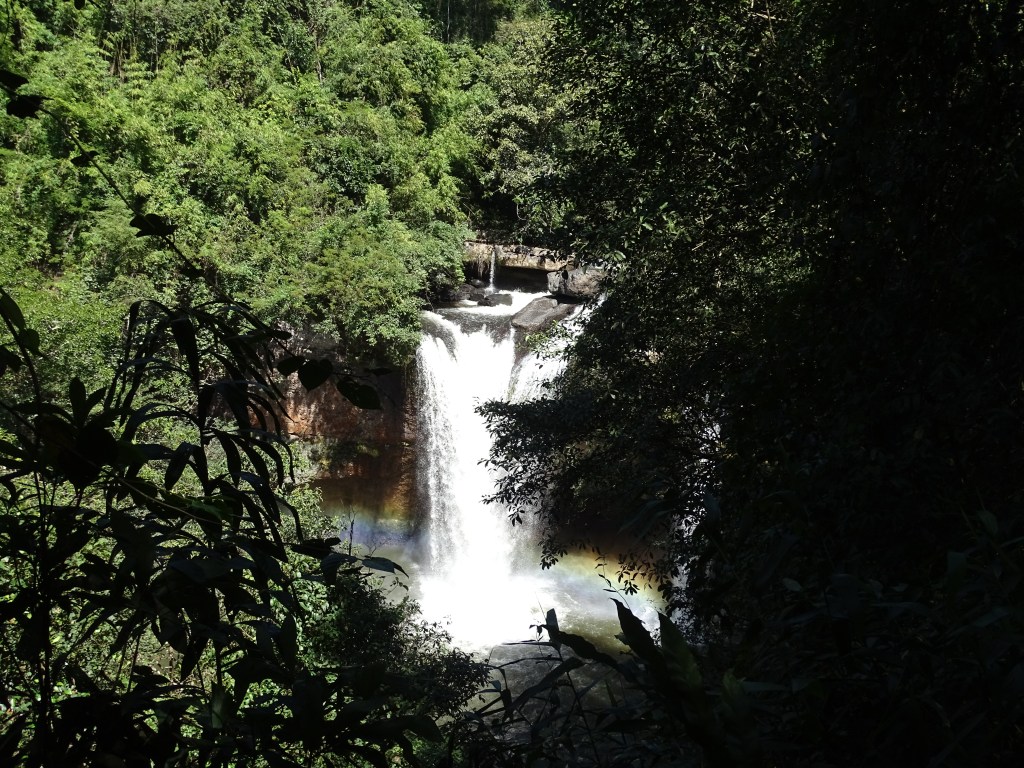
There is a restaurant at the park headquarters, I had seen it earlier. So, presumably, there is a place to have food in the evening. But I’m some way from it in my cabin, and it’s already dark. No choice but to use precious, expensive data on my phone to check if it’s open, before walking into the tropical night. I’m uncertain how safe this really is, but a kind lady on a moped who was passing by has evidently decided that it isn’t, and has offered me a ride there. I don’t really know the etiquette of holding on while on a moped with a stranger, so I end up placing my hands gingerly on her arms as we hurtle through the night-shrouded jungle. A few minutes later, I climb off in front of the park headquarters and thank her, taking a few moments to recover from the moped’s dizzying vibration as she leaves. I then turn to the restaurant.
Of course it’s closed.
No moped ride back, just a long, hungry walk and a baffled park ranger asking what I’m doing out at night.
Day 6
The journey back to Bangkok was much simpler than the journey to Khao Yai. I didn’t even need to walk all the way to the headquarters – this time, it was a pair of young men in a truck who gave me a lift. After giving the keys to a sympathetic young woman at the desk who suggested that next time, I might like to book a two-person cabin for myself instead of an eight-person, and unsuccessfully attempting to hitchhike back to the national park entrance, I decided to shell out for a taxi to Pak Chong’s train station.
Which is how I’m back on Bangkok’s sweltering streets, trying to find my hotel. This is one of the modern, shiny parts of the city, even with a section with a large gateway with LED screens that proclaims ‘Koreatown’, which seems to promise unspecified wonders that I don’t have time to explore. More worryingly, there’s an awful lot of single, middle-aged farang men around here, perusing establishments with all-female staff.
By the time I find the Atlanta, I’m wheezing like a dying man. A hotel with eccentric marketing that had gravely assured me that if I did not try at least of one of the dishes from their restaurant, which was the “best Thai cooking in the universe”, then “the angels would weep for me”, it reminds me of something one of my parents said. A traditional part of Gwynedd furniture is a “Welsh dresser” or “dresal” – a cabinet with a hefty piece of decorated woodwork for displaying nice plates that are never used. I was told that the way that poor quarrying families could afford such things was that the dresser had high-quality wood at the front, and low-quality at the back. With the Atlanta, the ground floor is an extraordinary display of Art Deco; the very image of a 1920s New York upper-class hotel, where successful gangsters and Hollywood stars swaggered across the tiled floor. The actual rooms are the very image of a 1920s hospital, where staff tranquilized “hysterical” women. Still, my great-grandparents’ logic was sound, and it makes the place is affordable.
Day 7
It has to be said, despite the well-deserved fame of Thai cuisine, breakfast is not their strong point. Usually it’s just rice and eggs. In the previous hotel they had a more European breakfast, but had to mix the butter with ice cubes to stop it melting in the tropical heat. In the Atlanta’s case, however, they have pancakes on their breakfast menu, so I chose that. At the first mouthful, I freeze. It has banana in it. Something I had read about beforehand was the semi-affectionate, semi-disparaging slang term for naïve young Westerners backpacking through Southeast Asia, often in search of “spirituality”, but unadventurous in their diet:
“Banana Pancake”
Oh, god, I’m a stereotype.
After a short plane ride, I am thoroughly in Banana Pancake territory. Chiang Mai’s airport is overflowing with farangs, spilling out into taxis and red songthaews. After a while in Thailand, I feel like I keep seeing the same tourist over and over again: either the older man, shuffling around in sandals with his hands behind his back, or the young woman striding more purposefully in trainers with her blonde hair in a ponytail, both wearing shades and baseball caps.
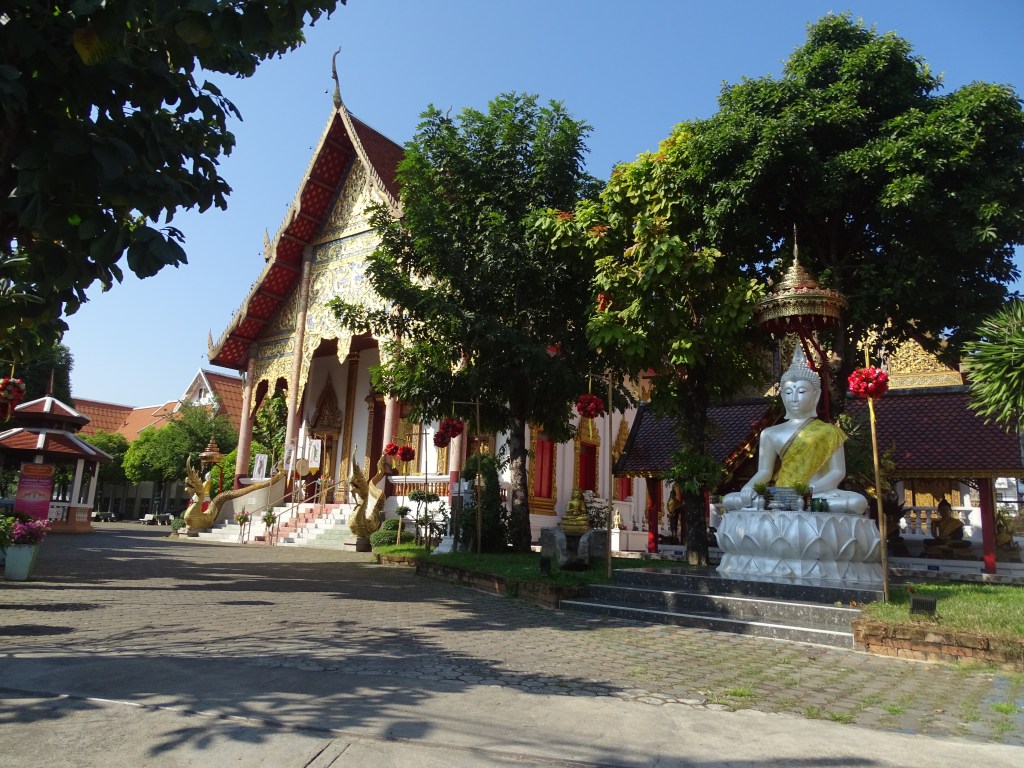
The centre square of the city, marked by the medieval remains of moats and crumbling brick walls, is what draws them. It’s dotted with temples, resplendent with gilding and representations of nagas – Thai dragons. This time of year, though, they’re not the only attraction. It’s Loy Krathong, the festival of the river goddess, and it turns out that the celebrations, according to the sheet my host gave me, last longer than I expected, spread out across several days.
Day 8
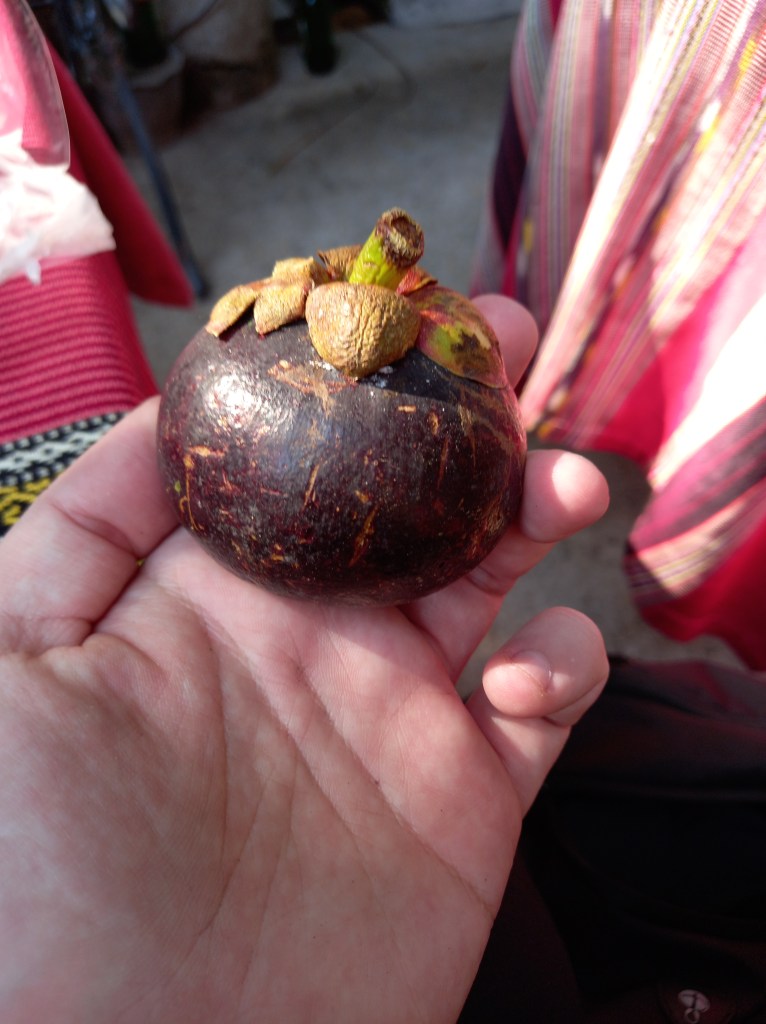
The moats split the city into two – the touristy centre, filled with hotels, restaurants, cafés, etc, and the rest of the city, which is populated entirely by locals. That’s what it seems like, anyway, as I leave the confines of the centre and head to the local fruit market in search of durians and mangosteens, the former famously stinky and distinctive-tasting, and the latter an allegedly wonderous fruit that had been described to me in superlative terms. Durians, green and spiky, turn out to be bigger than my head, so I abandon my intentions towards those, but I do get a bag of mangosteens.
They’re quite nice.
I’m taking some with me on a hike through the city, up through the jungle-covered hills to the famous temple of Doi Suthep. Turns out that it’s not a great idea to start the long climb up after walking through the city for hours in the tropical heat. Already exhausted, and after briefly humiliating myself in front of some other hikers when I thought I could feel something crawl up my leg, I decide that the best I’ll be able to do is reach Wat Palaad, a far smaller temple that’s supposed to be halfway up the trail.
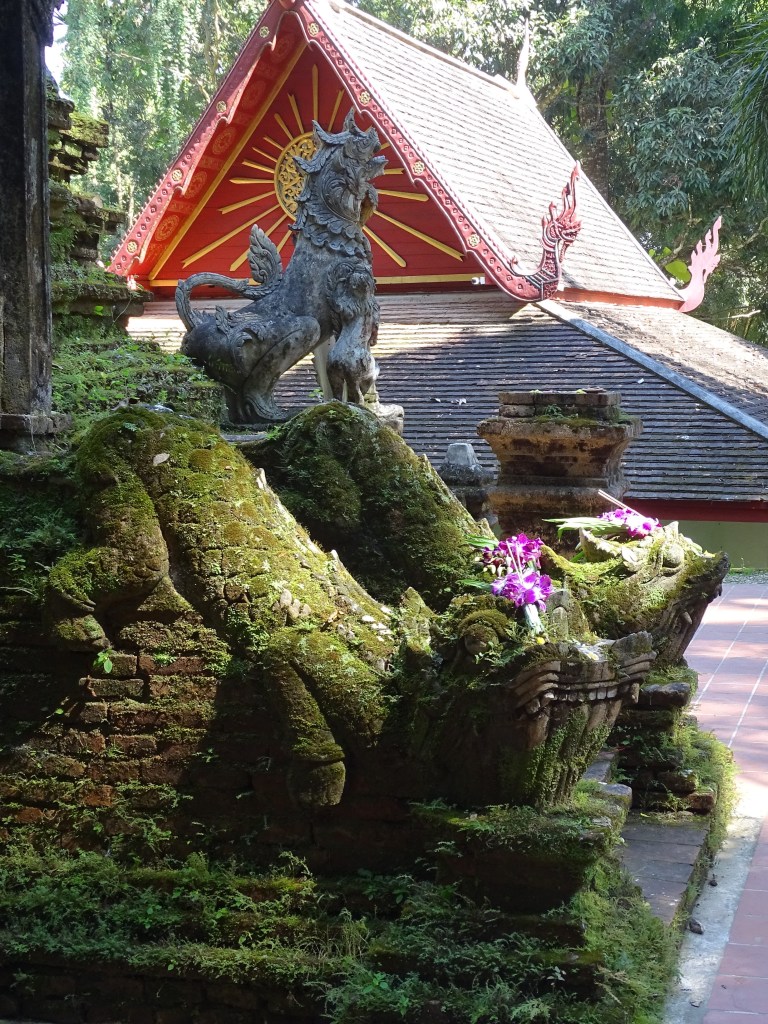
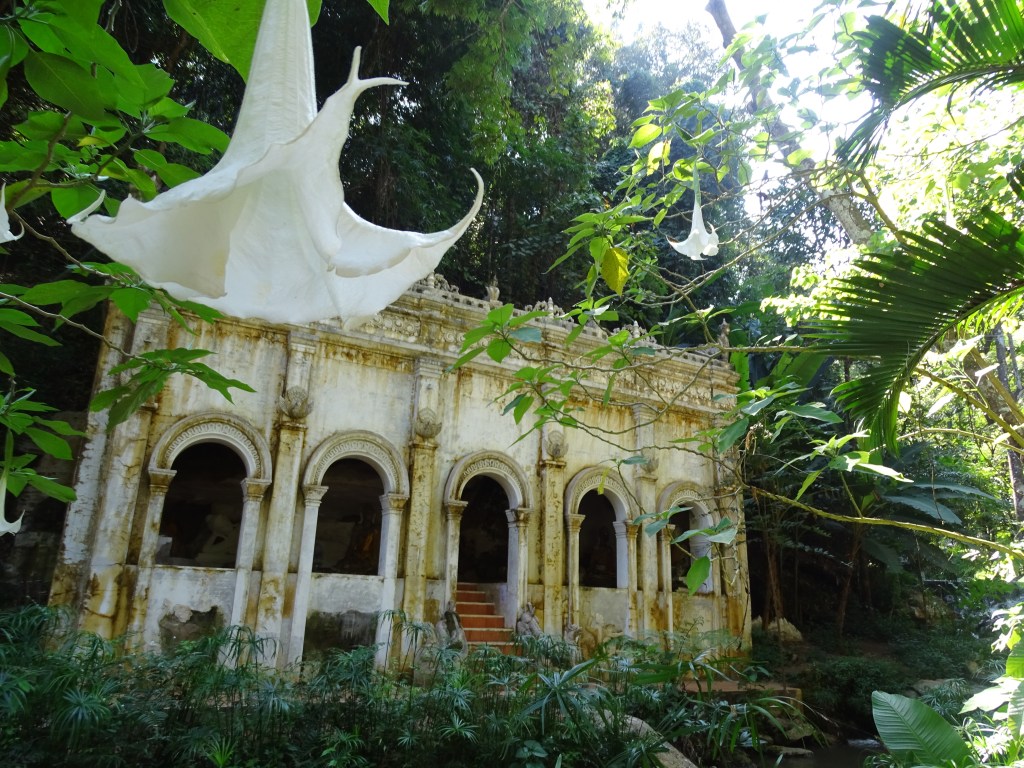
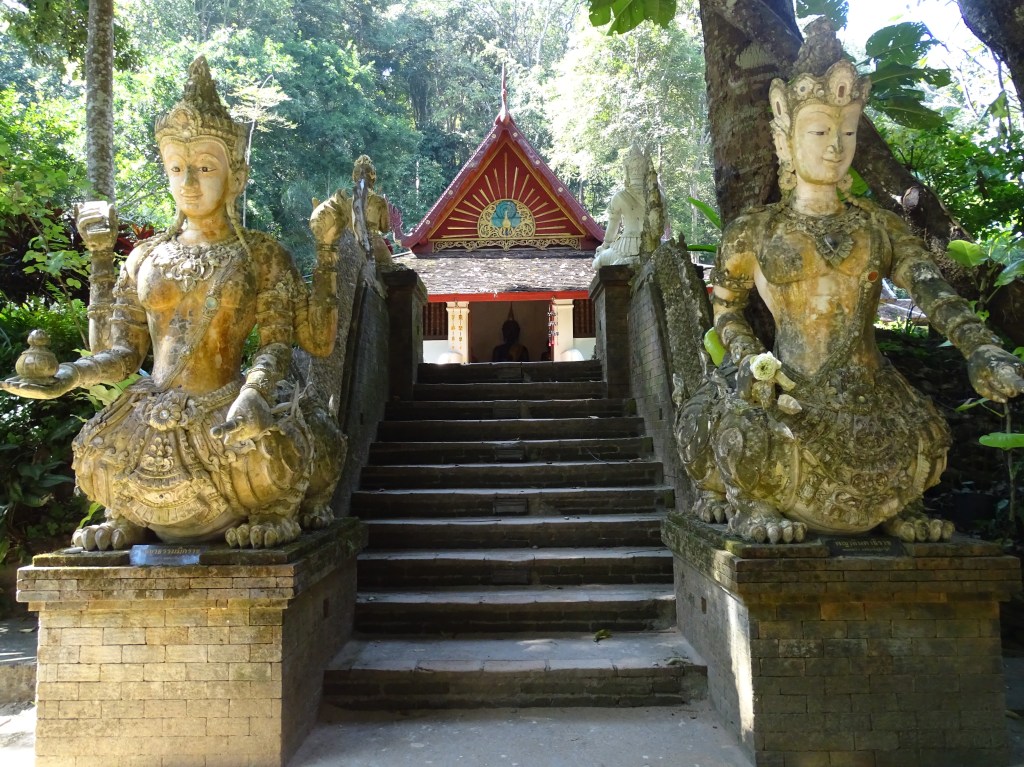
It turns out to be much more than a temple – it is in fact an entire temple complex with a small waterfall, surrounded by jungle. There are Buddhist statues. Not tacky garden decorations, but the real thing. It’s still touristy, but garlands of flowers have been left on some of the statues and on the moss-covered medieval stupa. Tourism may have tried to claim it, but this place still has religious significance.
As I wander around, the surprised delight having washed away the exhaustion, I look up at the trees. I realise that there’s a spider up there that I’m quite sure it’s about the same size as my face.
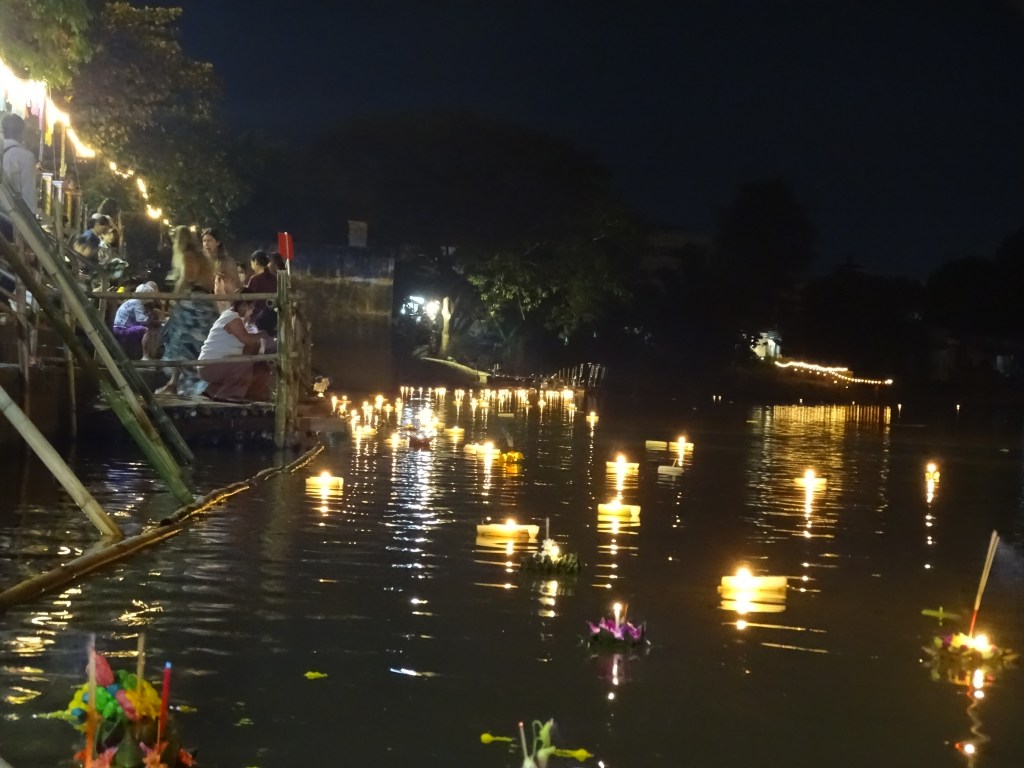
The main event of Loy Krathong takes place at night, at the river. Floating candles are lit, then placed on the river, symbolically releasing one’s sins. Although the person who had told me about it neglected to mention the children playing with fireworks. After some indecision, I decide to take part – after all, there are people selling the candle-floats right next to me, even lighters too. I’m sure I can think of some sins to release.
It’s at this point, trying to take part in this sacred ceremony, that I realise I don’t really know how lighters work. They’ve always looked so simple, but apparently pressing the button isn’t enough. A kindly young German man helps me, and we eventually manage to get the candles lit, but by the time we do, I’ve forgotten what sins I’m supposed to be releasing. I usually feel vaguely guilty, so that will have to do.
Day 9
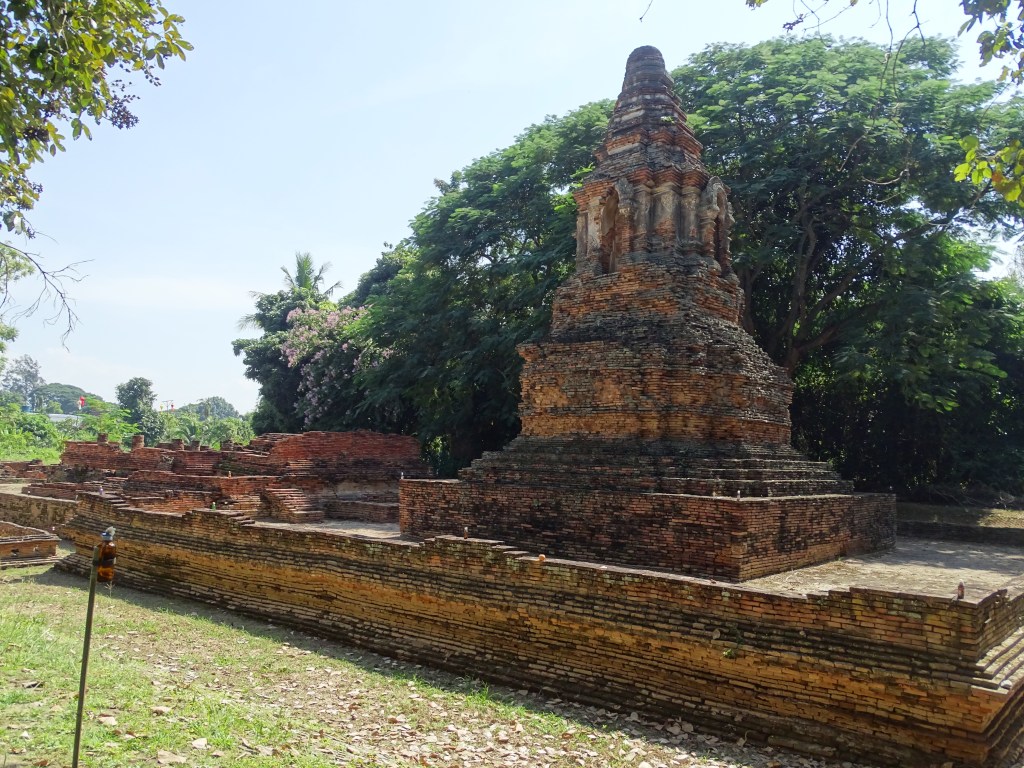
Today, I am on an expedition to find the lost city of Wiang Kum Kam. It really feels like something that should involve hacking through jungle with a machete, rather than trying to find a road with a pavement on Chiang Mai’s outskirts while following directions on my phone to the archaeological site. In the midst of the suburbs, I passed the remains of temples, mostly reduced to platforms of bare brick, but some still sufficiently intact to be impressive. Precursors to the main event, I thought, until I finally reach the destination, and realise it’s an information centre about Wiang Kum Kam, with a few carriages with sad-looking horses for tours. The ruins I had passed were, in fact, the main event.
It’s the long, scorching walk back. The sun is at its peak, and it is merciless, but I do come across a lifeline. When travelling and trying to expand one’s cultural horizons, the big no-no is having common fast food instead of the local cuisine. However, at this point, it seems to be a choice between heatstroke and McDonald’s.
Never, ever, has a McDonald’s, with its air-conditioning and cold drinks, felt so luxurious.
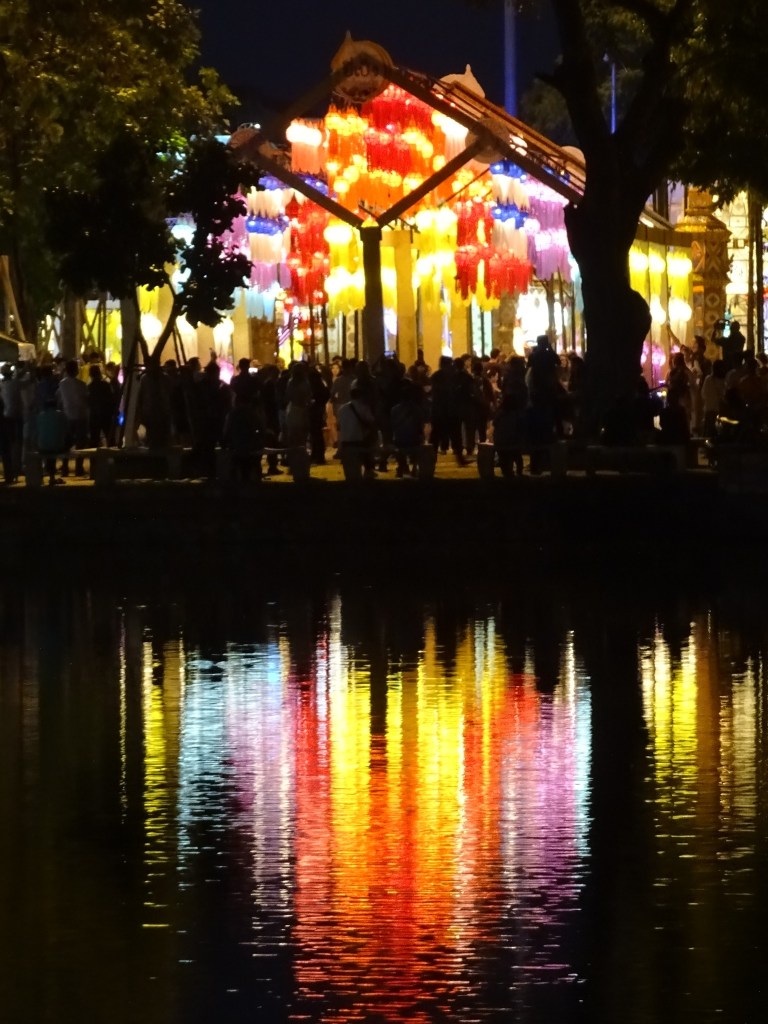
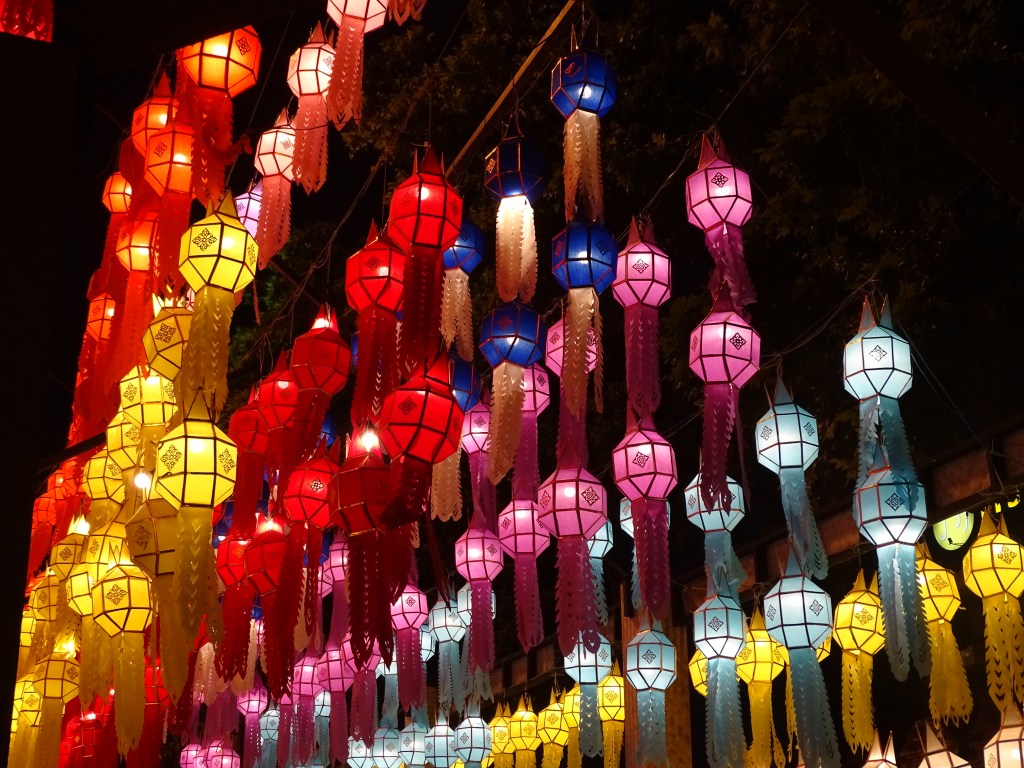
I had only gone out in the evening to in search of dinner, but appear to have wandered into a huge light show of coloured lanterns and a parade of the local hill tribes. It’s spectacular, but, still, I was really more interested in looking for something with rice
Day 10-11
From Chiang Mai’s airport to Bangkok’s airport. From Bangkok’s airport to Bangkok’s other airport. From one of the airport staff telling me, ‘My friend says you so handsome!’ to an elderly Australian telling me to stop pacing while waiting for boarding because I was making him “nervous” as his wife stared at me in horror. Then onwards to Singapore!
I was looking forward to Singapore as a more restful place, as it is officially the safest country in the world, but an announcement on the plane has seen fit to remind me that drug-smuggling in Singapore is punishable by death. And I’ve just remembered that a known scam inflicted on foreigners in Singapore is hiding drugs in their luggage in order to claim reward money.
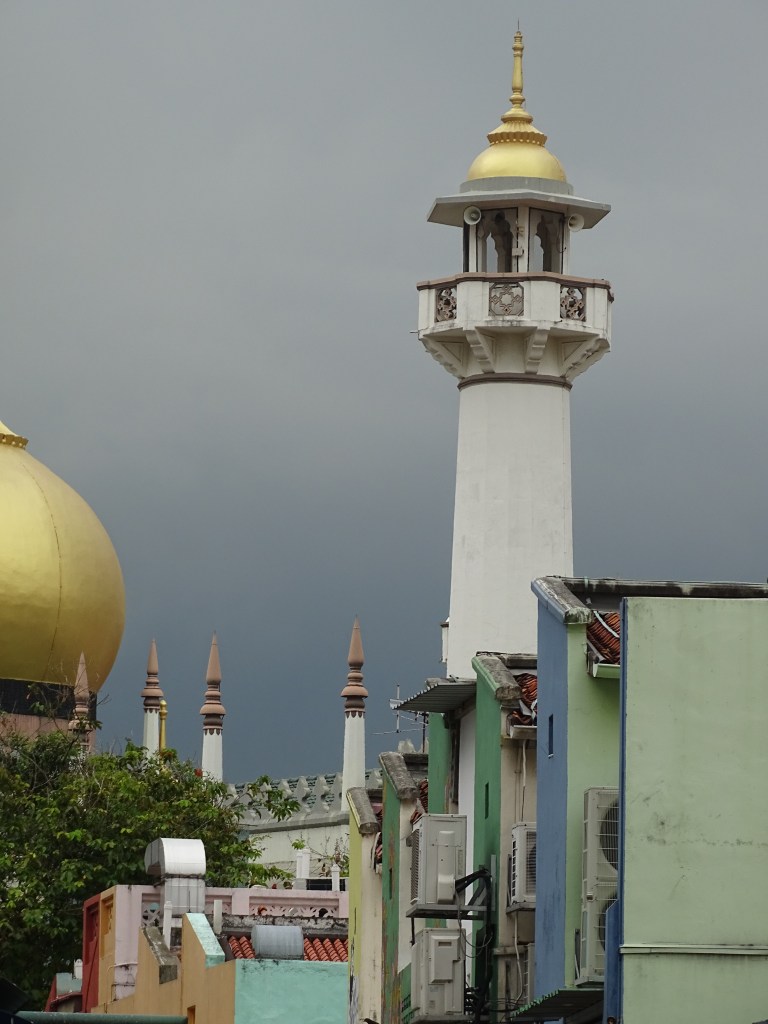
Singapore is a more sedate place than Bangkok, that’s for certain. I’m not stressed, but still inevitably tired as I search for my accommodation. It’s in Arab Street, a patch of colonial-era buildings whose carpet merchants and domed mosque seem straight out of old picture book of Arabian Nights.
This is one of the most expensive cities in the world, so a proper hotel would be a stretch. But I’ve booked a hostel with a local twist: podbeds. To put it simply, guests sleep in pods. This one’s space-themed. It’s like sleeping in a morgue, but whimsical!
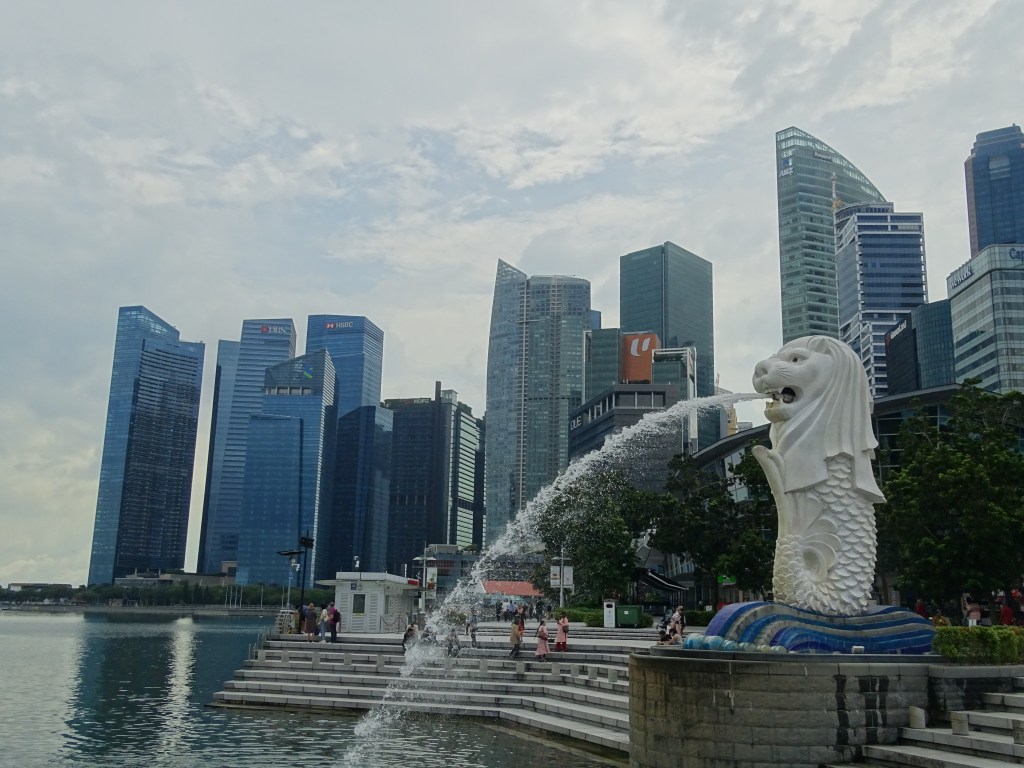
Day 12
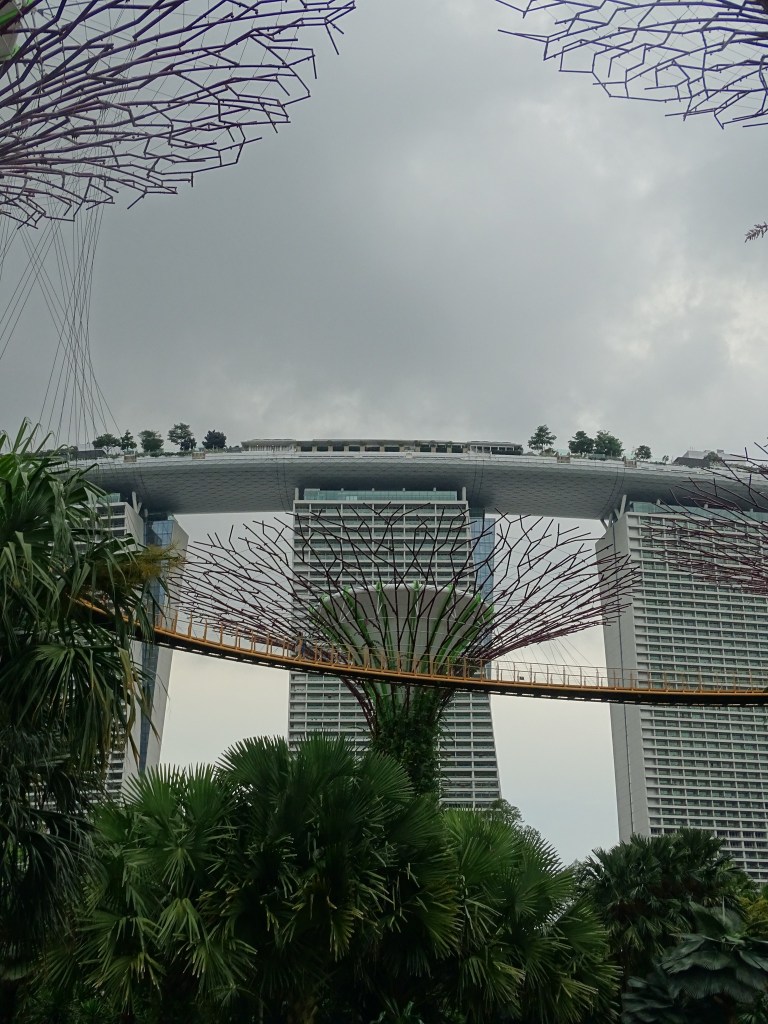
The city alternates between being a grey place of business, hemmed in by skyscrapers, and a child’s fantasy. In the famed ‘Gardens by the Bay’, I came across a dinosaur-themed restaurant, prompting a peculiar combination in my head as my adult brain wondered what the food of a gimmick restaurant is like, and my child brain squealed with excitement. The island of Sentosa, where the aquarium is, is even more geared towards children, being effectively one big theme park. The aquarium was full of schoolchildren, in any case, as is every museum or zoo when I visit.
Possibly including Singapore’s Night Safari, but it’s too dark to tell. Dedicated to nocturnal animals, it only opens at night. Being alone on a deserted path at night makes hearing a lion roar quite a different experience.
Day 13
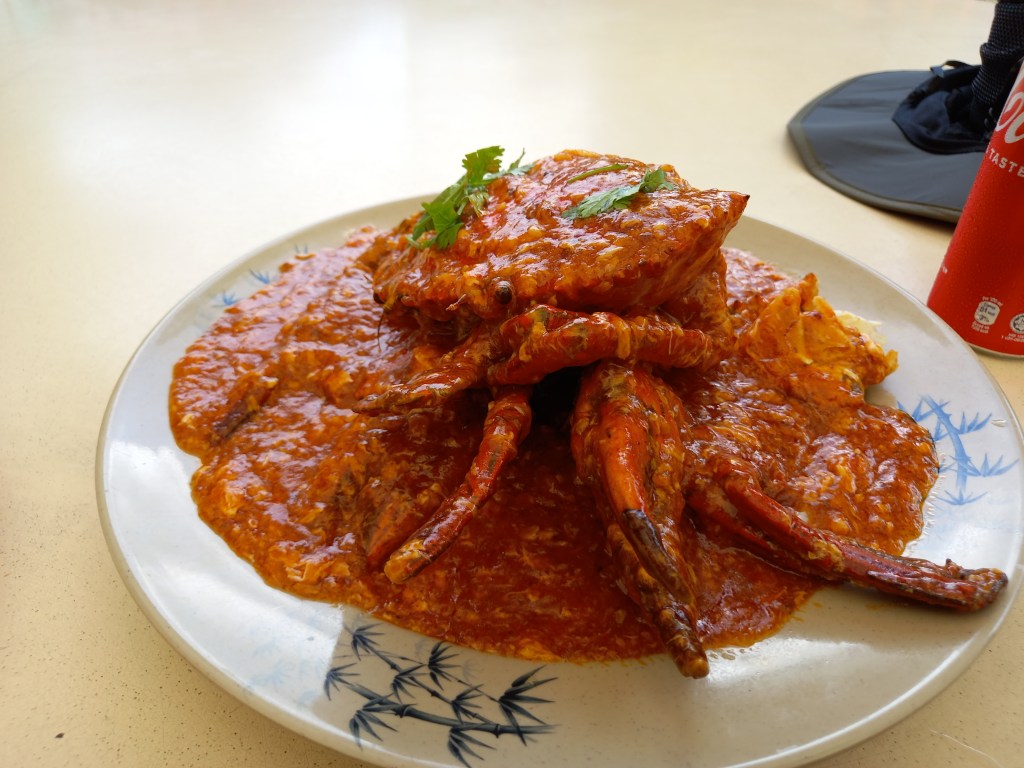
Metro, bus, then boat, and I’m finally standing on the island of Pulau Ubin. A little patch of relative idyll in a city-state – a kampong, in Southeast Asian terms – it has a seafood restaurant. There’s chili crab on the menu, one of Singapore’s specialities! A perfect place for it. There’s no price for it on the menu, and I don’t quite catch the first part of what the waiter says when I ask, but he seems to say that it’s 29 dollars. Quite a mark-up from a meal at one of the hawker centres, where chicken rice can be had for 7 dollars. The crab is massive, comes smothered in sauce, and I make such a mess of it that one of the restaurant staff comes over to show me how to eat it properly. I eventually finish, and the bill arrives.
It quite clearly says 93 dollars.
The restaurant has a sign that explicitly says that they only take cash and Paypal, not cards. I only have 72 dollars on me. After a long, protracted moment of awkwardness with the waiter, in desperation, I take my phone out and consider trying to set up a Paypal account. It’s at this point that the waiter, God bless him, decides just to take what money I have, after checking that I’ll still have enough money to take the boat back.
The worst part was: the chili crab was alright, nothing amazing.
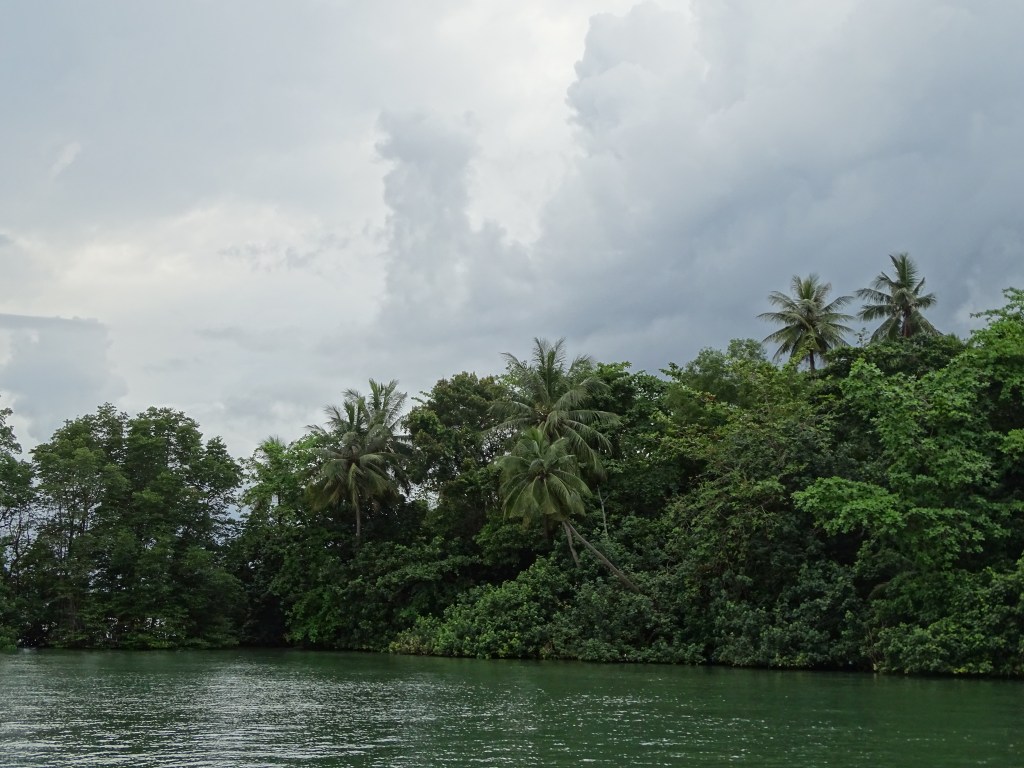
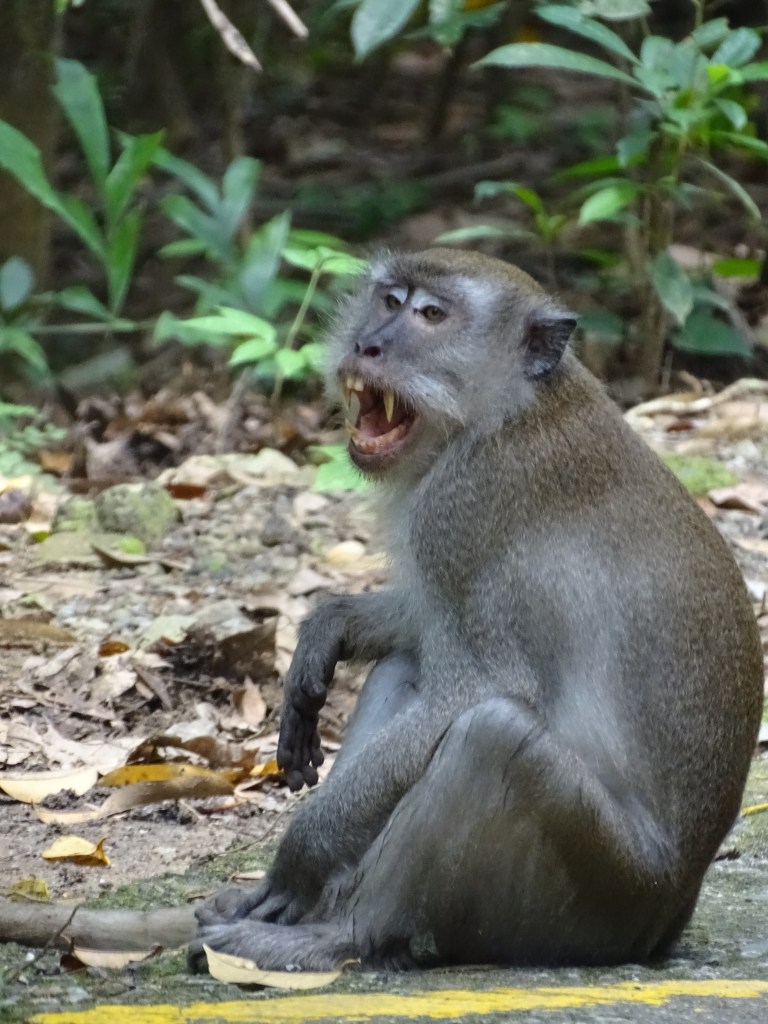
The path to Pulau Ubin’s nature reserve of Chek Jawa is supposed to be followed on a rented bike, but I can’t ride a bike, so I’m walking through a jungle filled with monkeys and wild boars. The boars thankfully ignore people, but the monkeys – long-tailed macaques – will try to grab anything that looks remotely like a carrier bag. I see one a visitor going at full speed on her bike, and yet a monkey still manages to leap onto the front basket to get at a white tote bag. The woman shrieks, hops off the bike, and tries to grab her bag, but the monkey tries to bite her. She then grabs a stick and chases the monkey into the forest. Having nothing that looks like a carrier bag, I have no such problems, but I’m still wary when I have to walk through a troop of the macaques on the path.
Chek Jawa has a raised causeway that extends out into sea, which would be a good way to see tropical sea-life if the sea was clearer. But now it’s dull and opaque, reflecting the sky above, which is a threateningly deep grey. In fact, it looks like an approaching tropical storm. In which case, the absolute last place I would want to be is on an exposed causeway on the sea. I head back as quickly as possible, but that just means that I’m in the jungle instead of on the causeway when the monsoon strikes. It is rain like I have never seen before, like the ocean has decided to invade the land. I am soon extremely wet and very, very miserable.
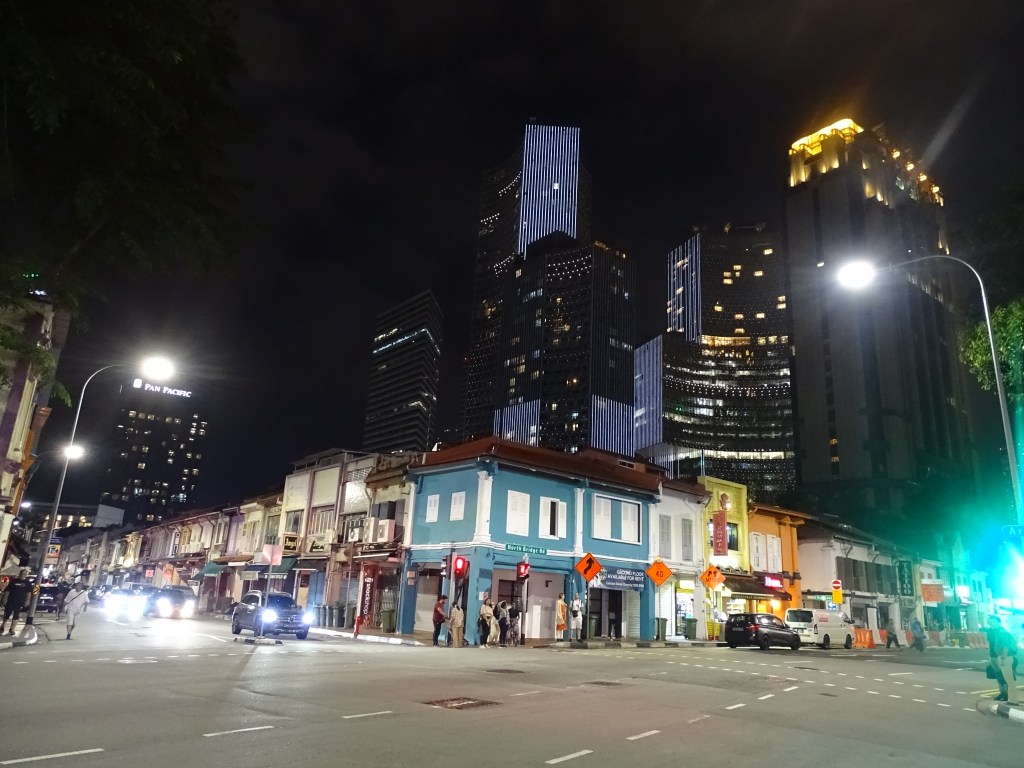
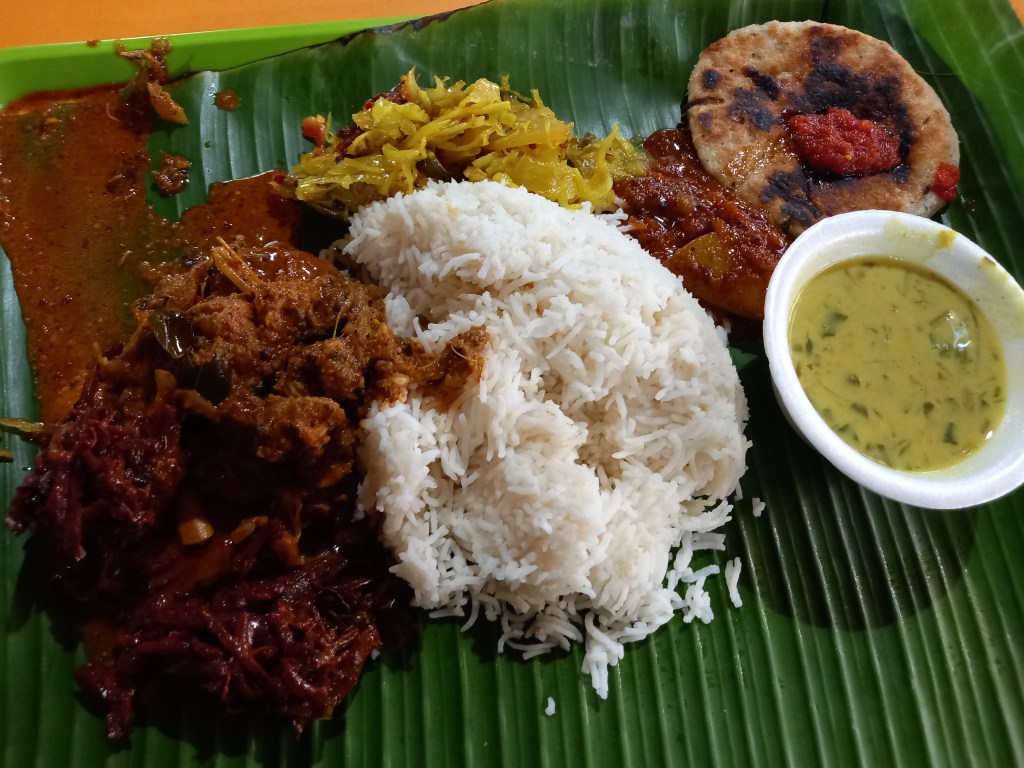
Dry, in the city, and hungry, I decide to try the cuisine of Singapore’s South Asian cuisine in Little India. The city had been described to me beforehand as being perhaps a little too orderly and sanitised, but the chaotic Little India seems to be an exception. Making the rounds of the hawker centre while trying to decide what to eat, I get the impression that the people here are displeased to see me, but maybe I’m just paranoid. In any case, I have a Sri Lankan curry, which consists of piles of different curries and rice served on a banana leaf. Other people who are having the same thing are somehow eating it with their bare hands, but I have no idea how they’re doing it, so like the pink-skinned European I am, I get cutlery. I have no idea what most of the ingredients are, but it’s very good.
On the way back to the hostel, I see a traditional Chinese dragon dance in the street. And to think, the best impromptu show you’d expect to see in the street back home is a fight.
Day 14
I’ve already checked out of the hostel, but the long flight back home won’t be for some hours. The Botanical Gardens, which are a World Heritage Site, should be a good place to waste time, but as I leave the metro station, who do I see, but my old friend the monsoon. After waiting for a while to see if it’ll die down, which it doesn’t, I realise that the only way that a visit to the Gardens would be pleasant would be if I’m wearing scuba gear.
After all that I had heard about the wonders of Changi Airport, the reality is a little disappointing. It’s a huge shopping centre, with an enormous indoor waterfall called the “Rain Vortex”, but I had read that you can take a huge slide down to the gates, and that’s turned out to be a misunderstanding. After that realisation, it’s inevitable that everything is bound to be a bit disappointing.
Perhaps, at the end of a long journey, you should reflect on the things that you’ve seen and experienced, but for all that I have witnessed, what emerges is one complete and utter truth:
I am knackered.
 Wandering/Wondering