Day 1
By the time I’ve got off the plane, picked up my luggage, humiliated myself in front of the immigration officer by forgetting the names of the places I’ll be staying, and left the airport, the sun is setting. My first host, Saïd, is waiting for me, and drives me to my first destination – the small city of Taroudant, at the foot of the Atlas Mountains in southern Morocco. On the drive there, I’m struck by how, well, Moroccan everything is. The square, sand-coloured buildings being turned into amber by the sunset in a dusty landscape are what I’d expect from a Hollywood movie trying to hammer its setting home through stereotypes rather than what the country is genuinely like.
Day 2
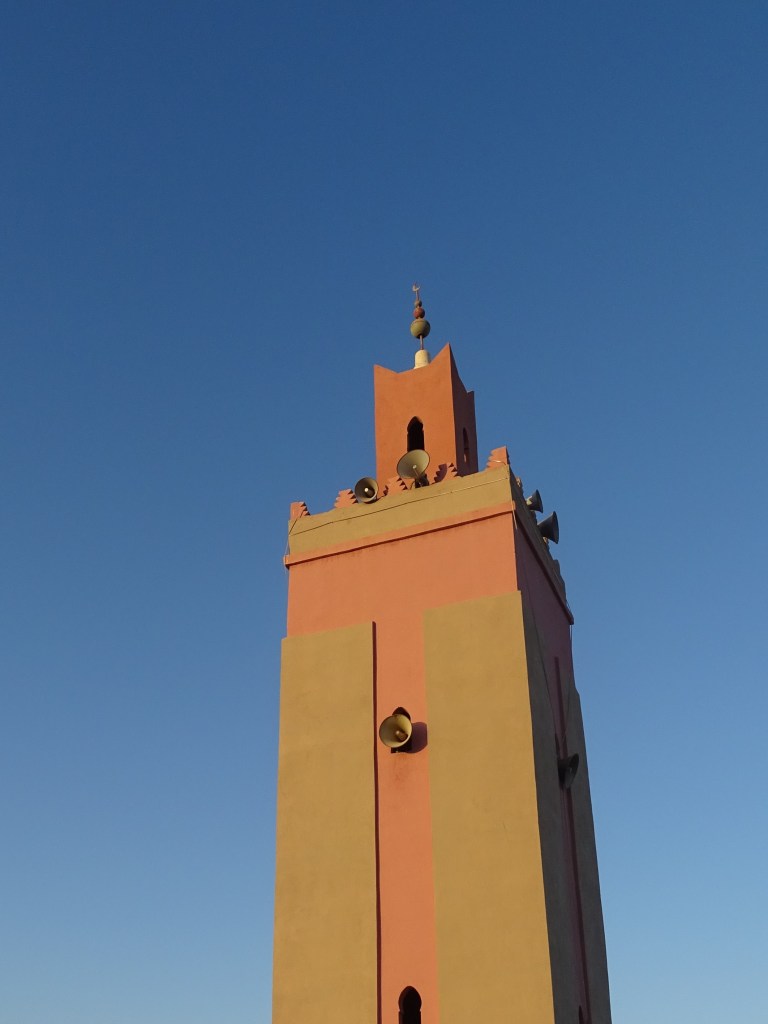
I’ve heard the Islamic call to prayer – the adhan – in other cities, but they were brief things. The one that woke me up this morning was a far more drawn-out and much louder affair. As I blearily stepped out onto the rooftop terrace for breakfast, I realised that the volume was because the adhan was coming out of a tower right next to the hotel. Just one more way that my surroundings are constantly trying to remind me that I’m in North Africa, I suppose.
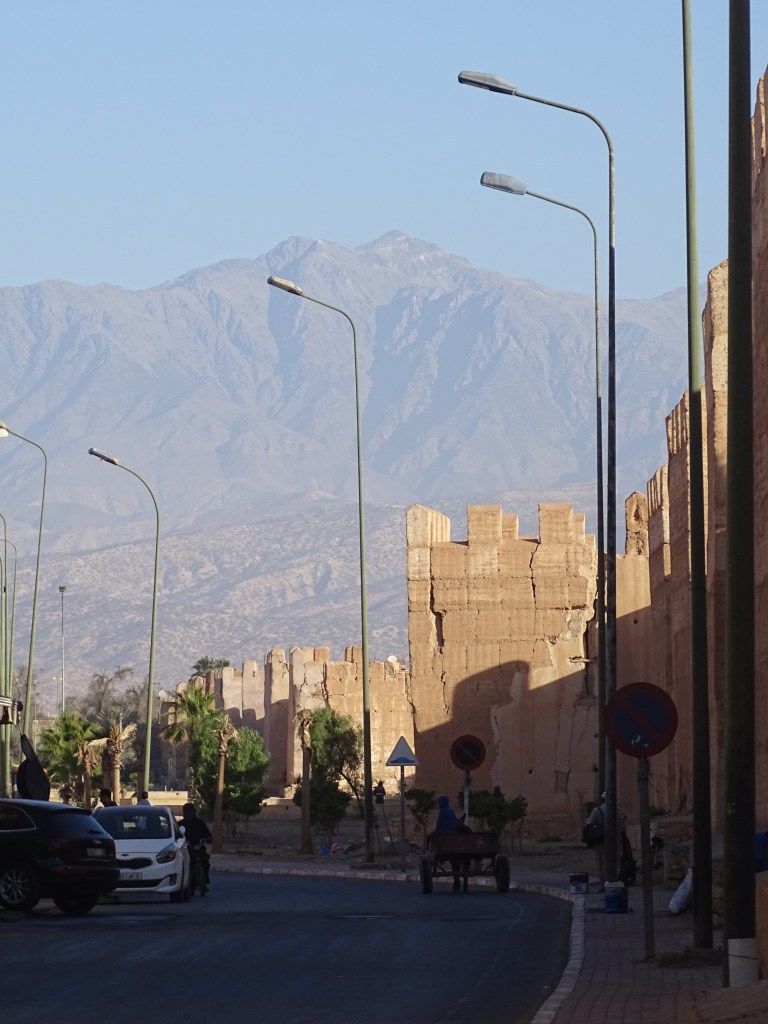
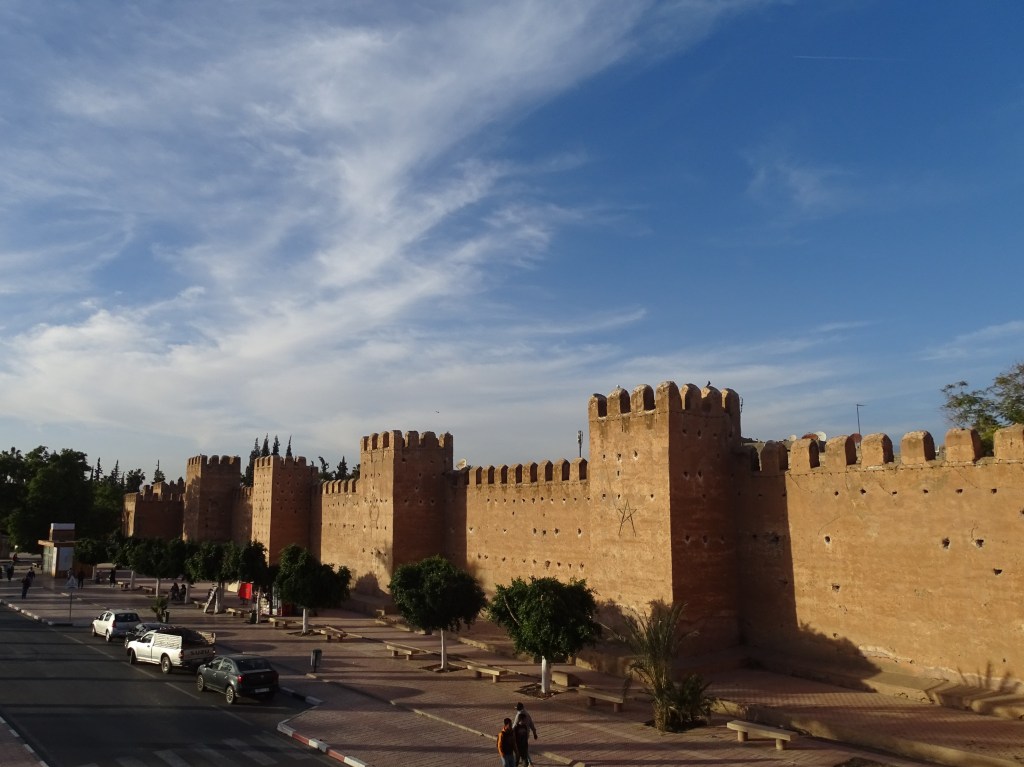
The city had been struck by an earthquake some three months ago, and, aware that there had been fatalities, I had been hesitant to visit so soon afterwards, worried that I would be intruding on a grieving city. I had seen that a section of the centuries-old city walls had crumbled, but the streets seem healthy and lively. As I make my way into the heart of the city through one of the city gates, I compete for space with pedestrians, bicycles, motorbikes, cars, tuk-tuks, fruit stalls, and the occasional horse cart. I had been under the impression that everyone in the world dresses in much the same way these days, but many of the people here wear robes. A voluminous striped variety that comes with a peaked hood looks particularly comfy.
I had mentioned to Saïd that I intended to explore the city today, and he said that if he saw me there, he would show me around. Sure enough, he’s in the main square, and takes me to the headquarters of an organisation where divorced and widowed women are employed to make various products out of argan oil, which is harvested locally. It’s all worthy enough stuff, and I do take the opportunity to buy some amlou – a sweet Moroccan spread made out of argan oil.
But the second place is a different matter. For one, Saïd doesn’t wait outside this time. Instead, he calls through the doorway, then leaves. I enter alone, into an interior of dark wood and a vast array of jewellery and antiques. A pair of women murmur Islamic greetings as the proprietor – an older, bearded man in robes – advances out of the shadows with more effusive greetings in perfect English. He takes me to the back, where colourful, patterned carpets cover the walls, and subjects me to a lecture on the cultural context and manufacture of the local carpets. He then he tries to sell me a mini-carpet, claiming that it could fit in my pocket. When I manage plead the size of my pockets, I am instead encouraged to spend money in the front of the shop, on the traditional jewellery of the Amazigh of North Africa. Something there does catch my eye. There, on a glass-topped cabinet amidst the silver necklaces and bejewelled daggers, is a book. Its yellowed, frail-looking pages are covered in writing that is neither Arabic nor Latin. I ask the proprietor about it, but he’s dismissive, saying that he knows nothing about it, he’s just selling it.
In this ancient city at the edge of the desert, this mysterious old book, displayed alongside gold and silver as if its words are worth more than jewels, should whisper to me as I lean over it. A sudden gust of wind on a still day should rattle the necklaces as I try to read its undecipherable script.
As it were, though, I judge the book to be no older than 19th century, and the writing is Hebrew. The seller knows that it’s Jewish, and this being during an Israeli assault on Gaza, may want to distance himself from it. Instead of anything mysterious, all that happens is that I come to terms with the fact that I’ve been hustled – Saïd has a deal with this shop to bring them tourists, and then the proprietor charms and hassles them into buying something. Frustratingly, it works on me, as I don’t feel like I can just leave after such a long, and, to be fair, sometimes insightful, lecture on the local culture and craftsmanship. I select the plainest-looking bracelet I can find, and try to haggle as the seller sets out his price:
‘Two hundred and seventy-five dirhams.’
‘Two hundred,’ I try to counter.
‘Two hundred and seventy-five.’
I checked my pocket. ‘All I have is two hundred and a few coins.’
‘Two hundred and a few coins will do.’
I actually have three hundred-dirham notes, but one of them is a reserve; not under consideration. I have no intention of wandering around Taroudant completely cashless, especially if it’s after being cleaned out by a carpet salesman.
[A few days later, I found myself wracked with guilt over not disclosing the extra hundred dirhams that I had on me, and wondering if I had technically deceived the old man.
Then I showed the bracelet to an Amazigh friend, who valued it at about twenty dirhams.
I really need to stop feeling guilty so easily.]
Having managed to replenish my funds from an ATM, yet another old man makes me feel bad. While I’m having a lunch at a restaurant on the main square, Place Asserag, an elderly musician is sitting on the ground, playing a traditional stringed instrument and singing in a reedy voice in full view of the harsh sun. I wish I had some spare change to give him, but I only have large denominations, thanks to the carpet salesman. When the old musician, having received nothing but a kiss on his bald head by a girl, finally gets up and approaches the restaurant, holding out his empty cap for donations, I look down at the table, ashamed. I resolve to find him the next day, once I have some change.
Of course I never saw him again.
Place Asserag has no shortage of musicians and storytellers. There are only a handful of tourists around, so these entertainers still serve their traditional clientele, as they presumably have for centuries. Whenever I’m in the square, either wandering around or having a tagine, I can never see the storytellers clearly, only their gesticulating limbs from behind an avid crowd. It looks like there is still an appetite for the old forms of entertainment here.
Day 3
The standard Moroccan method of public transport is by grand taxi – people-carriers which are half-taxis, half-buses. They have a destination, then once they have enough people on board, each paying for a seat, they leave. Having waited for an hour for the grand taxi to fill up, I am unconvinced of their merits. Still, we get going eventually, and as we head into the surrounding semi-desert, we pass argan trees whose branches are festooned with munching goats.
Like racks of goat-hangers.
Soon afterwards, we arrive in the Amazigh village of Tiout, nestled in a range of scrub-covered hills.
As I walk up through the village, past the houses decorated with strips of blue and purple paint, people greet me with cheerful calls of ‘Bonjour!’. On the hill above the village I can see a kasbah, half of which is in ruins, and the other half very much still in use, with enormous blooms of vibrant purple flowers billowing from its garden.
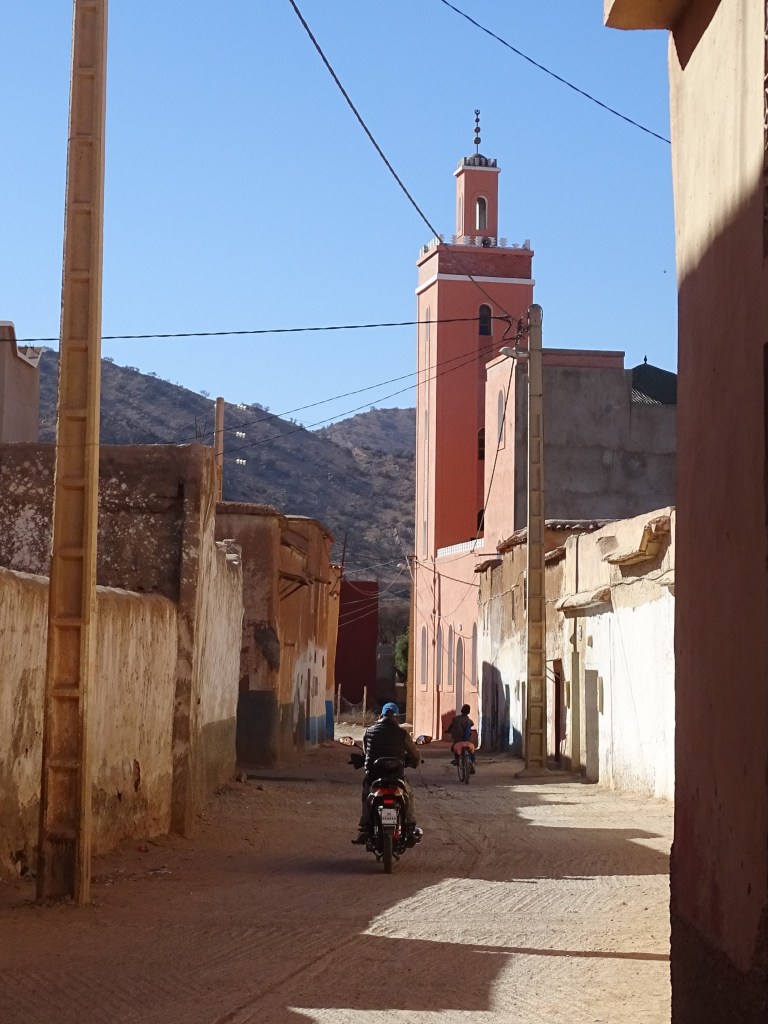
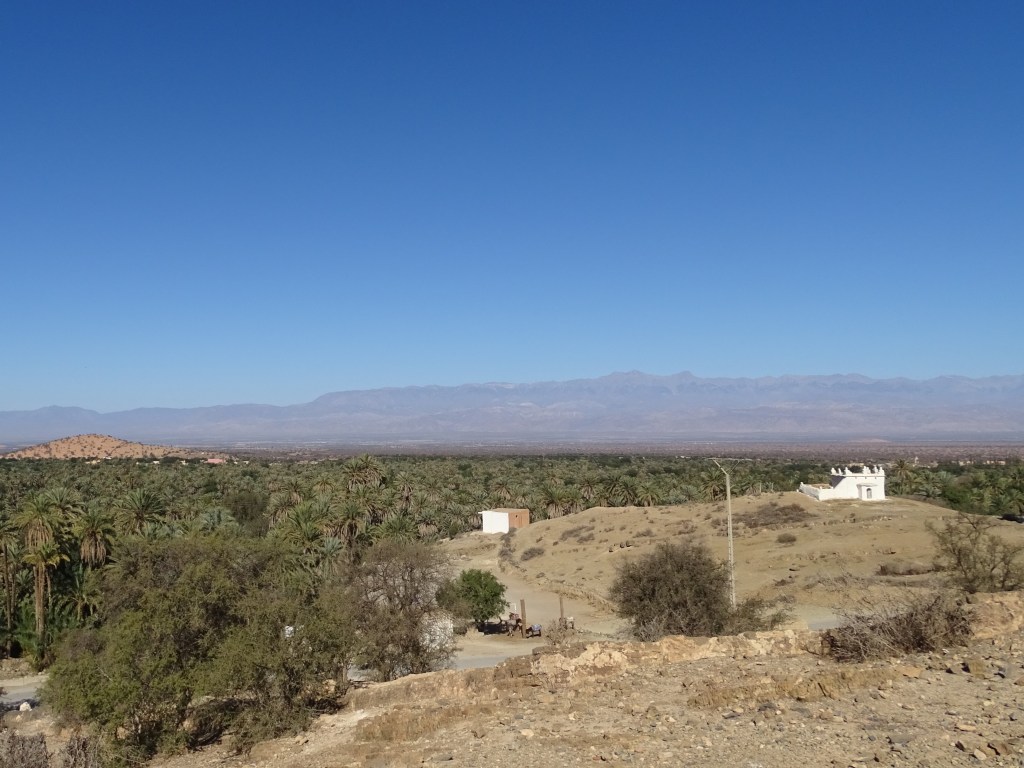
Standing on the rocky slope beneath the kasbah’s ruins, I can see a lush forest of palm trees below, the Atlas mountains beyond, and above, a sky so blue it’s as if the ocean is overhead. On a hill nearby is a small, whitewashed building that I recognise as a marabout – the tomb of a local saint. Maybe I should explore this extraordinary vista further, but the sole of one of my boots has started to come off. It flaps about as if I’ve unexplicably decided to tape a dying fish to my foot as I walk back down the hill.
On my way back down through the village, a woman greets me with the usual ‘Bonjour‘, but then unexpectedly follows it up with ‘Ça va?’. I am so caught so off-guard by the additional pleasantry that I blurt out ‘Bof, thank you!’ in an accent at least three times stronger than usual. Such are my social skills.
Day 4
With a newly-bandaged boot, it is time to head further south, deeper into Africa, and closer to the Sahara. Inevitably, this means taking more grand taxis, this time with drivers who have some odd tastes in radio.
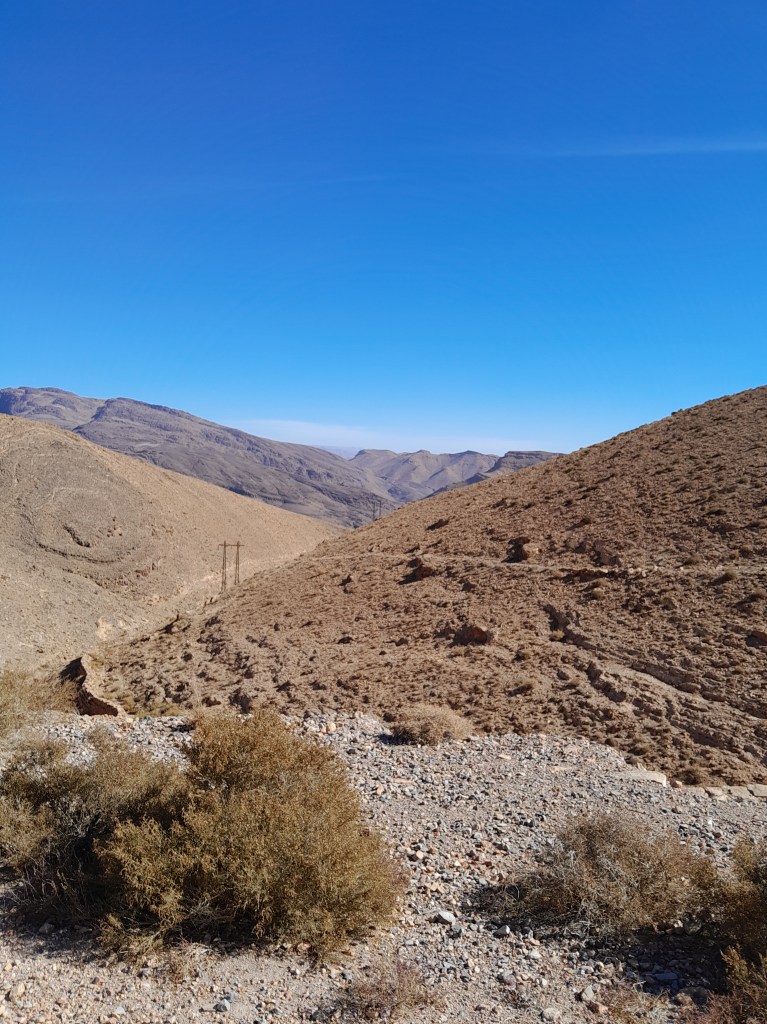
The first leg of the journey is to Irherm, a surprisingly pleasant town among reddish cliffs in the mountains. From there, I’ll have to catch another grand taxi to my destination, Tata. But it’s getting a bit late, and there are few people around. With no-one else looking for a grand taxi to Tata, I have no choice but to hire one for just myself at terrible expense.
When we’re on our way, the driver, who appears to be a friendly man, says something as he gestures towards a fork in the road. I get the feeling that he’s telling me that he’s decided, given that it’s just me, an obvious tourist, that we should go the scenic route.
And scenic it is. We travel through canyons of red-rock cliffs, towering over palm trees. I keep thinking that this barely seems to be a place for mammals, never mind humans. The vast, primal landscape seems more of a place for dinosaurs or dragons. But there are humans, in villages among the palm trees. These would be Shilha people, a local branch of Amazigh. I see a girl wearing a traditional headdress, medallions dangling on her forehead.
Despite all this, I slept badly last night, and start nodding off as we leave the mountains and head across a desert plain. Then, on the horizon, Tata finally appears.

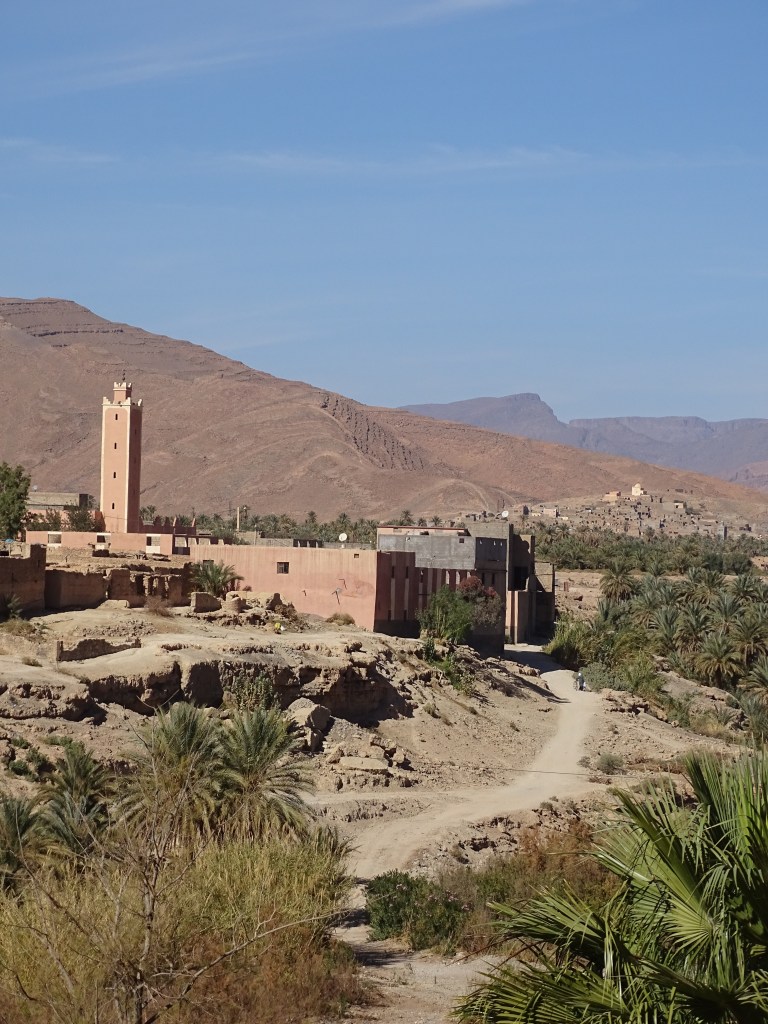
Once I’d gone through the protracted check-in process at the hotel, where they initially couldn’t find my booking, I go out to explore this pink garrison town at the edge of the Sahara. Pink, as I understand it, because the buildings are clad in local pink clay. And some of the people are clad in robes of deep indigo, like the Tuareg. And the many, many stray cats are, I assume, clad in diseases, which is why I resist their attempts to befriend me.
Day 5
Today, I am going to push deeper into the Sahara, to the desolate wilderness of the desert mountains. First to the village of Akka, then hiking through the searing heat to the remote Targant Gorge, to the realm of nomadic camel herders, ancient petroglyphs, and ruins abandoned to the sands…
…unless the bus doesn’t turn up.
It didn’t turn up.
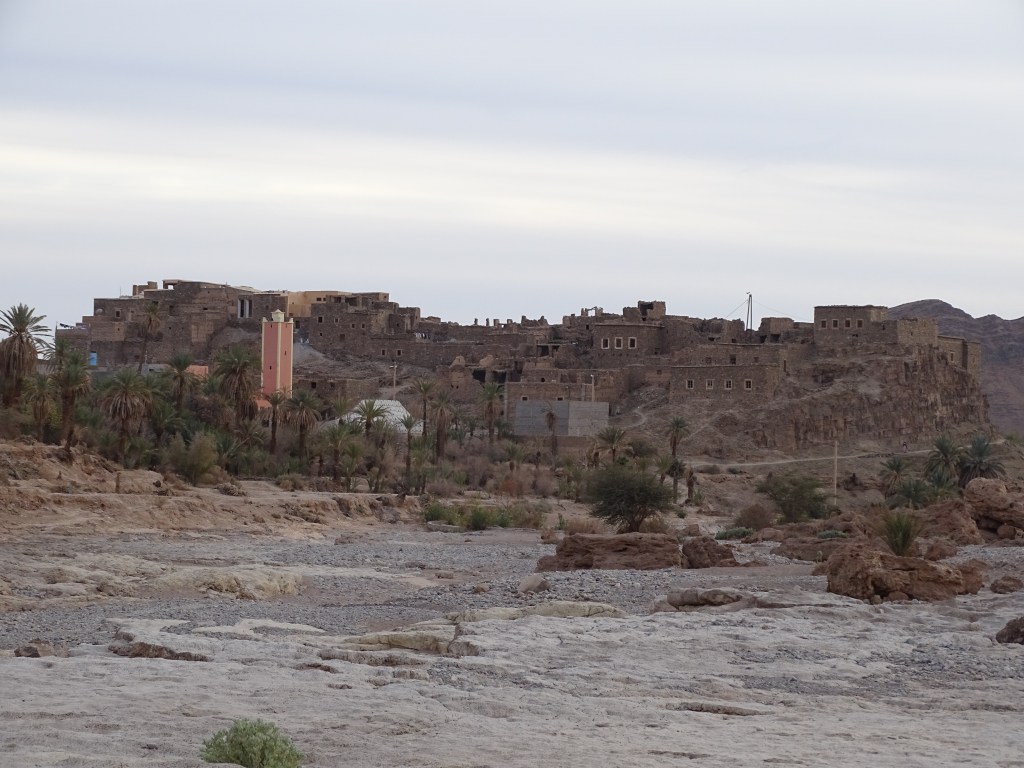
So, I just end up wandering around Tata dejectedly. The best I can do is to walk to the town’s outskirts and look out at the vastness of surrounding semi-desert, before climbing a ridge overlooking Tata. As I scramble up, my boots sink into the sand, which I suppose is still the sand of the Sahara. It’ll have to do.

It’s not a complete bust. As I wander onto the bridge over the mostly-dry Drâa River, its remaining stream feeding flowers, bushes and small trees, a nearby goatherd hops onto a hillock and sings a strange, ululating song. There are a few other tourists around Tata, but this is clearly still a corner of Morocco not that many outsiders have seen.
Plus, I find the toothbrush I thought I had lost in my jacket pocket, so now I don’t have to brush my teeth with a finger anymore!
Day 6
Here I am again, waiting for a grand taxi to fill up. At least this time there is a young woman, a student-to-be at Agadir University, who speaks English and helps me negotiate with a driver, the end result of which is me hiring half the grand taxi’s seats, this time all the way to Taroudant. She tells me her name as she leaves, but I don’t quite catch it. Just one more thing to feel guilty about, I suppose.
Early on in the journey, the driver stops in the middle of nowhere to let one of the other passengers pee. That’s when I finally see them.
Camels!
Darker and woollier than I expected, they’re being herded across the desert by a man swathed in robes riding a donkey. I watch them saunter over the rocky plain to chew on the small trees. It seems a better option than watching the guy peeing.
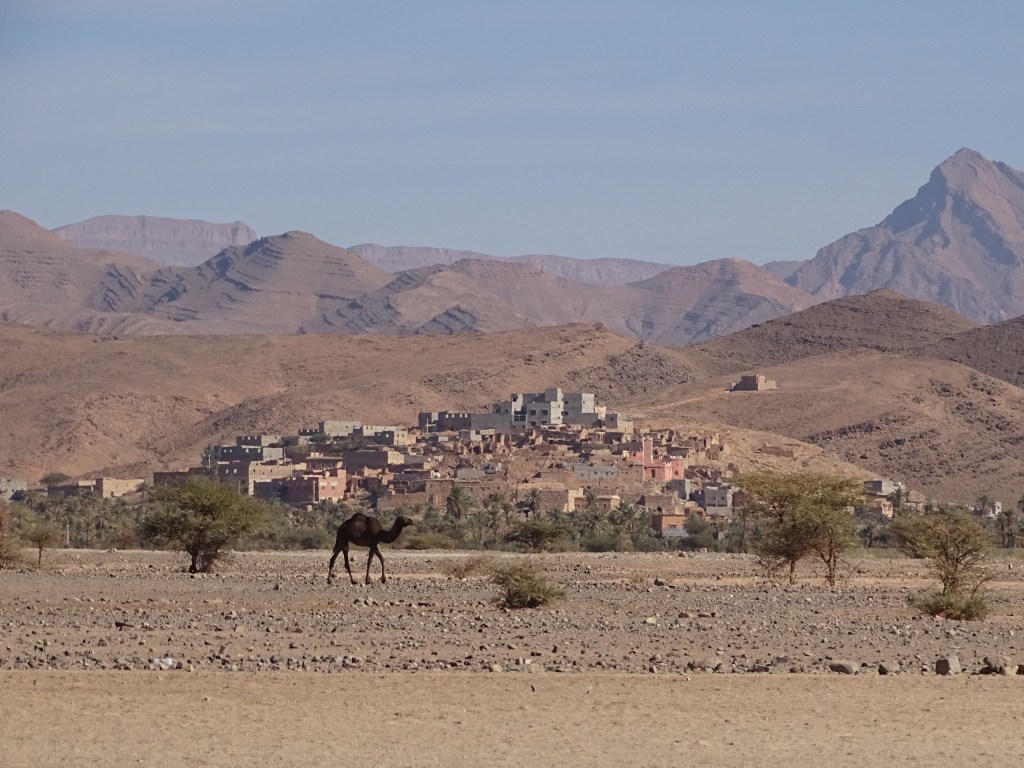
There are more camels ahead, including one defiantly blocking the road until they decide, in their own good time, to move out of the way. I can see a nomad’s striped tent at the foot of a mountain. This driver is taking a different route through the mountains to the one that took me to Tata, but it’s only slightly less impressive.
Day 7
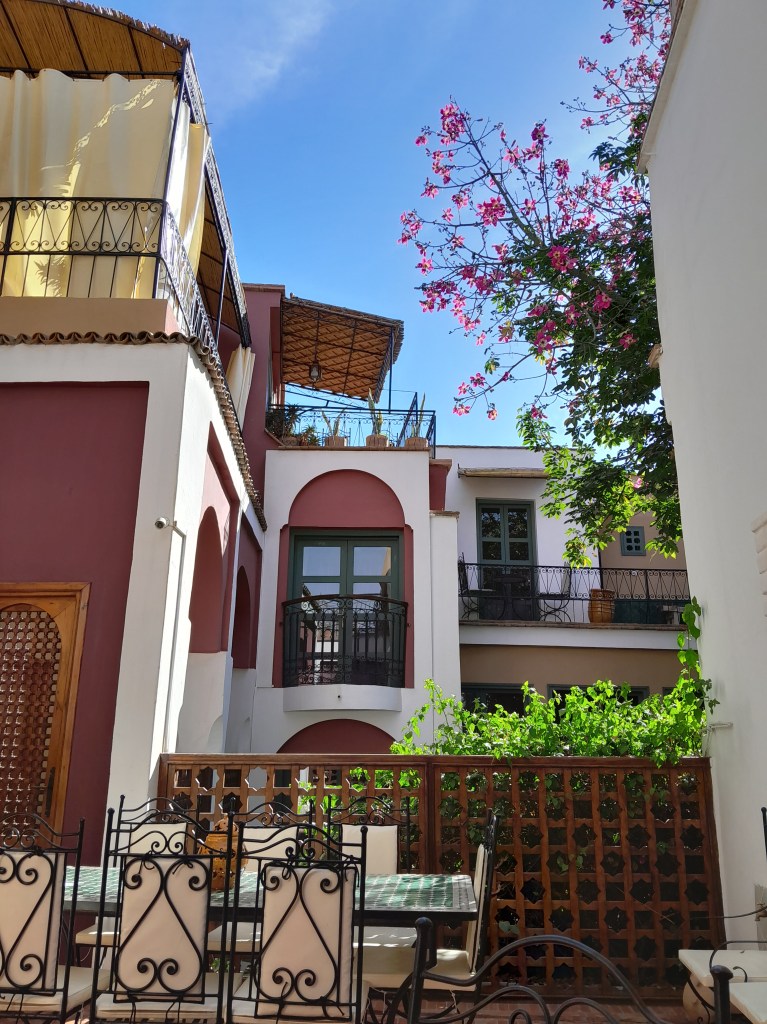
Back in Taroudant, and staying in a riad – a traditional kind of building with a courtyard in the centre (technically the term refers to just the courtyard). This one has an enormous tree growing in it, resplendent with pink flowers. The riad is full of traditional artwork and is quite possibly the nicest place I have ever stayed in. I had booked it in order to recover from the rigours of the desert at Targant Gorge, but as the bus to Akka didn’t turn up, now I’m just wallowing in the luxury of a place where they serve chocolate cake at breakfast.
I go out for a brief stroll in the city, under an overcast sky which is threatening rain. This is actually not unusual, as it is supposed to be the rainy season. Saïd had told me when I first arrived that most of Morocco has been suffering from drought for some time, and it had been niggling at the back of my head when I looked up at the clear blue skies earlier. A few drops fall, but nothing more.
Day 8
I could have sworn that I heard chickens behind one of the walls of my room last night.
I didn’t manage to reach the desert proper, I am now in possession of a bracelet that I didn’t want, and I’m baffled by the name of a restaurant called “Venezia Ice & Bakery” in the Agadir’s airport, but I feel like I have witnessed a more traditional North Africa. People herded camels as livestock, rather than as tourist photo opportunities, tagines were simple stewed meat and vegetables, rather than the fancy dishes with nuts and dried fruit that I was expecting, and old men sat in cafes, watching the world go by while sipping copious amounts of green mint tea.
Well, back to winter in Gwynedd.
 Wandering/Wondering