Day 1
It’s about midnight by the time I land at Istanbul Airport, but thankfully, the hotel I had booked is in the airport. All my needs and worries are met as I check in to my tiny – but sleek and modern – room, get a bag of toiletries handed to me by the receptionist, and find the toilets and showers at the end of the corridor. But, as I open the door to a cubicle, I discover the catch.
There’s no toilet in there. There’s a pit.
Sure, it’s made of porcelain, but it’s still just a hole in the floor. I look at it uneasily – literally gazing into the abyss. I have heard of these, and I think I’ve come across one or two before, but that’s it. I have neither first-hand experience of one, nor any desire to gain any. But my need is urgent, and, as I tell myself, isn’t this why I travel? To experience new things? To show courage in the face of the unfamiliar? Maybe even to seek adventure? I step hesitantly onto the porcelain.
Just then, I hear a flush from the next cubicle. A toilet! A real, civilised toilet! The most glorious sound ever! I hastily step away from the pit. This particular adventure can wait a little longer.
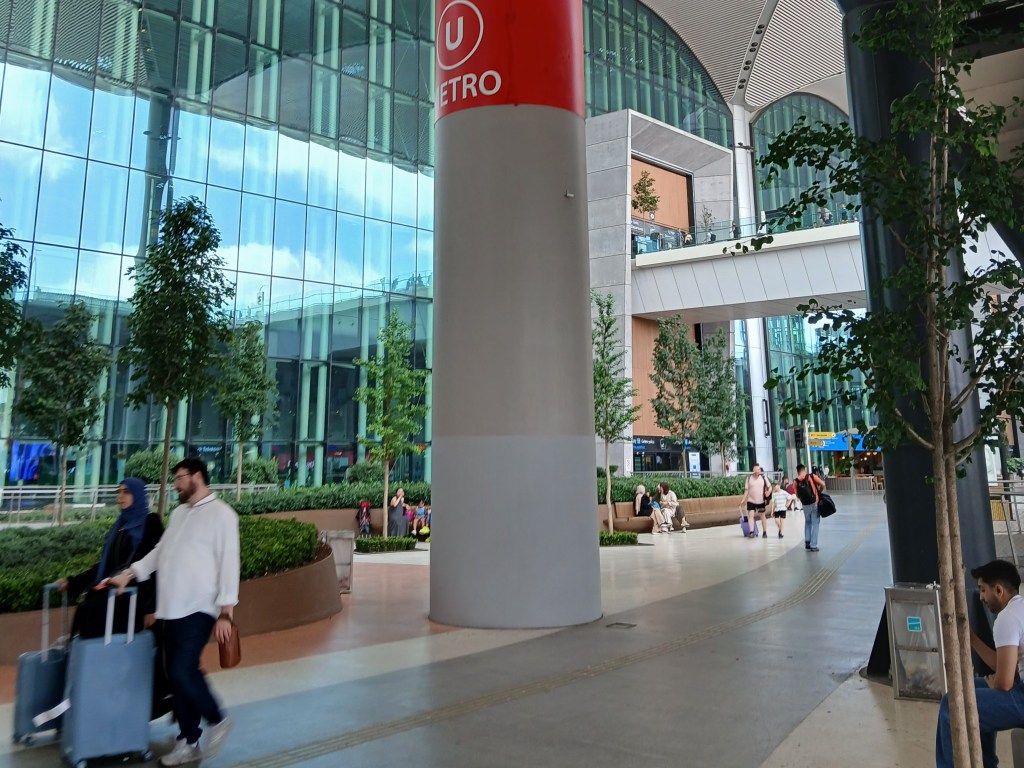
Discovering that you can leave the airport during a stopover has been something of a game-changer. All I need to do is remember to pack a few spare clothes in my small backpack beforehand and instead of spending the morning endlessly pacing Istanbul’s huge airport, I can wander the streets that twice formed the capital of an empire. Still have to go through passport control, though. At this crossroads between Europe, Asia, and Africa, I watch the traffic of all three continents shuffle along the queue, including a young man with a military-style camouflage backpack emblazoned with the Russian flag. We’re between Ukraine and the African warzones where Russian mercenaries are known to operate, and all sorts pass through here.
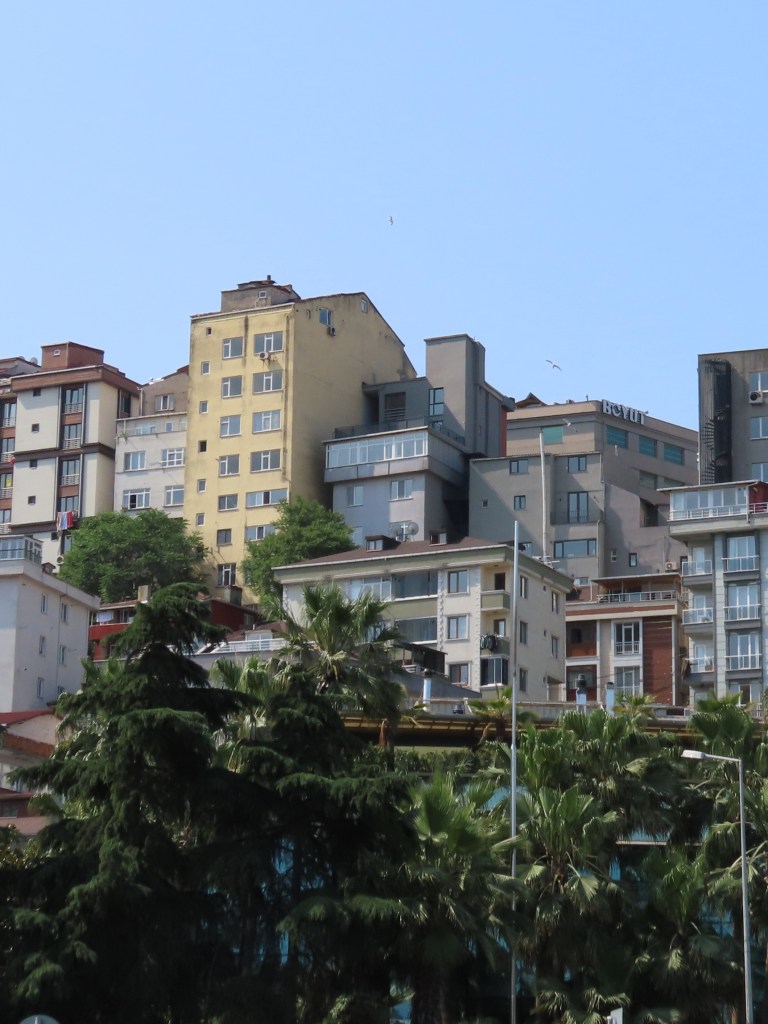
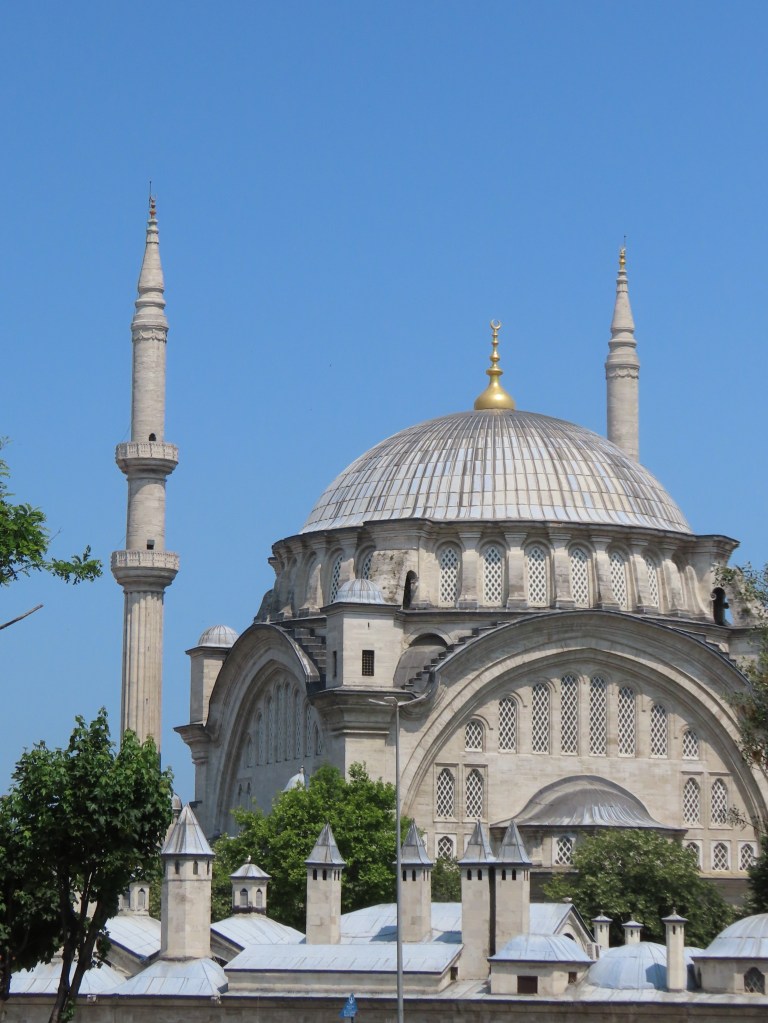
Navigating the metro was a hassle, and I’ve never seen such crowded trams, but I’ve managed to reach the touristy heart of the city. More importantly, now that I’ve taken care of my biological needs (a glass of Turkish tea, a meat pastry called a burek, and use of the café’s toilet), I can, despite the intense crowds, appreciate it. I’ve already gone past any number of pretty churches and mosques that were doubtless centuries old on my way here, but now I’m in what was once the centre of imperial power.
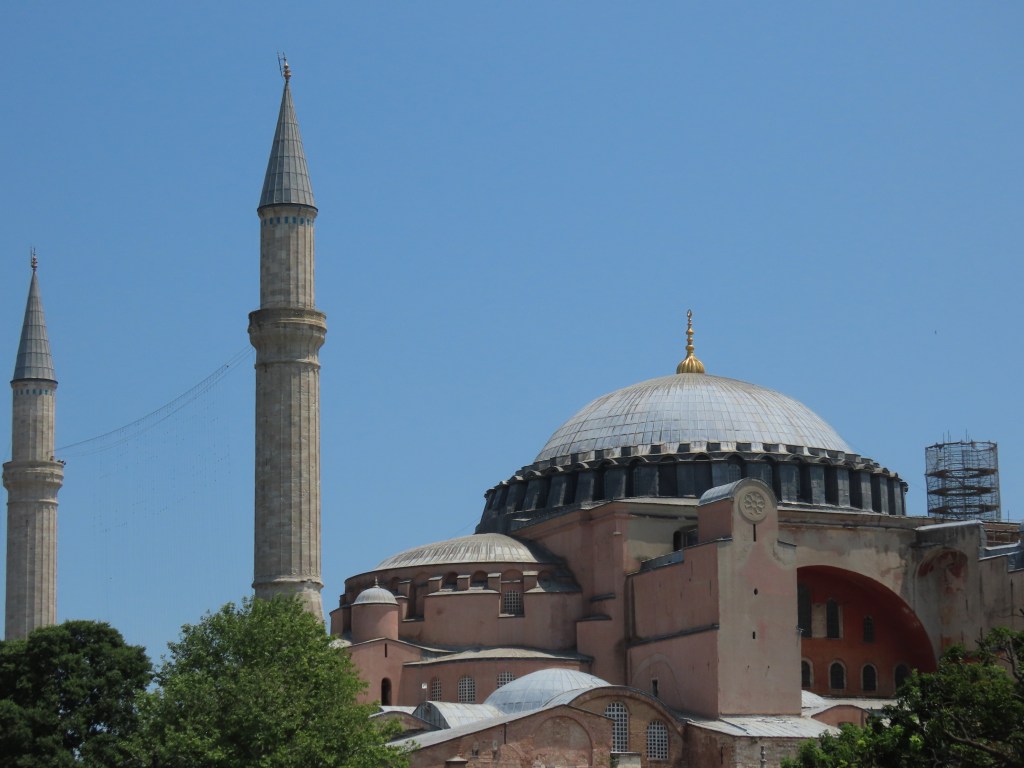
Between the Blue Mosque’s towering minarets and an ancient Egyptian obelisk, I notice that many of the tourists, judging by the amount of hijabs, are Muslim, but visibly not Turkish. I hadn’t really considered the potential reach of religious tourism before, but it makes sense. We are, after all, not just in the presence of the Blue Mosque, but the massive bulk of the Hagia Sophia. About 1500 years old, two thirds of it as a church under the Byzantine Empire, then a third of it as a mosque under the Ottoman Empire, one of the focal points of Istanbul’s heritage is bound to be a massive draw for specifically Islamic tourism. From this brief stopover, though, to it’s impossible to gauge the effect of the government’s Islamist-courting decision to convert it from being a museum to a working mosque again.
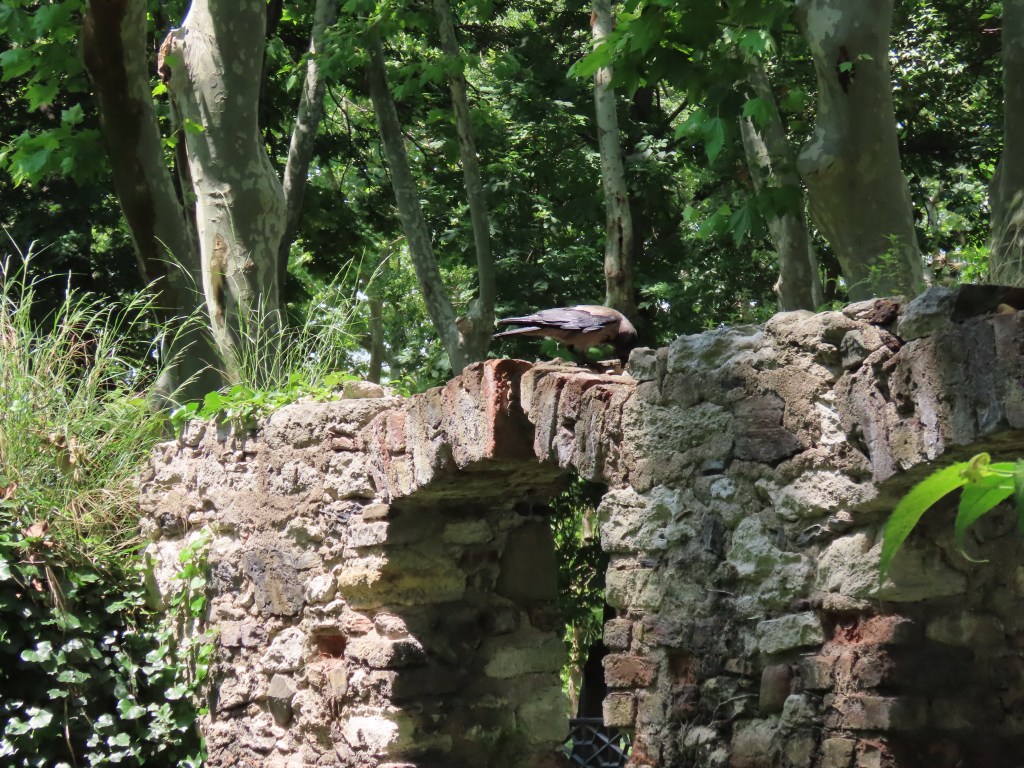
I leave behind the worst of the crowds in a shaded, tree-filled park. I can see signs for Topkapı Palace and a smorgasbord of other historical sites, but once I reach the end of the park, between ancient Greek and Roman ruins and a parked armoured vehicle – the latter probably linked to the recent mass protests – I turn back. I only have a limited amount of time in the city, and I might as well end it here, between Istanbul’s illustrious past and turbulent present.
Day 2
Not being able to sleep on planes has always been a particularly awkward problem for me, but thankfully there was a pod-hotel in Kuala Lumpur’s airport, rentable by the hour. This means that I could, in theory, have a short nap before it was time to travel into the city and check in at my proper hotel. I mostly failed, of course, and there was no shower, so my smell was almost an extra guest in itself. But in the air-conditioned monorail speeding over the heart of the city, it almost doesn’t matter. Amidst the skyscrapers, I can see domed mosques, a Chinese clan house crawling with dragon statues, a garishly-painted Hindu temple, and patches of tropical forest. It’s nearly enough to make the tiredness disappear.
It does nothing for the stink, though. I can only feel sorry for my fellow passengers.
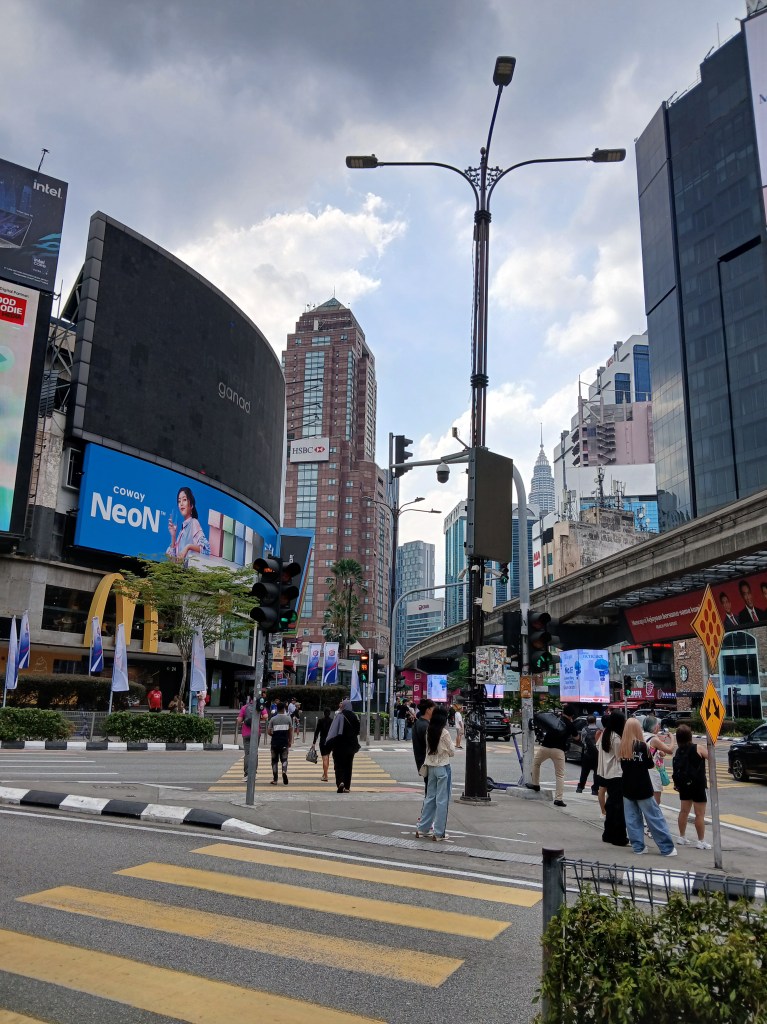
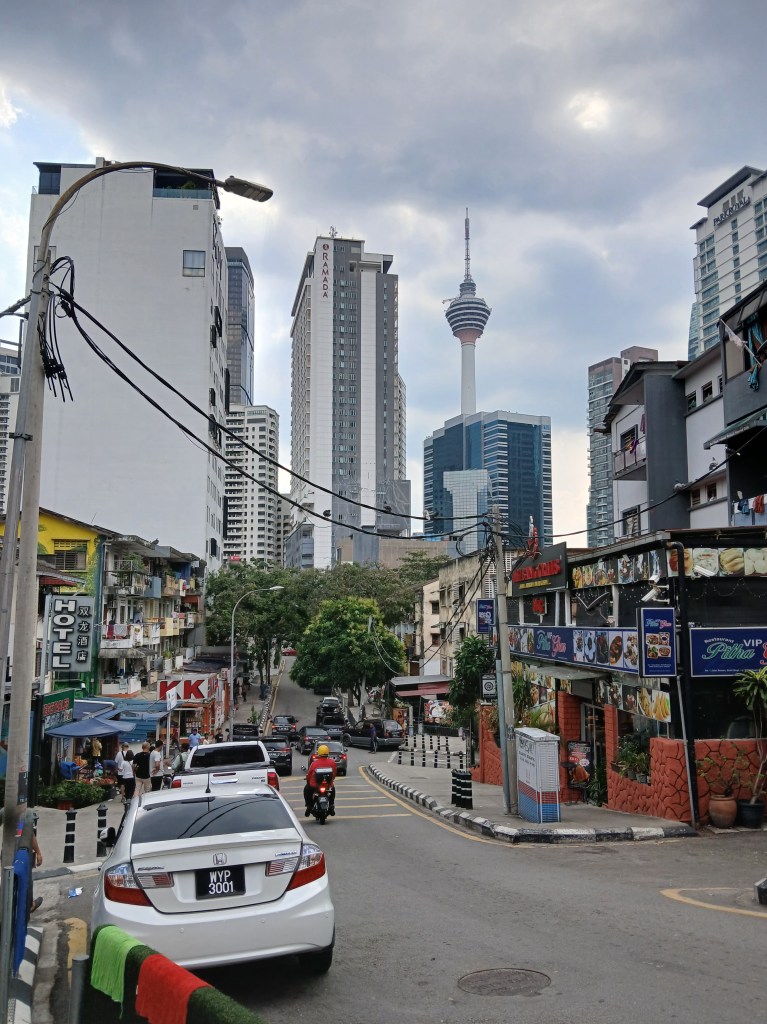
Hemmed in between concrete and the overcast sky, the air is thick with heat and humidity. I had forgotten how tiring the tropical climate is, especially with a heavy rucksack, as I follow tentative directions leading from the bustling pavements under blaring adverts and huge malls to grimier streets and back alleys.
It’s a similar kind of environment to what I had seen in Bangkok a few years ago, with expensive shops and sleek infrastructure cheek-by-jowl with crumbling pavements. Thankfully, the street that the hotel is on turns out to be something in between. There are no greater pleasures, at this point, than the holy trinity of a shower, a bed, and air-conditioning.
Day 3
It’s morning, I’ve recovered to at least a functioning state, and there’s a hipstery but nice place on this street to have breakfast and load up on caffeine. It’s time to set out and see if this city can impress me.
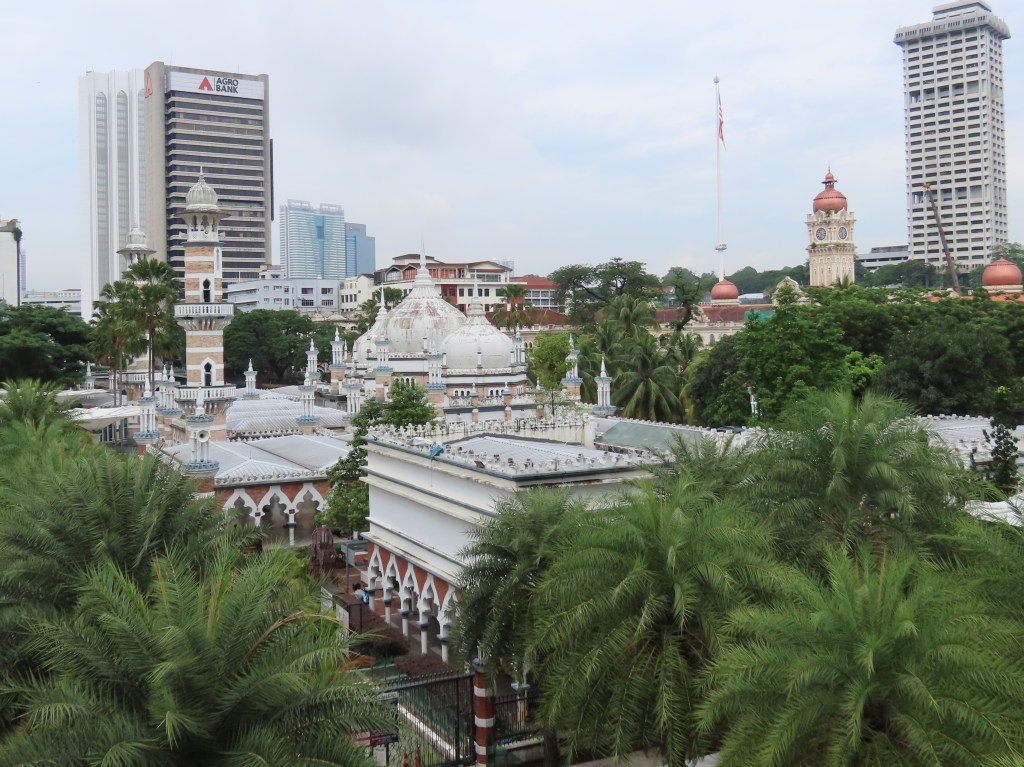
I’ve never really understood what large open spaces in cities are for. If it had trees and bushes, it would be a park, at least, but Merdaka Square is just a massive patch of grass next to an unreasonably-huge flagpole. The black and white mock-Tudor buildings on one flank give it the impression of somewhere trying to emulate a quaint English cricket pitch in sweltering jungle heat. On the other side is a massive, pale…palace? Museum? Overly-elaborate train station? Whatever it is, it’s topped with copper-coloured domes and a clock tower. I think it’s an example of the colonial-era “Moorish architecture” that’s dotted around the city. An odd juxtaposition of a British building trying to copy (badly) North African style in Southeast Asia.
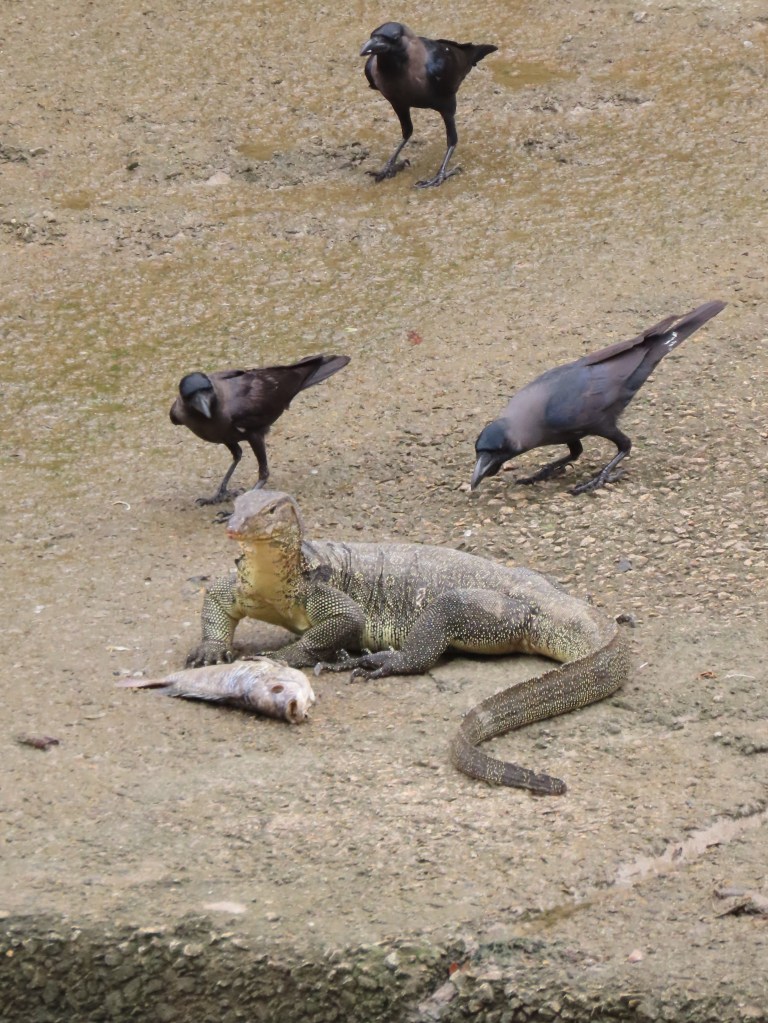
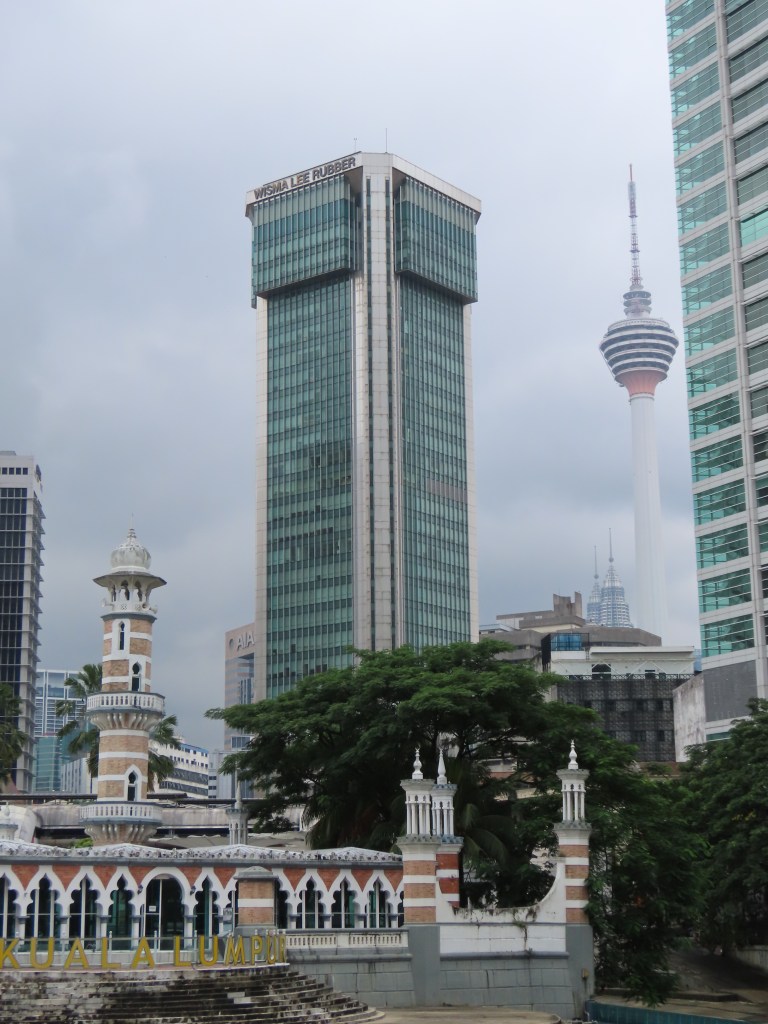
At the heart of the city, two rivers converge – the original kuala lumpur (“muddy confluence”). Appropriately enough, it’s good spot to get an impression of KL. Look down, you see brown, rubbish-strewn water and concrete, where a huge water monitor lizard guards the fish they’ve caught from crows. Look up, you see skyscrapers, including the distant twin spires of the Petronas Towers. Muddy brown below, shiny silvery-blue above. Jungle trees and flowers on one side, construction on the other, and an elaborate mosque in the middle. Unfortunately, though, pithy portrayals of Southeast Asian cities don’t fill my stomach.
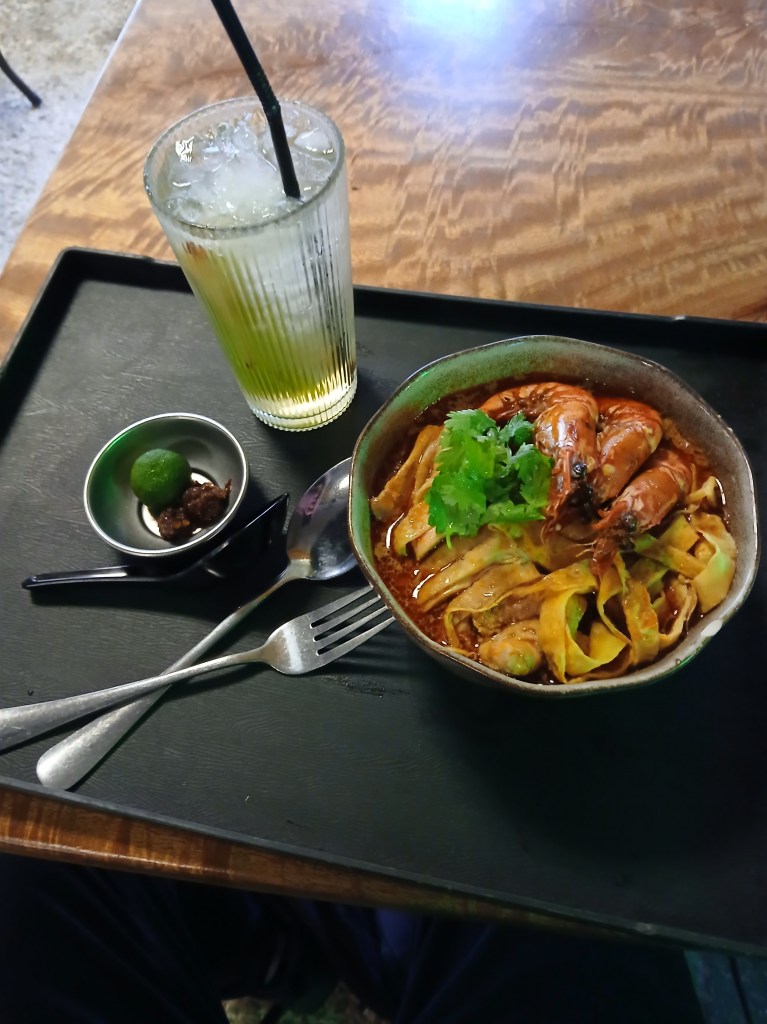
Jalan Petaling is supposed to be one of the best places for street food, but after I plunge through the ornate Chinese gateway into the heaving crowd of the street market, it’s a while before I see any food. Phone accessories are all very well, but I can’t eat those, can I? The food stalls, as it turns out, are closer to the centre, but nothing there tickles my fancy. There’s nothing particularly interesting, or, for that matter, Malay. It’s all Chinese. Yes, Jalan Petaling is part of KL’s Chinatown, but it’s in still in Malaysia. And given that I’m in Malaysia, I was hoping for something Malaysian. I keep walking, until I leave the street market, while anxiously trying to remember the way back. Right next to the market, there’s an indoor food court. I had read that there’s a trendy food court in KL that’s based in an old cinema – maybe this is it? Whatever, close enough. In any case, there’s a place that does laksa – a noodle soup that’s one of the most prominent Malaysian dishes. It arrives with whole prawns, and a little dish with sambal (chili paste) and a tiny unidentified citrus fruit on the side.
As I start breaking open the prawns and shoving noodles, bean sprouts and bits of chicken into my mouth, I start worrying that this is just a tourist thing. The signs declaring the addictive properties of Bornean laksa are all in English. I’ve sought out Malaysian cuisine, but is what I’ve found just a watered-down copy specifically for sweaty, pink-faced foreigners?
Then I try the sambal. After my tastebuds recover and my head stops ringing, I conclude that no, this is not aimed at tourists.
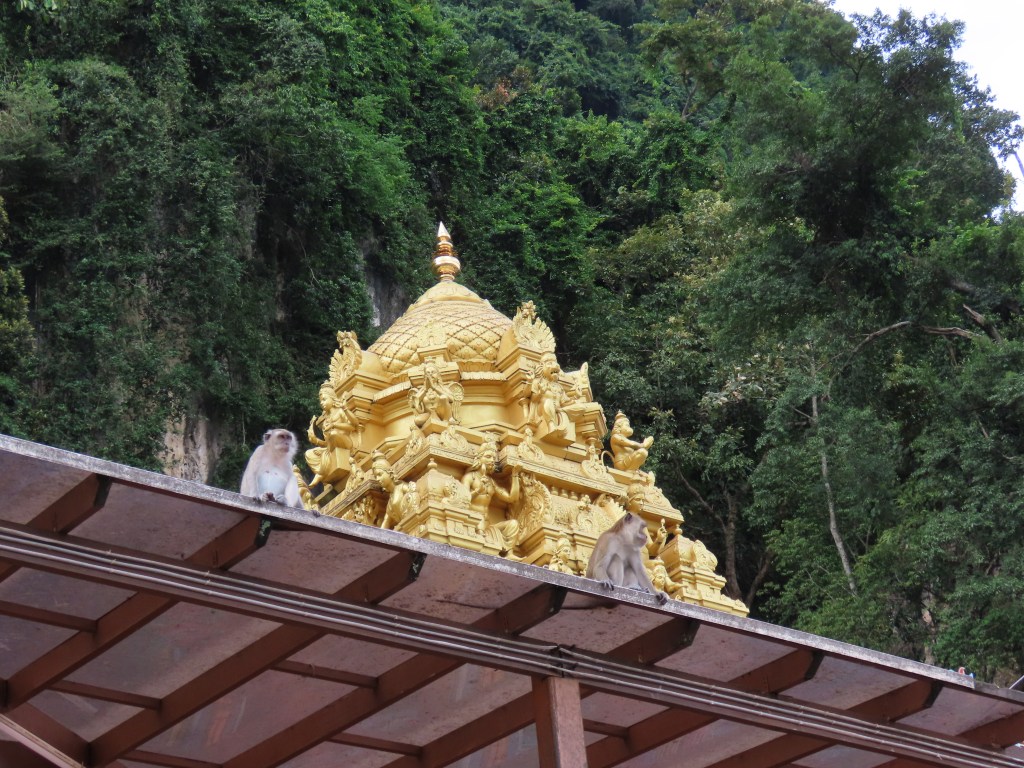
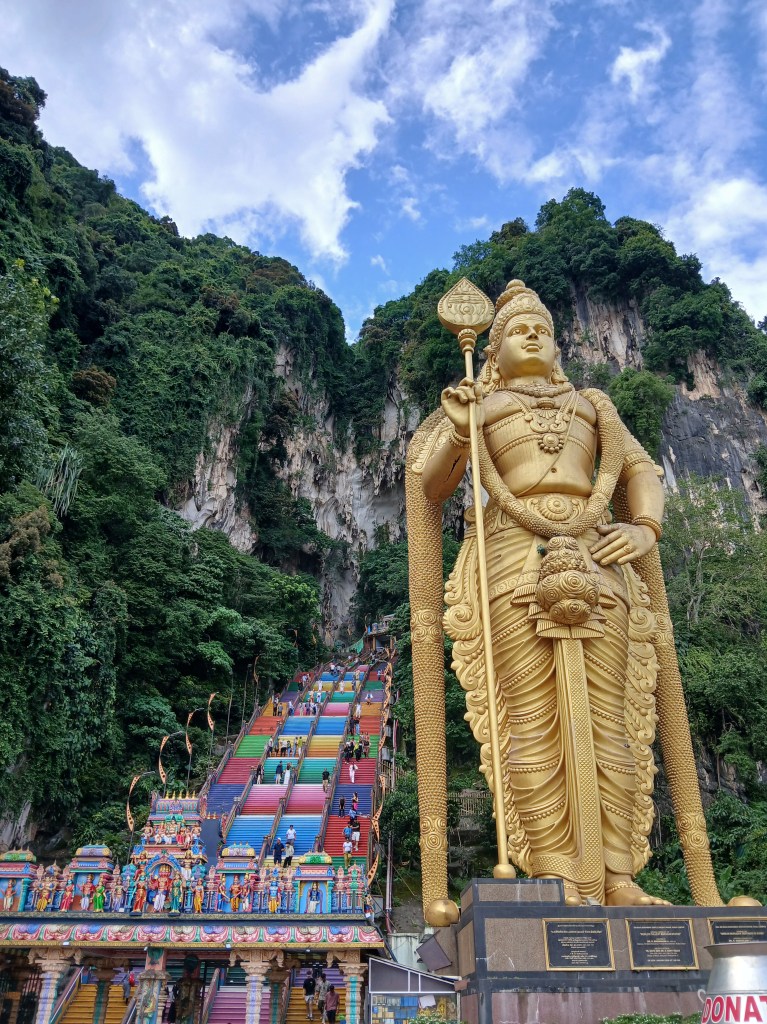
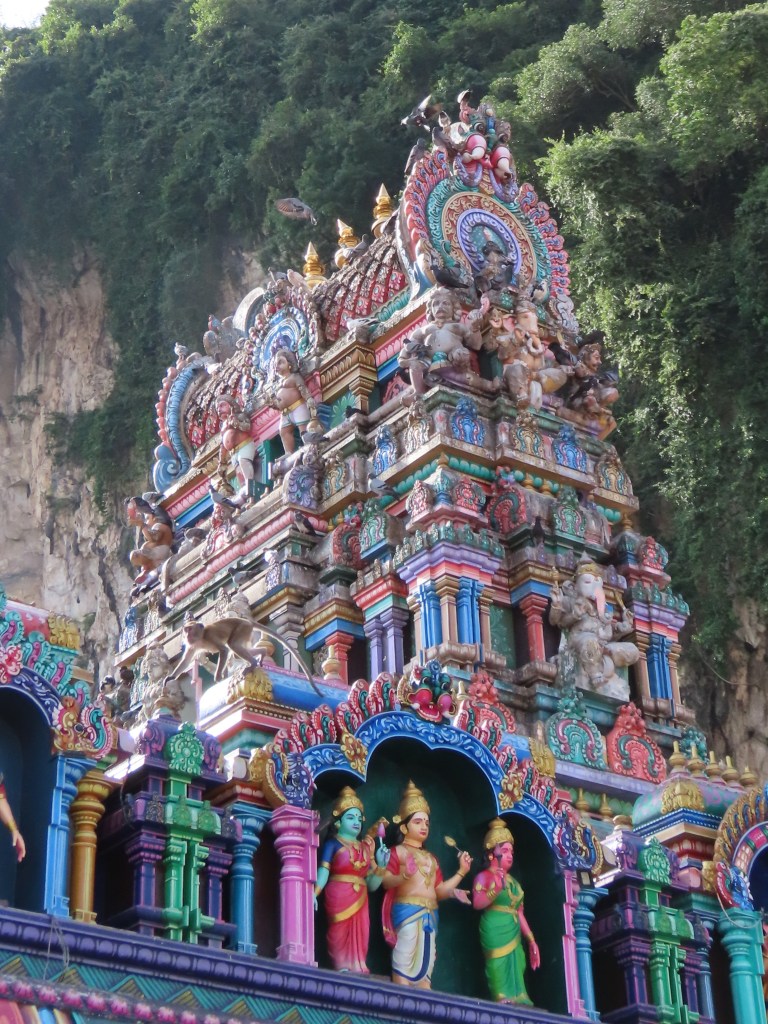
I leave a train station in Southeast Asia and enter a little theme-park chunk of South Asia. Between towering jungle-covered cliffs and a big carpark, there are Hindu statues overlooking the pavement. Ahead, through throngs of tourists and scampering monkeys, are the most prominent symbols of Malaysia’s South Asian communities: the temples of the Batu Caves. They are completely saturated in bright colours and carvings; gods and peacocks alike in pink, blue, green, purple, and gold. They are, I think, a South Indian style of Hindu temple. For all their flamboyance, I only glance at them. Partially because I’m distracted by the question of why would someone would deliberately try to feed the pigeons here, unless it’s an experiment to see who would win in a fight between a flock of pigeons and one determined monkey, but mostly because my attention is grabbed by a massive golden statue. It’s almost as tall as the cliffs, and welcomes visitors up the multicoloured steps into the cave. This is Lord Murugan, a god, despite his affable expression, of war.
By the time I reach the cave, my eyes sting from the sweat pouring into them. Or by the time I reach the cavern, rather. It is properly and thoroughly, in every sense of the word, cavernous. Beneath the high rock ceiling there’s another temple – another riot of colour, this time with lights. Maybe it’s because of the grandiosity of the temples, but I’m particularly struck by the plainness of the rest of the cave. It’s grey, the floor is completely flat and even like concrete, and there are miscellaneous fences, bins, and chairs scattered around. It’s so ordinary and functional it feels out of place amidst the exoticism of this huge tropical cave-temple.

Another flight of stairs leads up to another section of the cave, where there’s what looks like a stage, topped with a roof covered in yet more statues. I assume it’s used for religious ceremonies, but it’s currently empty, leaving this section unoccupied except for me, a few other tourists, and pigeons. Instead of a rock ceiling, there’s a tree-framed patch of blue sky. I can smell the rainforest above.

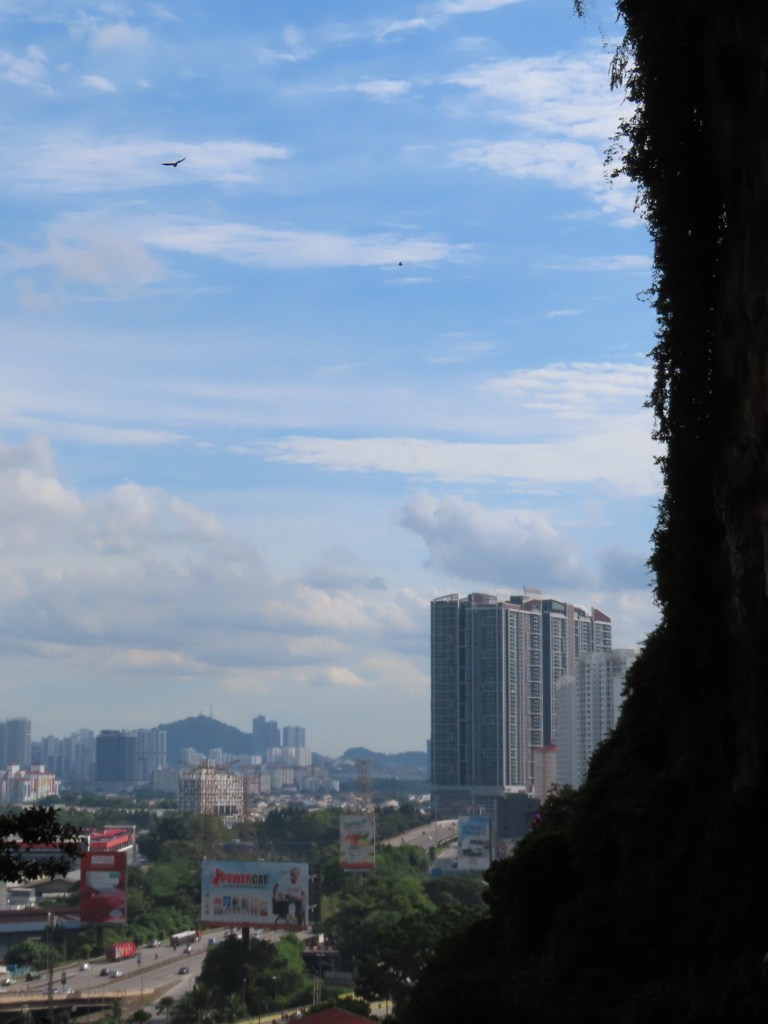
The sun is on the verge of setting when I leave the cave and witness the view Lord Murugan has of the city. Now, let’s see which ones hassle me the most: the monkeys of Batu Caves on my way back to the train, or the staff of Kuala Lumpur’s restaurants and massage parlours while I’m trying to find dinner?
Day 4
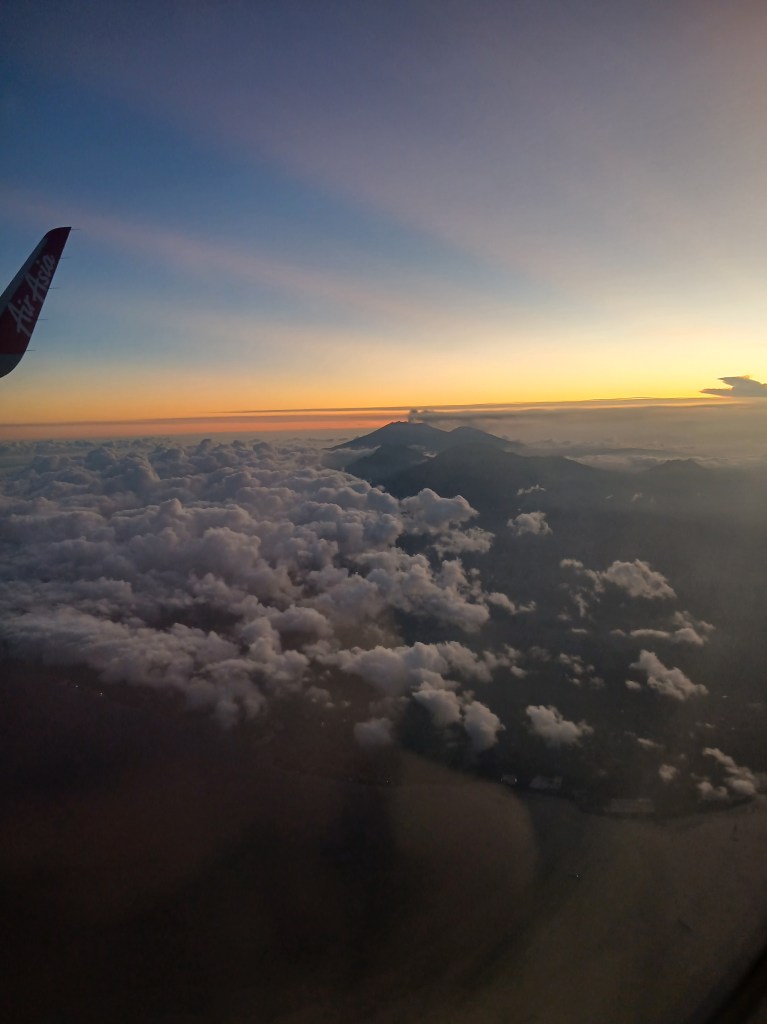
I only have an overnight stopover at the airport in Bali, which is OK with me, given its intensely touristy reputation, but the traditional music and artwork in the immigration hall almost makes me regret it. As I’ll be coming through here again later on a much tighter schedule, I am reassured to see that the airport is equipped with rows of e-gates activated by passports scanners for quick processing of large numbers of visitors. Of course, I’d be a lot more reassured if the e-gates actually worked more than half the time, instead of condemning a large crowds of arrivals, myself among them, to waste a sizable chunk of our lives queueing for the Immigration Control desks.
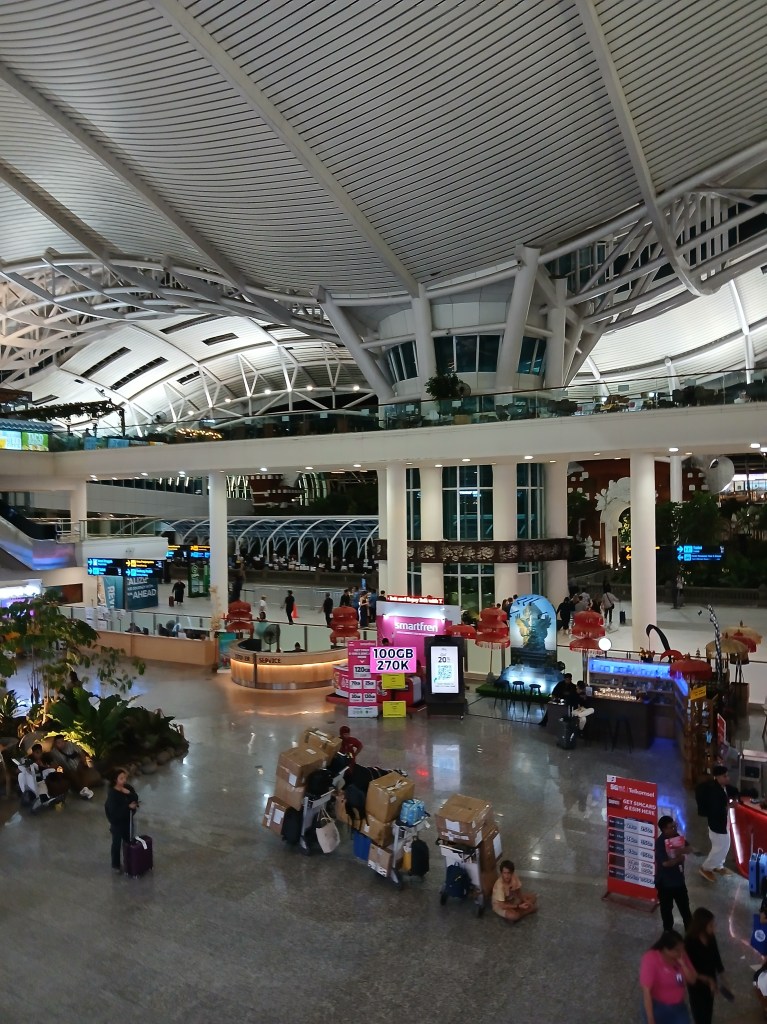
No pressure to find the local cuisine here. A Burger King on the terrace above the arrivals hall will do just fine. Opposite me, on another table, a woman sits. She’s wearing a black leather jacket, and the rest of her clothes are all in black and grey. With most of her face concealed by a black facemask and curtains of long black hair, she’s watching the arrivals below. The table in front of her is empty; she’s neither eating nor drinking, just watching. She does not look away, even for a second. She is completely and silently dedicated to observing every single person who arrives at the airport. Dressed like a shadow, and utterly still and intent, like a hunter.
Then she enthusiastically waves to someone and dashes off, completely ruining the sense of mystique.
Day 5
The plane is uncomfortable, I understand that. The seats are so thin with so little legroom that I can feel it every time the person behind or in front of me moves. I accept that this will not be a pleasant flight. But what really alarms me is that, in the seat pocket in front of me, there’s a sheet of prayers, from an array of religions, all begging various deities to keep the plane safe. Is this plane literally held together by spit and prayers?


The flight was as hellish as I expected, the immigration queue was repeatedly held up by arrivals with limited English and dubious legal status, and then the taxi from the airport was expensive, but I’m here. The equator has been crossed, and a new continent reached. With a few skyscrapers between the turquoise sea and a flat green-and-grey cityscape, Darwin is wedged right in the northern corner of Australia (the region is referred to as the “Top End”), which makes it far closer to Asia than to Melbourne or Sydney.
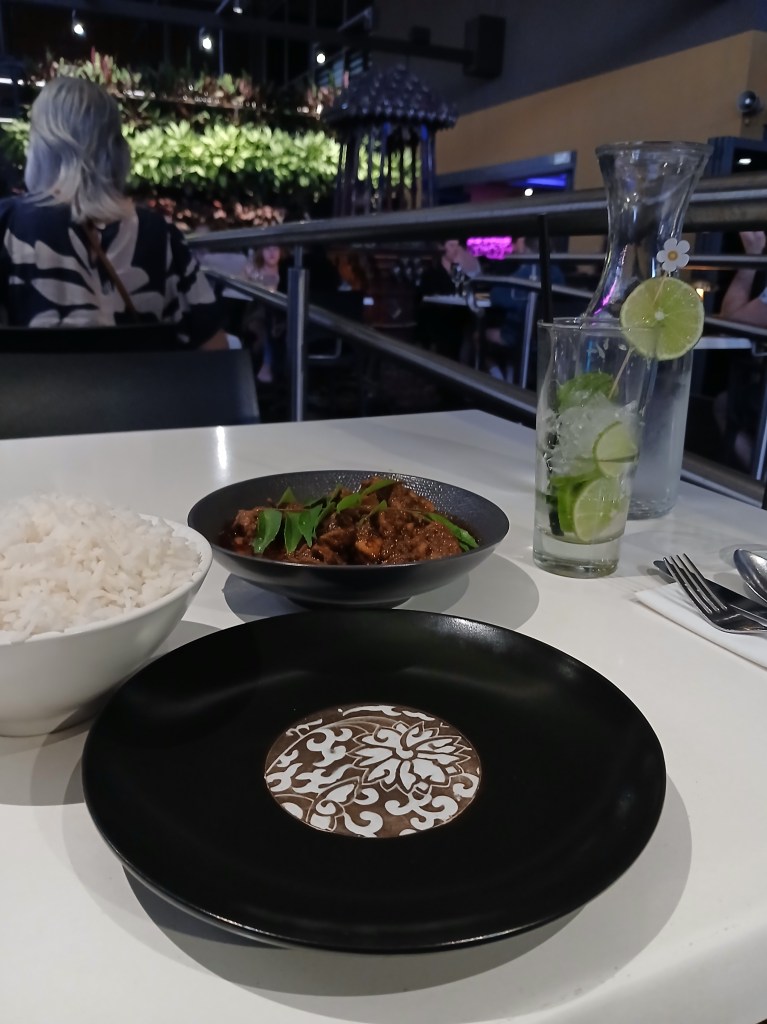
It slowly dawns on me, sitting alone at a corner table of the Asian restaurant, that I’ve gone somewhere too fancy for dinner. There’s Indian-style artwork with tasteful pink lighting, and all the tables have white tablecloths and wine glasses. Everyone else here is older and clearly dressed up for an occasion. I just wandered in because I recognised the restaurant’s name as a recommendation while I was hungrily wandering the streets. I’ve been wearing this shirt for the last four days. Nothing for it now but to try to look confident and order the cheapest thing on the menu.
Day 6
I always thought that the term “youth hostel” was just a name, but in this case it’s very, very thoroughly apt. In fact, almost everything on this street is aimed towards young backpackers: other hostels, restaurants, raucous pubs, etc. This hostel has an outdoor bar and pool, and young Europeans of various nationalities wandering the corridors in swimwear. Every night seems to be party night, and obviously, this makes me feel ancient.
As I set out into the morning light, it quickly transpires that the hostel’s street is in stark contrast to the rest of the city, which has been taken over by elderly couples escaping the south Australian winter. Darwin’s usual inhabitants are younger and more Asian, and include groups of the local Aboriginal people, the Larrakia, about half of which, from what I can hear, still speak their own language with each other.
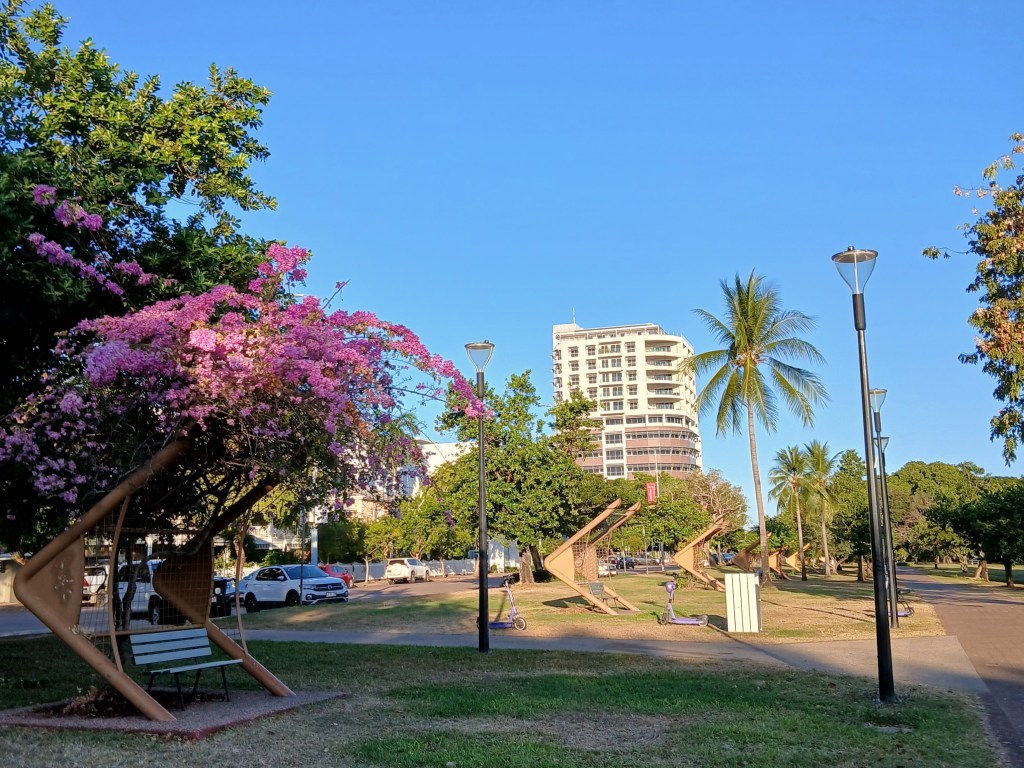
This city is unlike any I’ve ever been to. I caught a bus in the Central Business District, where the handful of tall buildings are, and pavements are shaded to protect customers of various kinds from the fearsome sun, but then there are long stretches of grass and trees going past the window before I reach anything urban again. The overall impression is of a chunk of a city dumped into the middle of the savannah, with some small towns nearby. But the bus interchange I’ve ended up in, next to a retail park, still feels like it could be on the outskirts of a nondescript town back home. The difference being, of course, that I’m trying to reach an isolated beach north of the city, where there could potentially be saltwater crocodiles.

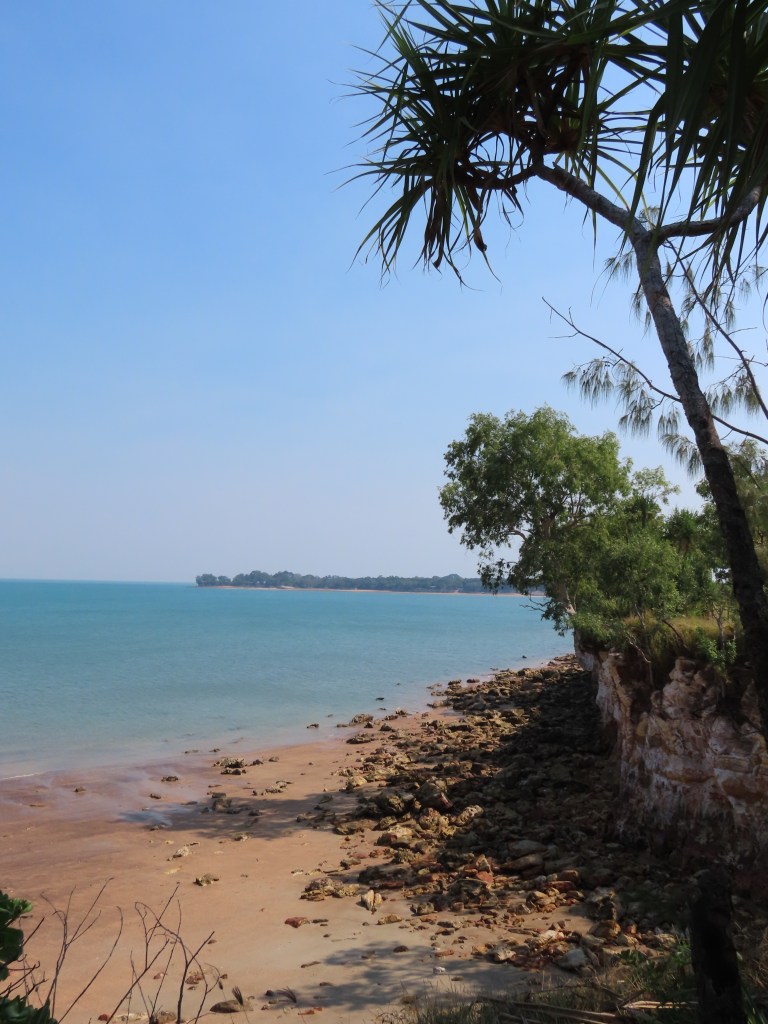
An irregular bus schedule thwarted my attempt to reach the secluded beach, so I get off the bus in one of the gaps in the urban sprawl. On one side of the road there is a row of large houses, each of a different design, but each an absolute image of opulence. Behind a line of palm trees, they all look like shots from a film that wants to emphasise that a character is wealthy. But anyway, I didn’t get off here to stare covetously at rich people’s houses. It’s the houseless other side of the road that interests me. The sun is harsh as I follow the paved footpath through the manicured grass, but I eventually reach what I had been glimpsing through the trees: a beach and a bright blue sea.

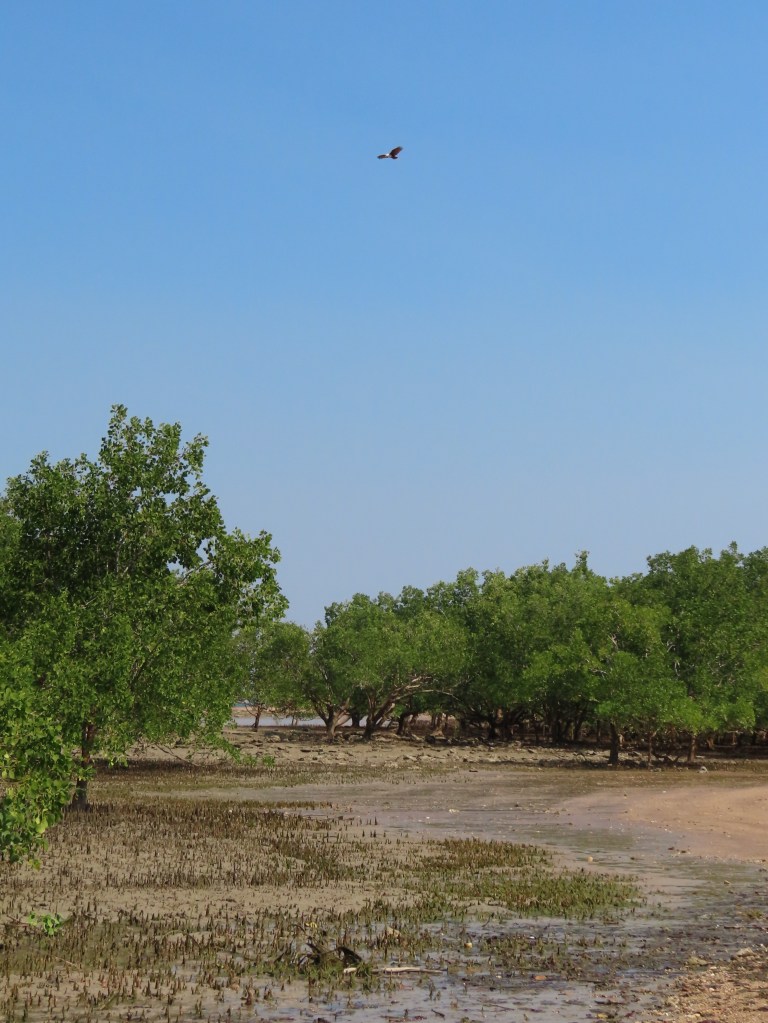
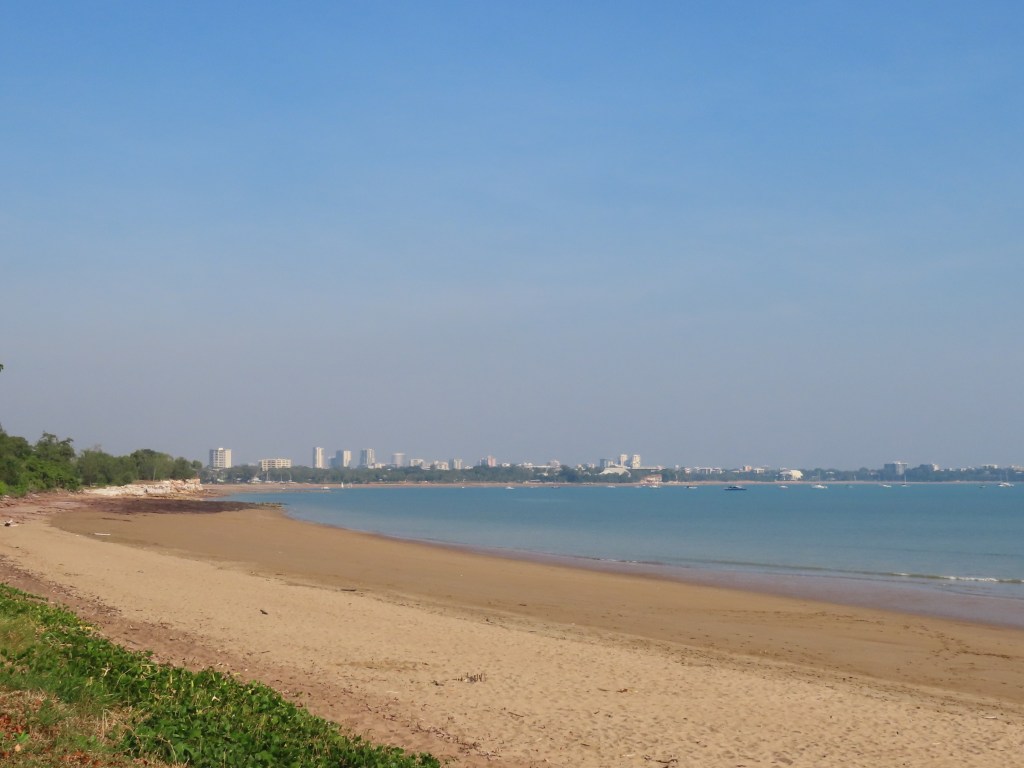
While not as remote as the one I had been trying to reach earlier, it’s still next to a nature preserve, and the city is reduced to just some pale blocks dotted on the horizon, beyond the green trees, the blue ocean, and the golden sand. No crocodiles here, just some spinner dolphins leaping among the boats out at sea.
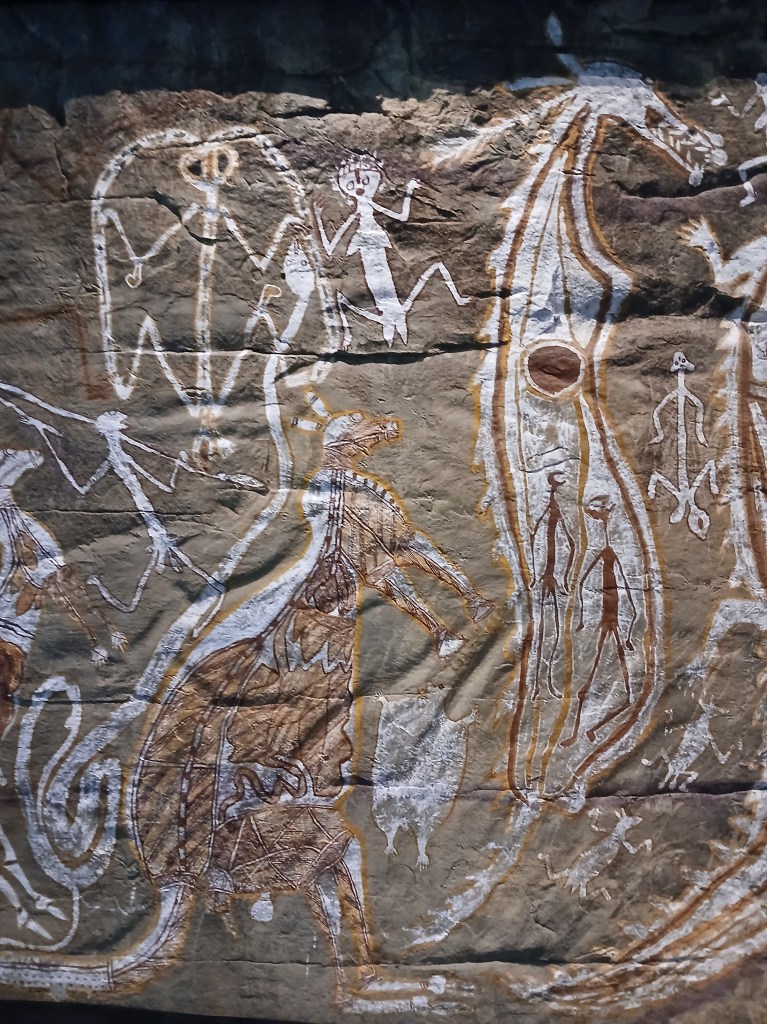
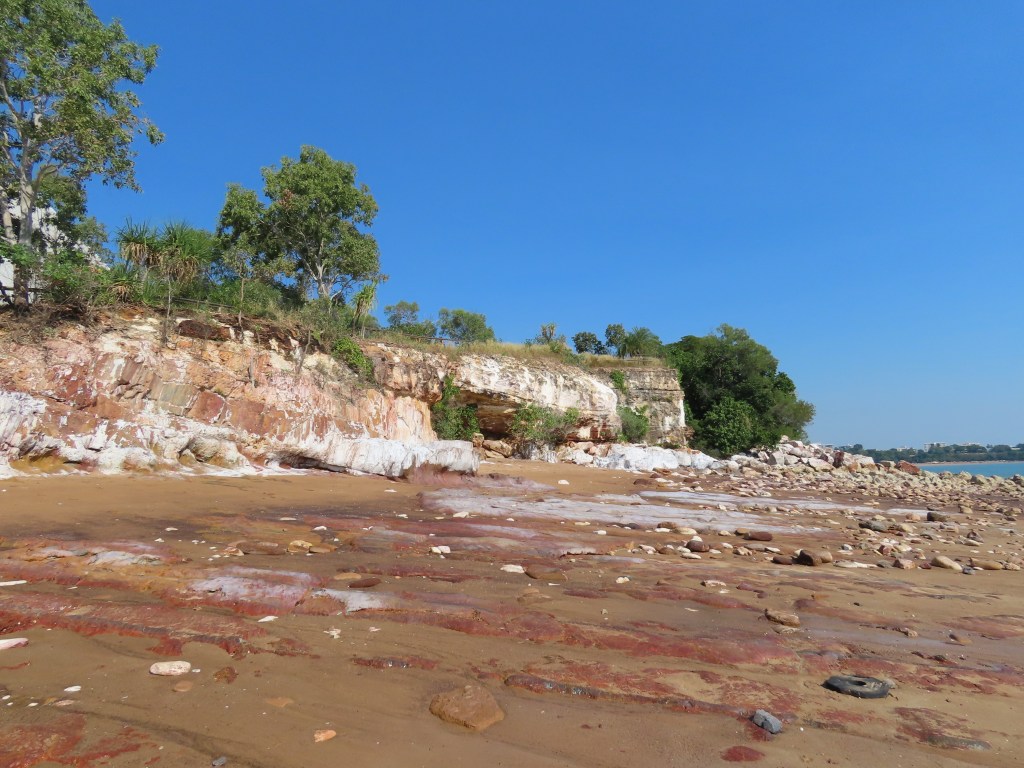
On the coastal route back to the city proper, there’s a museum, with exhibits on the region’s history, a taxidermized menagerie of the local wildlife, and a receptionist who’s startled to hear where I’m from. It’s alright, as the museums of small cities go, but more intriguingly, on the beach outside under the white-and-reddish cliffs, there are sharp coral rocks emerging from the water. A dead and grey reminder of what’s living and colourful under the waves here. If only I could swim. Or drive a car, for that matter. Or sort my life out in general.
Day 7
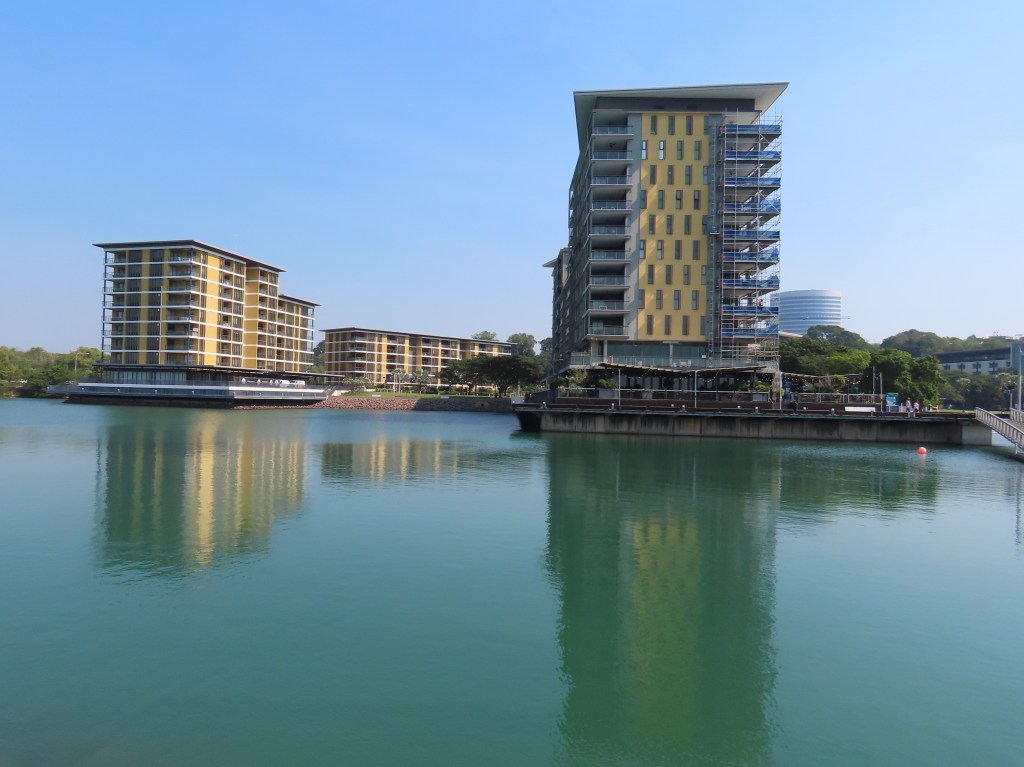
Past rare forested slopes and high-rise buildings, amidst cafés, restaurants, and the bustle of preparation for a festival of Nepali culture, the focal point of Darwin’s waterfront is a waterpark. Fitting, I suppose. A patch of sea has been tamed for it; supplied with its own artificial beach and sealed off from the blue wilderness beyond and all its sharks, crocodiles, and stingrays. Rendered safe, and in my eyes, dull, as I look down, dissatisfied, into the near-lifeless waters from a pontoon bridge. A crocodile or two would really liven up the waterpark.
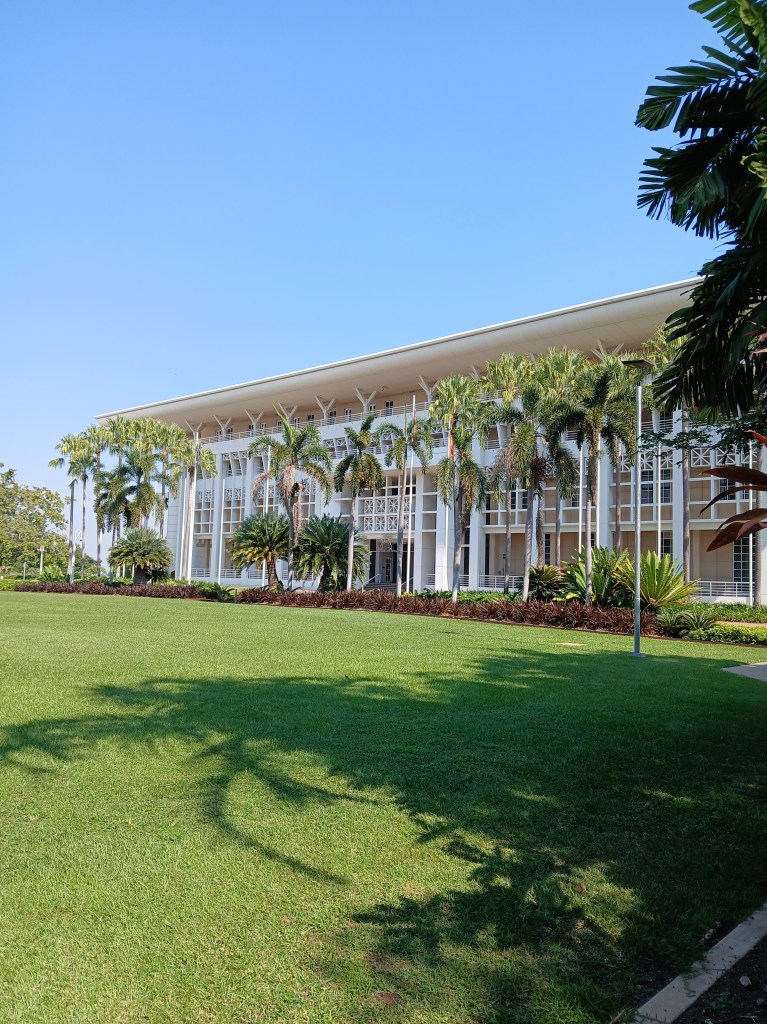
There was some kind of event at the governor’s house. Maybe, in another life – and in a different era – I could have been the kind of person who is invited to events at the governor’s house. But in this life, I was just wandering past when I noticed that there was something that was open to the public happening, with people milling around and some stalls, so I ambled in. I don’t think the governor actually lives here anymore, in any case. It’s a historical building officially called the Government House – a large wooden house, blindingly pallid in the sunlight. The actually functioning government buildings nearby are similarly white, albeit far larger, far more modern, and with less of a sense of Anglo-Saxon style imposed on the tropics.


I only wandered around the Government House garden with the other visitors before leaving. Still have no idea what was actually going on. Ultimately, after exploring the city, I’ve ended up back on the beach next to the nature preserve. Maybe this is more the place for me, with the cockatoos in the palm trees and a wallaby grazing in the long grass. The latter watches me as I walk away from the beach and into the mangrove forest. I pass a sign warning about crocodiles, but all I see, as I pass through the mostly-dry swamp, is trees, scrub, and elderly tourists, before reaching the end of the boardwalk at the other side of the peninsula. Then I can see a bit of the sea again, in between stretches of sand. There’s a Larrakia woman wading through the water with a stick, and beyond, on another shore, more buildings. It seems that all around this peninsula, there are either boats on the sea or buildings on the horizon. I’m still, if not in the city, in civilisation. For now.
Day 8
It’s going to be a long trip south, but not as long as the flight was, so it doesn’t seem too bad. I’m sure that four hours’ drive away is close by Australian standards, anyway. The coach is going all the way to Alice Springs, at the very heart of Australia, along the Stuart Highway, which extends right down to the south coast. The view through the window is of nearly endless long grass and trees, with the occasional farm. I notice that the side of the road is littered with abandoned tyres, many of them in tatters. Victims of the Stuart Highway’s continent-spanning length. The view is suddenly interrupted by something new: smoke. The charred ruins of trees are right next to the road, and, more alarmingly, so are the scattered flames. Black kites hover above, buoyed by the thermals and hunting anything fleeing the fire. But the coach trundles along, and no-one seems bothered. I suppose wildfires are common here.
The town of Katherine is supposed to be the second-largest settlement in the Northern Territory. A surprising title for what looks more like a large village scattered across a swathe of outback. It still has hotels and a few restaurants, though, including a club restaurant that offers lemon & pepper crocodile (locally caught, the menu assures me). But they’ve run out of that, condemning me to some mediocre calamari instead. At least it’s something different from barramundi – a fish that absolutely dominates menus in this region.
Day 9
Despite Nitmiluk National Park only being twenty minutes away, the cost of the taxi was eye-popping. After spending the trip making polite small talk with the driver while attempting to conceal how little of what he said I could understand, I got dropped off at the national park centre. It’s much larger and fancier than any I’ve come across before. There are speakers playing local bird noises around the entrance, an entire room dedicated to the history of the park, and a café where I can have breakfast – a big one, with pancakes made with some kind of local seeds – before I walk off into the bush.
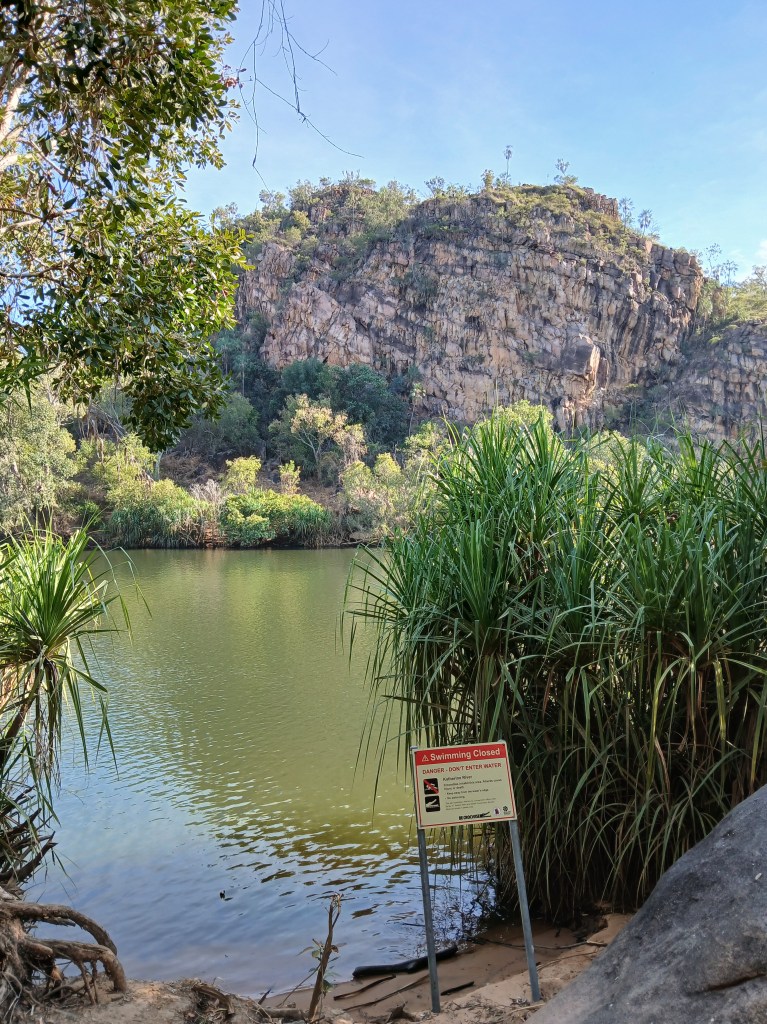
After passing through carparks and picnic areas, both steadily filling up with people, the narrow path between the trees and undergrowth leads past the Katherine River. At the water’s edge, there’s a sign that forbids swimming. Presumably connected to a poster in the centre warning that the park rangers haven’t finished checking the river for saltwater crocodiles that could have entered it during the rainy season. I can’t see anything moving in the water, but I know that’s no indication of anything. Even large crocodiles are able to hide in a foot’s depth of muddy water, I’ve heard. Freshwater crocodiles are not large enough to be a serious threat to humans, but saltwater crocodiles can be up to seven metres long. The path continues up stairs that climb a cliff. The view from the top is one of an expanse of ochre and green, as the savannah stretches one way, and the crags of Katherine Gorge another.
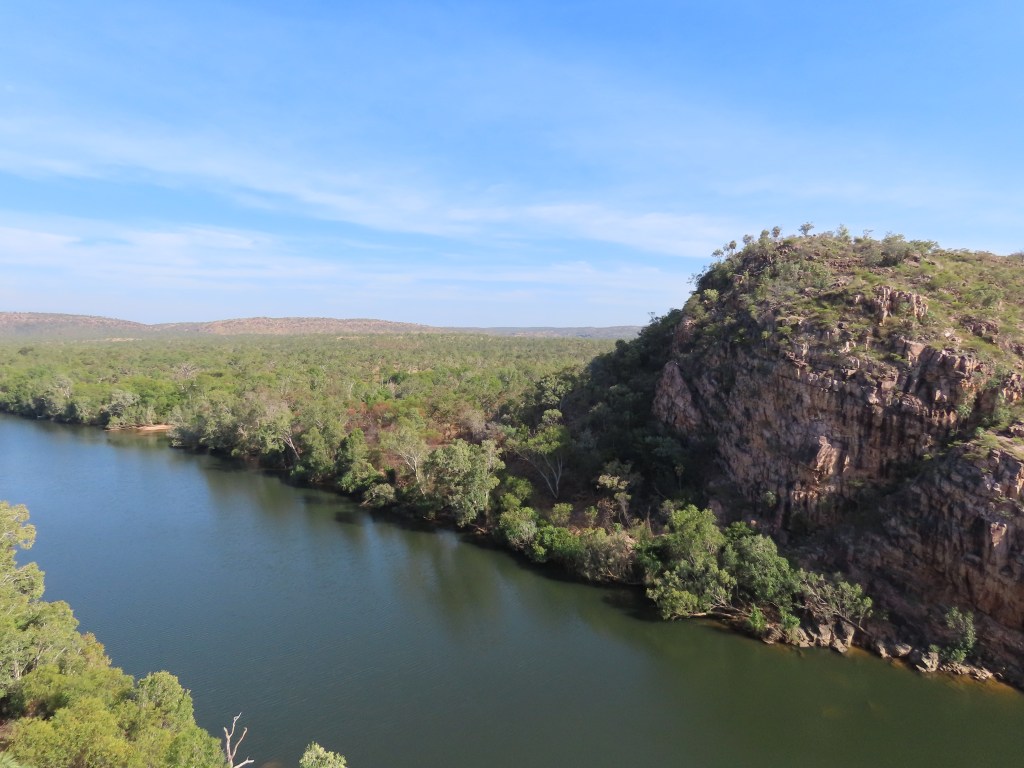
I can tell that this is extraordinary, but something stops me from fully appreciating it.
I’m ill.


This is no tropical disease, no exotic infection that I’ve picked up. It’s a common cold. I’ve had a sore throat for the last few days, but I’ve been telling myself that I just slept badly. Now that I’m also coughing, feeling nauseous, and have a throbbing headache, it’s become undeniable. Most likely I got it from all that youth in the hostel in Darwin; a version of “fresher’s flu” that circulates around universities every start of term. As I wander the plateau; a combination of sand-hued stone and scraggly trees, the illness forms a buffer between me and the fact that I’m somewhere unlike anywhere I’ve ever been before. It’s profoundly frustrating. Especially now that I’ve finally managed to find some solitude away from the other tourists. It also feels ridiculous – this is something that confines me to my bed in winter at home, with a cold, overcast sky outside the window, but I’m in the same state here, in the outback, where there are palm trees and black cockatoos flying overhead.
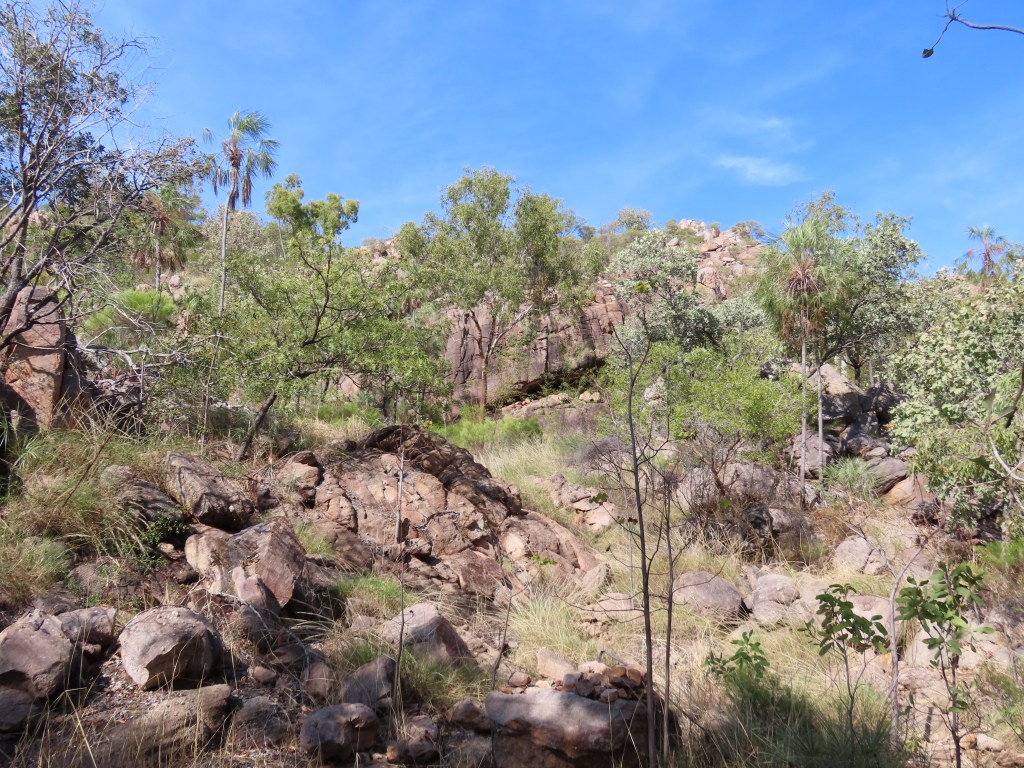

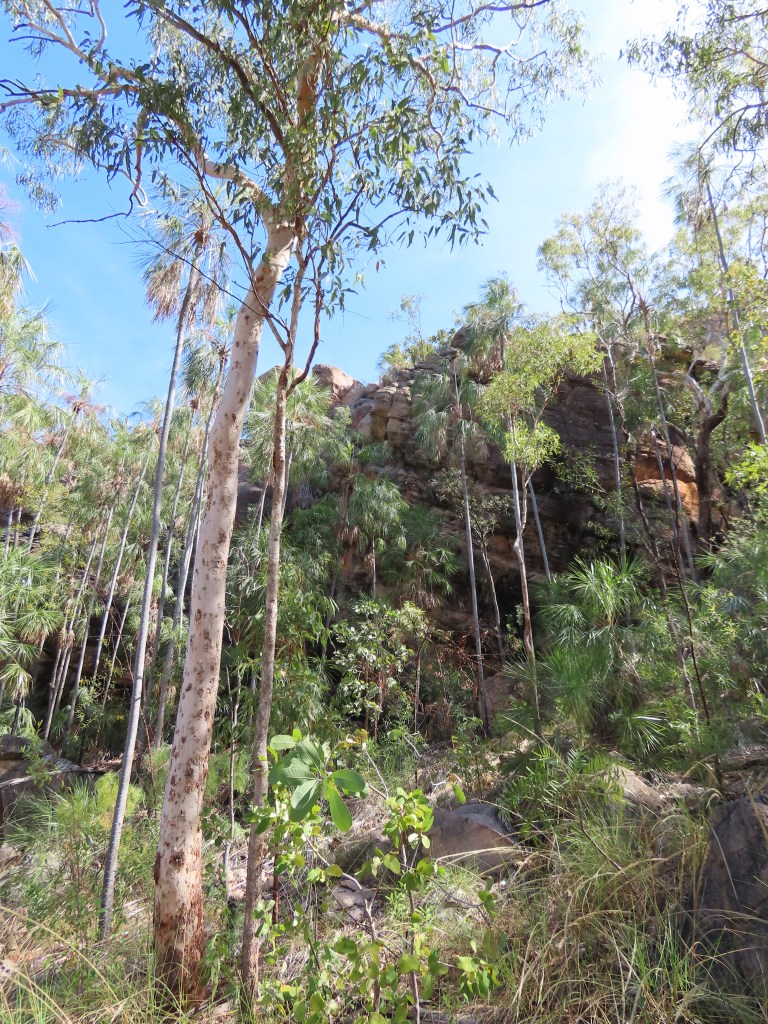
I walk through a canyon filled with tall thin trees – maybe eucalyptuses – despondent that I’m unable to properly appreciate where I am. I eventually reach the end of the path, which is the shortest in the Nitmiluk. It was supposed to be a starter before the main hiking routes into the bush, but for now, after finding the healthiest-looking lunch option in the centre’s café in an attempt to pack my diseased body with desperately-needed vitamins, I accept that I should probably carry out a tactical retreat. The taxi driver had given me his number instead of arranging a time to pick me up. Which would be an advantage for an early exit, but even with the centre here, I am still effectively in the middle of nowhere. And true to form, there’s no phone signal out here. I wander around the centre and the carparks, uncertain of what I’m hoping to find – a taxi rank, a helpdesk, or maybe even a kindly stranger who would take pity on this infectious wayfarer. But my salvation is something unexpected: a free phone booth. Except that it’s not even a booth – it’s just a landline phone on a stand, with a sign advertising that it’s free to use. What would be strangely archaic and immediately vandalised back home is a pristine lifeline in the outback. There isn’t even a penis drawn on it.
Day 10
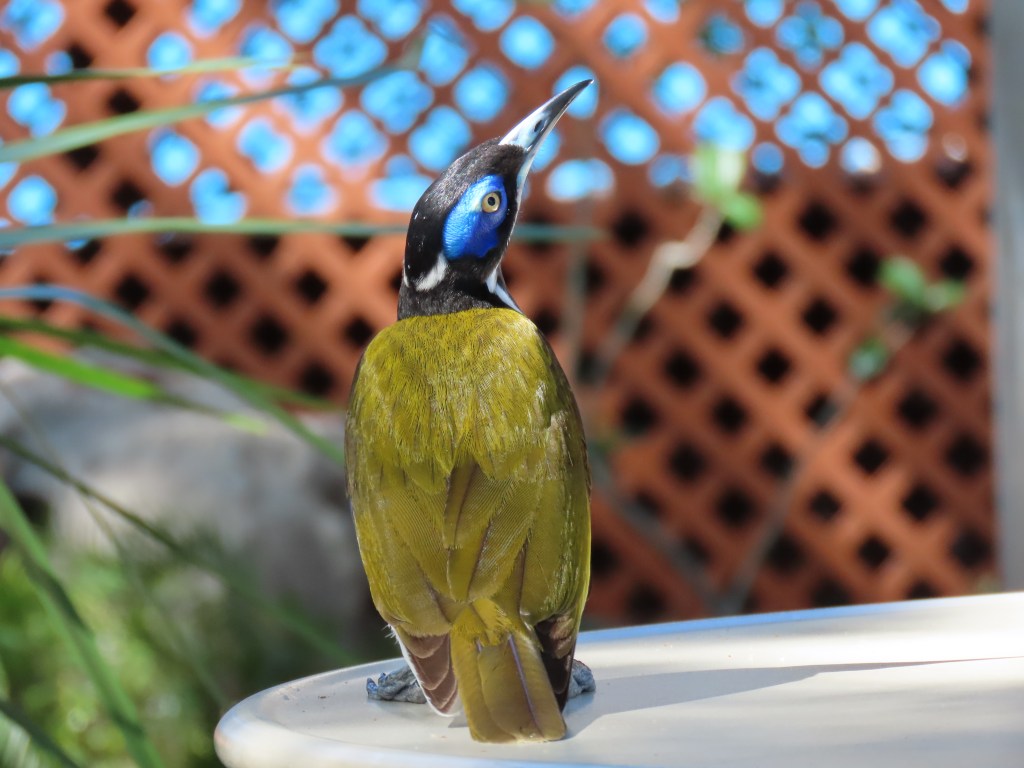
There is so much more of Nitmiluk to explore. This is precisely why I came here, to the other side of the world. But I can barely stand up without becoming light-headed, and the official guidance makes it clear that hiking in Nitmiluk, with its snakes and intense temperatures, should only be attempted when fully prepared. That, and the prospect of another expensive taxi ride of small talk, forces me to concede that my time would be best spent recovering. Other than staggering to a outdoor café run out of a caravan to eat amidst the elderly Australian tourists and blue-faced birds, I stay in the motel room, while the calling of cockatoos beckon me to explore the tropical world outside.
In the evening, I venture out again, through the near-deserted town, to eat at a Chinese restaurant. While I’m eating lemon chicken at the corner of the restaurant (my reasoning was that lemon is good for a cold, but it turns out that it’s a huge platter of deep-fried chicken in a vaguely lemony-sugary sauce, so it doesn’t feel too healthy), I notice that the window behind me shows what looks like the courtyard of a small shopping centre. This must be the Pandanus Square that the signs outside are referring to. It is, despite the restaurant filling up, almost completely dead. There’s something eerie about this moribund result of trying to set up a shopping centre in the midst of Katherine’s remote, silent streets.
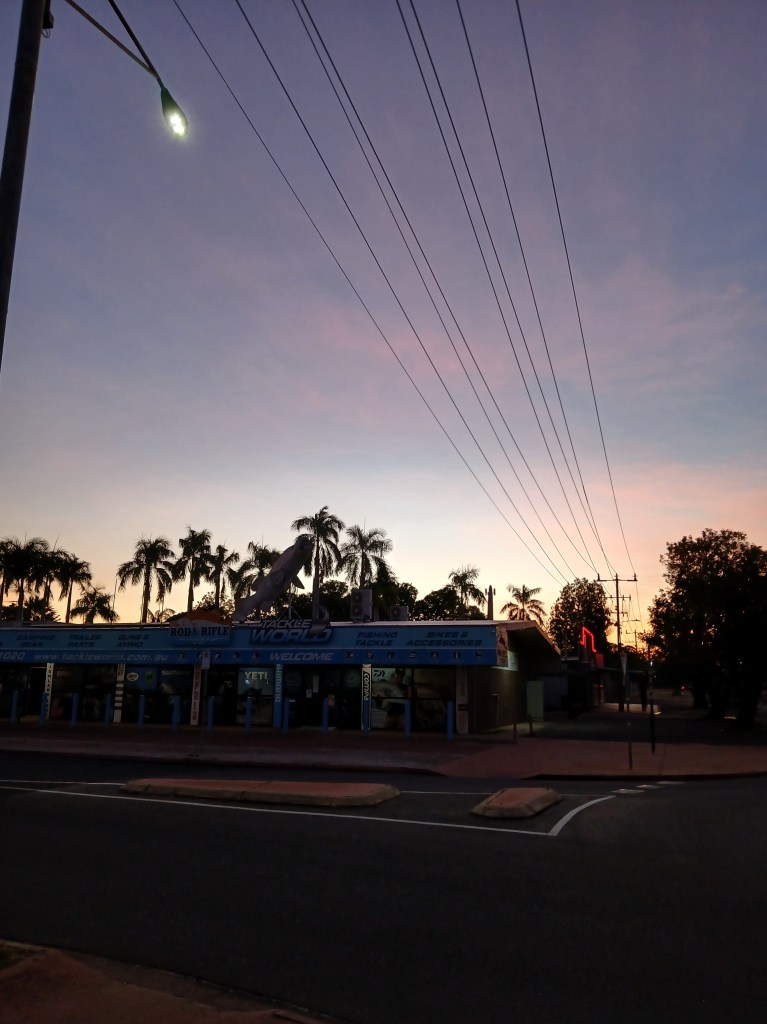
The twilight sky on the way back to the motel, painted subtle shades of pink and deep blue by the vanished sun, is filled with enormous fruit bats and colourful parakeets flocking to trees to roost. Being too ill to appreciate a warm evening in the outback like this seems to be thoroughly miserable luck.
Day 11
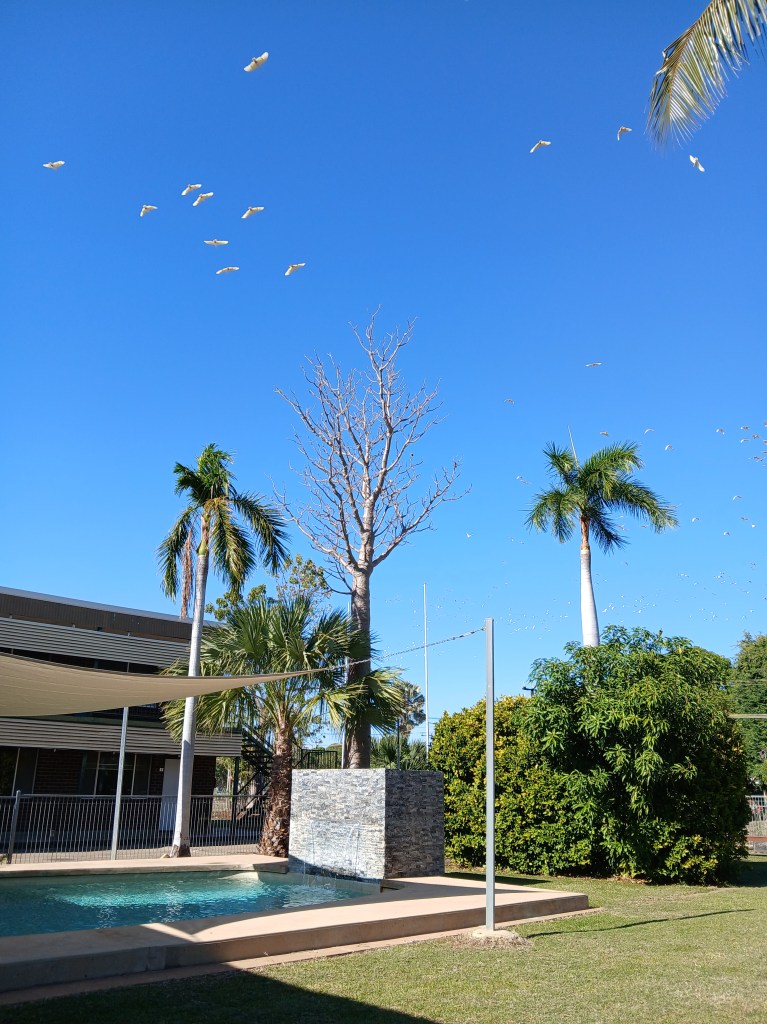
I’m not completely recovered, but still in a much better state than I was. I don’t need to anything strenuous for now, in any case. Just wait for the coach back to Darwin next to the hotel’s pool, under the canopy of a flock of white cockatoos against a blue sky. I can’t work out if they are genuinely flying in the direction of Nitmiluk, or if it’s just my jealous imagination.
After a surprising encounter with someone from Pwllheli at the youth hostel’s reception desk (I already knew that a lot of my fellow Cymry move to Australia, but at this rate there’ll be more of us in the southern hemisphere than in Gwynedd), I have a vegetable-filled dinner at an affordable Southeast Asian restaurant that I’d become familiar with down the street. I still need to chase away the rest the cold – there’s still some tribulations ahead.
Day 12
That flight somehow managed to be even worse than the last one.
Bali Airport’s passport scanners didn’t work again, but I needn’t have worried. Even with the queue, I still end up pacing the airport for ages, waiting for the flight, and anxiously trying to work out how much sleep I’ll be able to get when I arrive in KL’s airport in the small hours of the morning.
Day 13
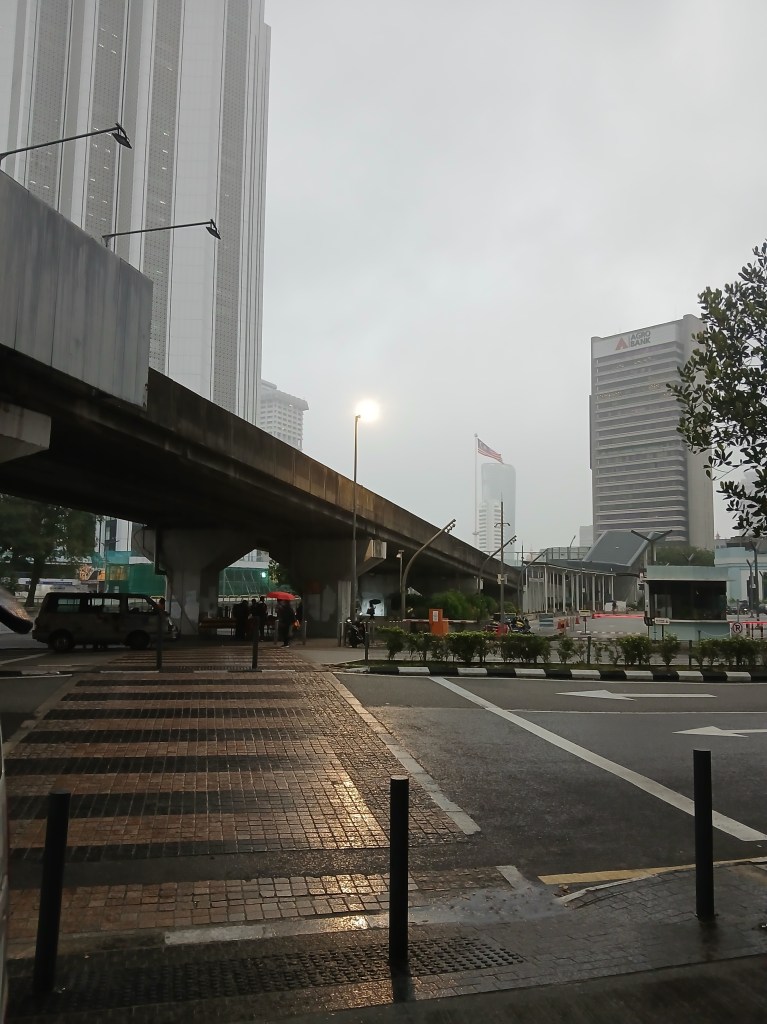
It’s a grey, rainy morning in Kuala Lumpur. I only slept for about two hours in a pod bed at the airport before it was time to catch a train into the city, but thankfully I don’t feel too groggy. And more importantly, I got here on time to register for the minibus to Taman Negara National Park. Still more waiting, though; trying to shelter under a hotel’s overhang as more and more foreign tourists turn up. Eventually, the rain stops, we all pack into our assigned minibuses, and set off for the Malaysia outside the capital city.
Sure, I could have got a minibus all the way to Taman Negara, but why would I do that when getting a minibus halfway then a boat along the river was an option? This is, without a doubt, a far better way of entering the jungle.
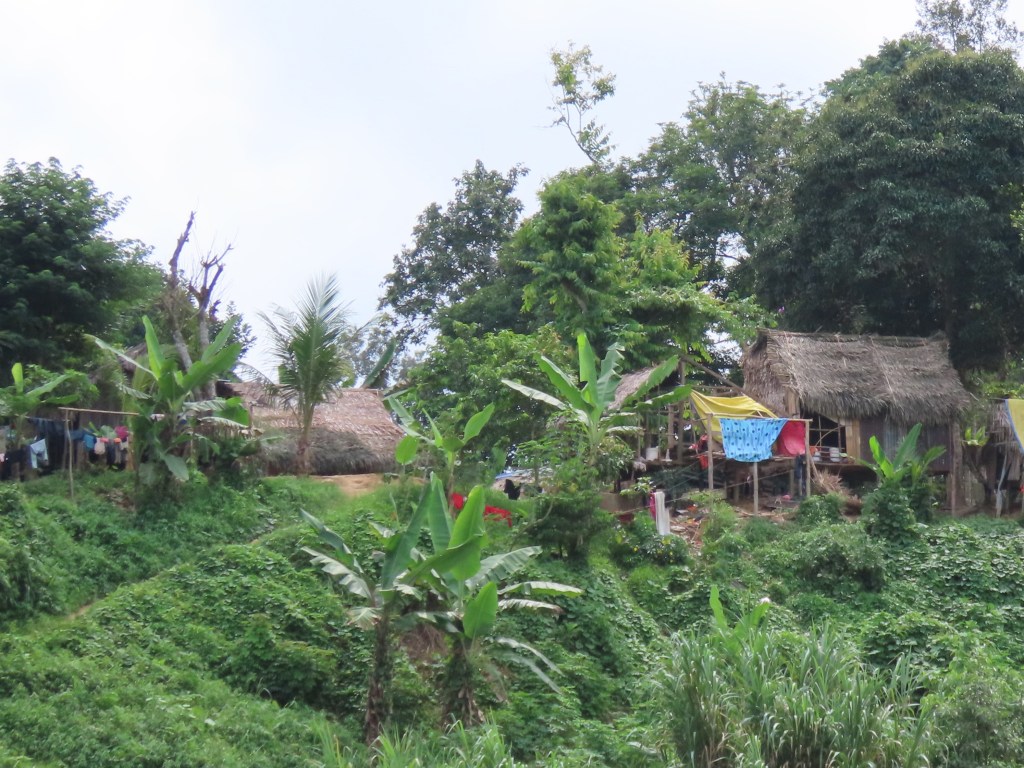
It is a more majestic way of being introduced to the Malaysian rainforest, as trees start to dominate the banks, but the young man next to me has four bags on him and a poor understanding of the personal space of others. And it was wishful thinking that I could get away with just two hours’ sleep. Even while being occasionally sprayed with water, on a boat weaving past hidden sandbanks in a jungle river, I’m still occasionally nodding off into semi-consciousness. I am awake enough, though, to notice thatched roofs, some covered in brightly-coloured blankets or towels, protruding out of the jungle. As we pass, I can see figures in the village watching the boat go by. These would be the Batek, the hunter-gatherer people native to this region.

Kuala Tahan, the gateway village to the national park, is not quite what I expected. Up the steep slope from the riverbank, there is a range of hotels, and, on the river itself, boats converted into restaurants. This is all as I thought what it would be, but what takes me by surprise, as I walk over a dirt track filled with tree roots to the hotel, is the realisation that the rest of Kuala Tahan is a not a glitzy tourist resort, but a standard, lived-in, somewhat ramshackle Malaysian village. It’s a nice breath of authenticity, but it’s what’s across the river that interests me.
Day 14
This jungle is thick with vegetation, heat, and noise, all of which seem thicker than in jungles I’ve been in before, especially the noise. It’s dominated by a single, continuous, buzzing note. It seems omnipresent, as much part of the jungle as the trees.
I had read a guide book that had repeatedly emphasised how unlikely it is to see wildlife in Taman Negara. I still think that it was being overly pessimistic, but it does seem to be right about large animals, at least. I’ve been quietly waiting in this observation tower for a while now, but both the salt-lick clearing in front of me and the surrounding forest are completely still. I can, however, hear what sounds like a tour group approaching. No point to wasting my ability to be quiet here any more.

Most of the hiking trails are boardwalks than run throughout the jungle. A lot of them are in seriously bad condition, as I discover when a broken plank nearly tips me headlong into the undergrowth. They’re not the only sign of decay, either, as I pass a dilapidated building, its corrugated iron roof fallen in and its original purpose unrecognisable. I think I can see some kind of rusted machinery inside.
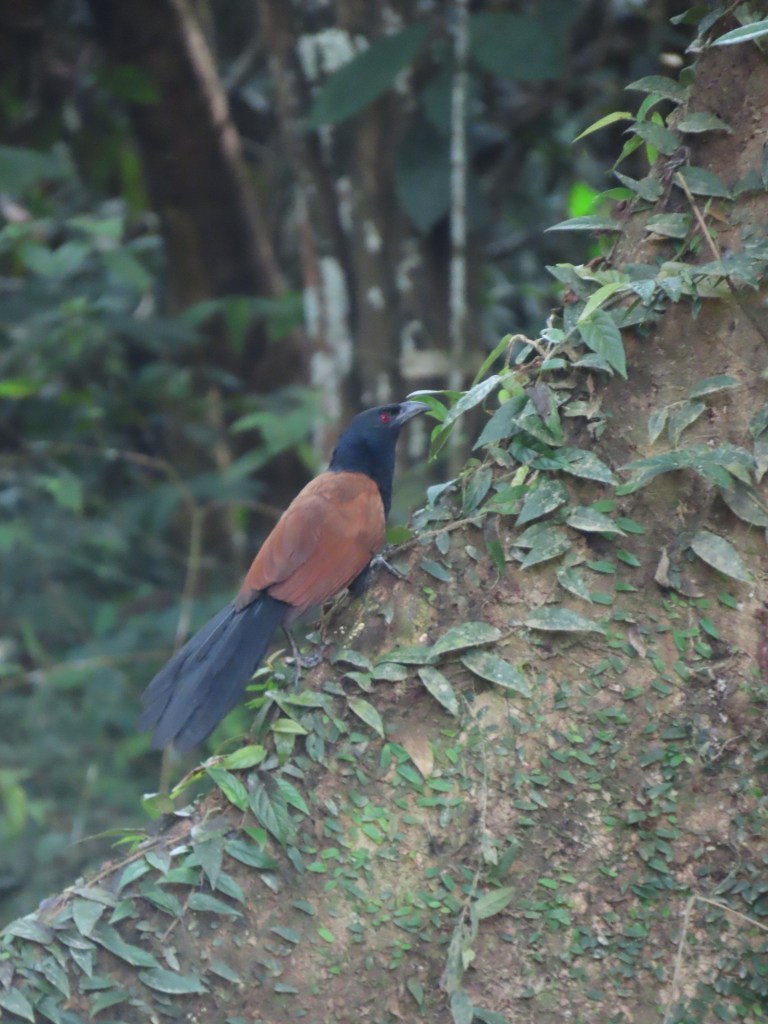
I was right about the claims of Taman Negara’s lack of visible wildlife being an exaggeration. Rustling branches and flashes of fluffy tails betray the presence of squirrels, and birds flit half-seen between branches. At one point a coppery-bronze lizard saunters on the boardwalk in front of me, before turning to fix me with a glare, as if appalled that I have the temerity to trespass in their jungle.


The hotel breakfast had been a buffet, and I had time to get back to Kuala Tahan for a proper lunch. I’ve been fully fuelled all day – a much better state than I’m used to when in the wilderness, or even semi-wilderness. So why do I end up going back to the hotel in the afternoon and falling asleep for three hours? Maybe I was being too optimistic, hoping that I could recover so quickly from illness and lack of sleep.
Day 15
Maybe it was the long nap, or maybe I’ve just finally adjusted to the tropical climate, but today I am in far better form. Plus, with the trails less busy, I get to have a riverside beach all to myself.
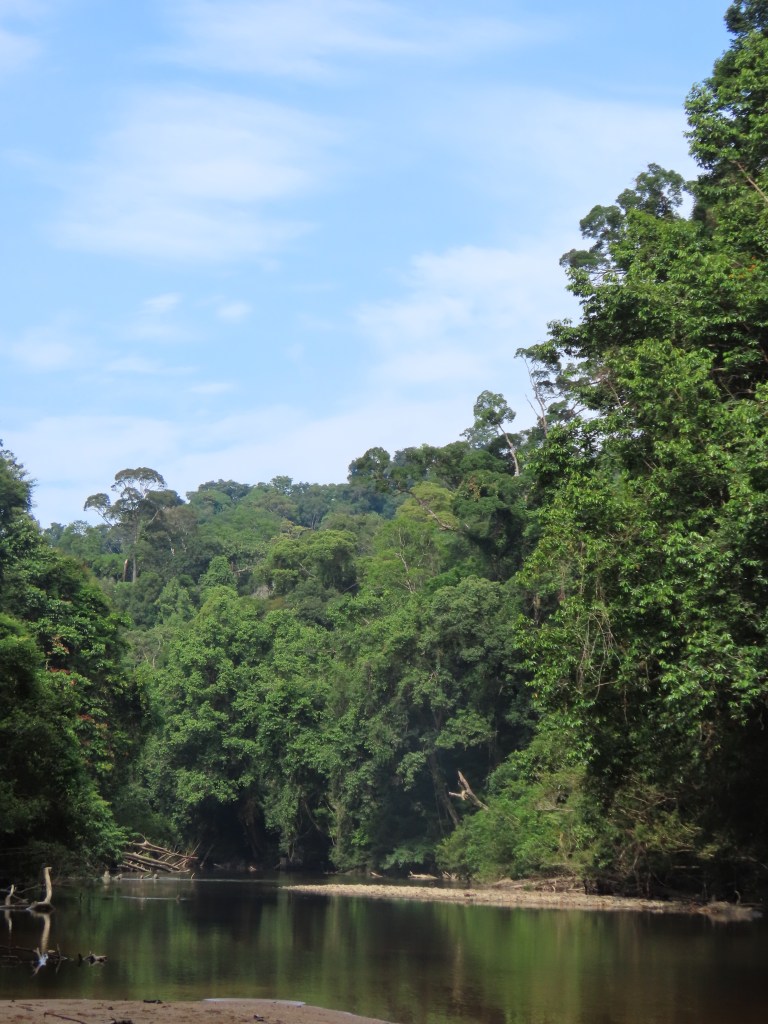
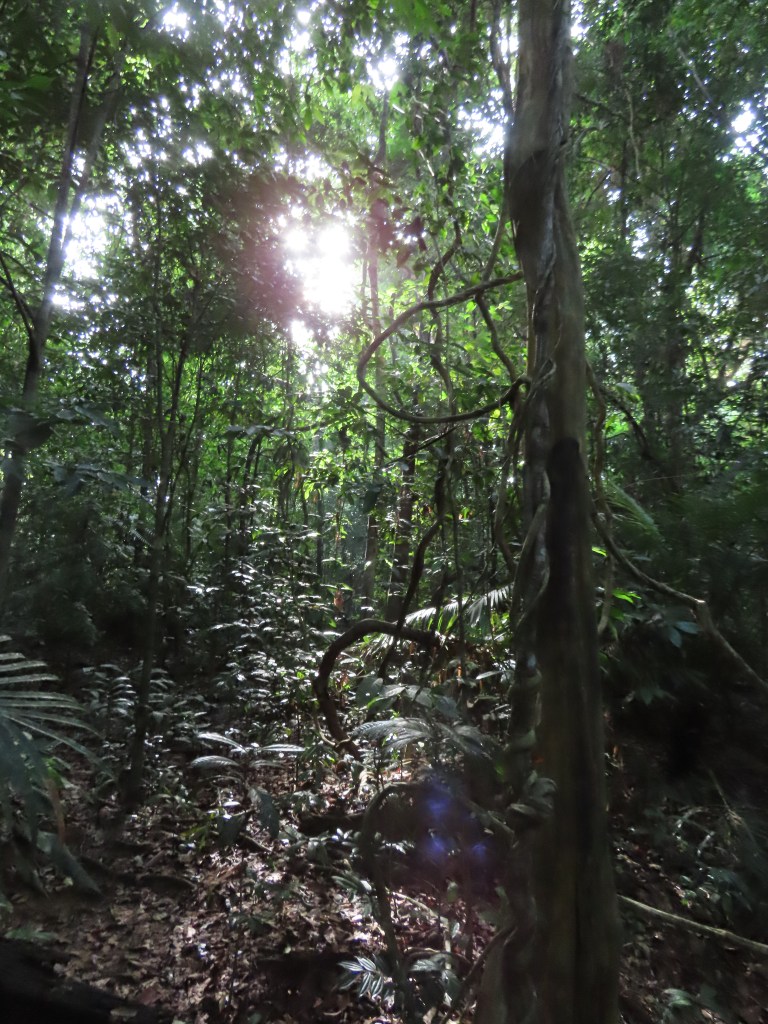
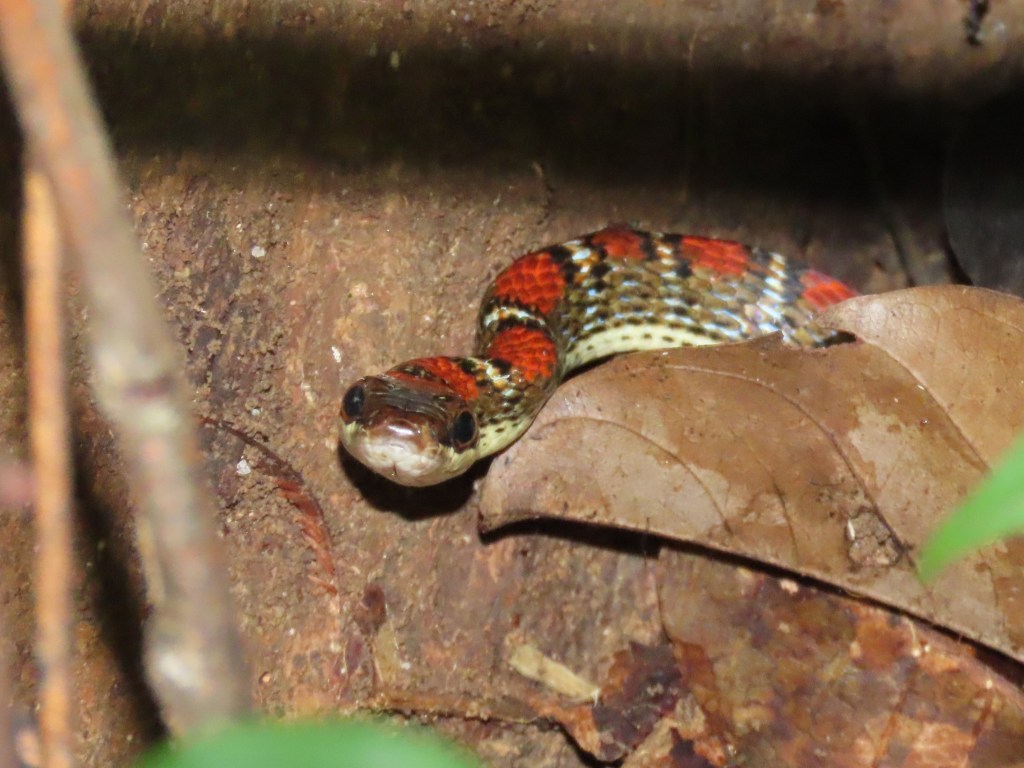
This time I stride along the jungle boardwalks at a decent clip, including over a section which was severely battered by a falling tree, leaving it warped and broken. Heading away from the river, the trail heads up a slope. I know that I’m ascending a hill, but there are no views, no vista. All I can see is the endless greenery of the trees and the undergrowth. I eventually lose hope of this view ever changing, and turn back. On a set of stairs on the way down, something finally catches my eye: a colourful, scaly tail, slithering out of sight into a tree. I cautiously peer into the hollow of the tree, to see the beady-eyed face of a gliding snake staring back at me. Just slithering for now, but snakes like this one are capable of flattening their bodies and launching themselves into space to glide from tree to tree.
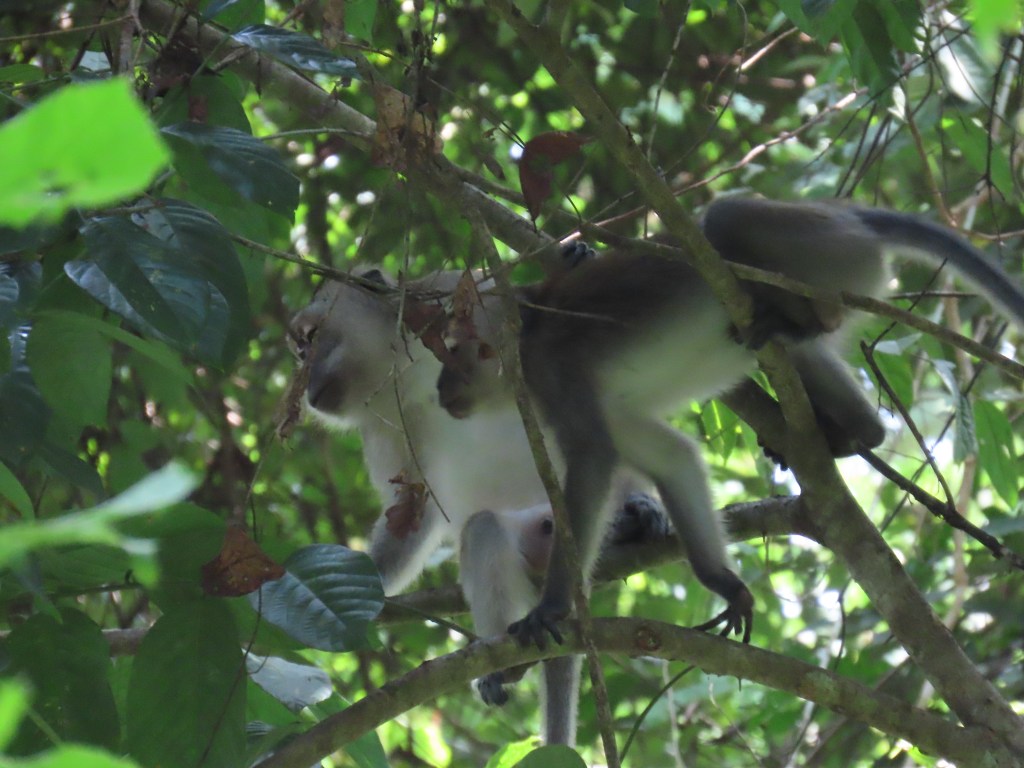
As I near the national park centre, I see some European tourists peering excitedly up into the trees. Following their gaze, I realise that they’re looking at a troop of monkeys scampering in the branches. I understand why the tourists are so excited – Taman Negara’s paucity of large animals sightings makes these monkeys the biggest animals I’ve seen here. It is quite nice to share excitement like this. I see a group of Malays coming down the path, and point the monkeys out to them. The man at the head of the group glances up, and says, ‘Oh. Monkeys,’ dismissively. It occurs to me that monkeys are less impressive to people from Southeast Asia. I can practically hear the man thinking, “These white folks sure love monkeys,” as he walks past.
Day 16
Getting into a boat is always a bit of uneasy experience, given how it sways as you step into it. But the boat trip promises to be much more comfortable this time, as I’ve slept much better and have the whole seat to myself. I’m going to need every bit of comfort I can get. First it’s the boat, then the minibus to KL, then the monorail to the city centre, then the train to the airport, then a plane to Istanbul, then another plane (no hotel to sleep in this time) to the UK, then another train home.
It’s going to be a long, long journey home.

 Wandering/Wondering