Day 1
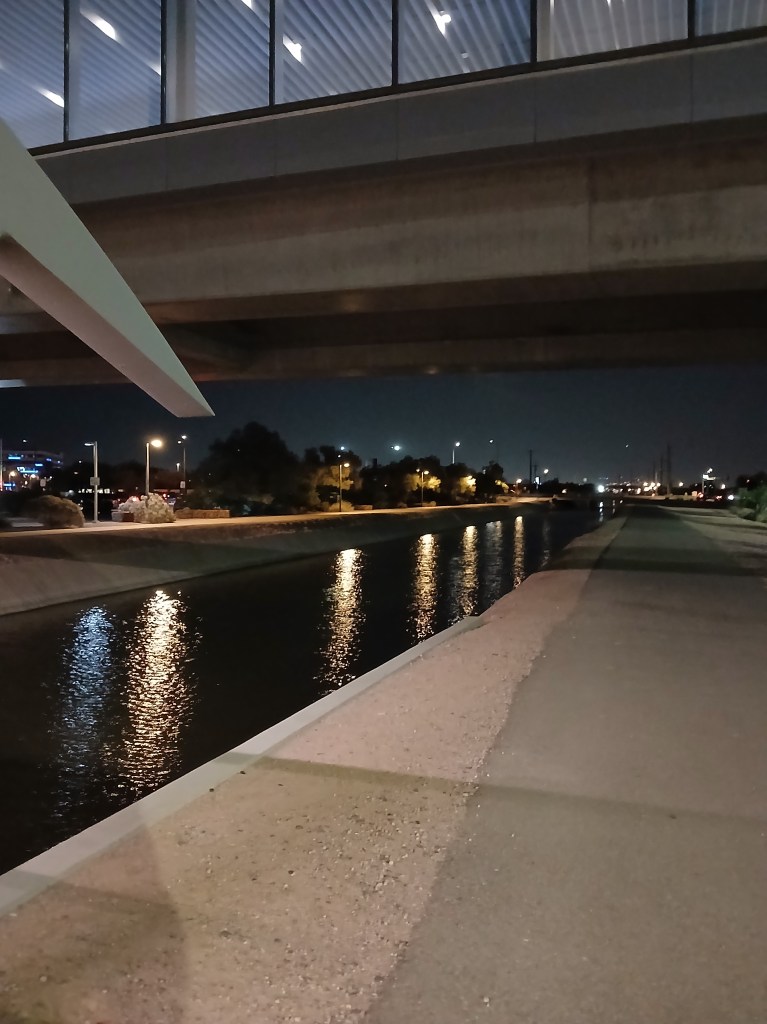
I had hoped that I would be finding my hotel in Phoenix by the light of a desert sunset, but no, night has fallen by the time I leave the airport. It makes the city all the more confusing and intimidating. I stop briefly to take stock, and note that there are almost no buildings this side of the airport, and somehow, the sky seems more massive here. Thankfully, one of the few buildings is my hotel, with its name in big letters lit up on its roof. But between me and it, there’s a road. Not an ordinary city road in a busy, bustling street; there are no other pedestrians, and the few streetlights are pitiful against the vast darkness of the desert night. I can barely see anything beyond the hotel’s sign, the road, and endless streams of cars on its six lanes. But there is a pedestrian crossing, and I focus on its lit-up stick figure as the only indication that I can cross this seething river of vehicles. But as it turns green, it still feels like I’m not supposed to be doing this. I don’t even feel like I’m supposed to be in this city; that it was not designed for living beings, and I’m just a mouse that’s fallen into machinery. The tarmac, illuminated by the headlights, has become a vast plain that I try to hurry across, weighed down by my bag. Apparently, the American right of way means that a red light doesn’t stop cars from turning onto a lane, and I reach the other side with the sense that I’ve just done something genuinely dangerous.
Day 2
Functioning wi-fi would have made my stay at the hotel a more fitting reward for potentially risking my life, but the important thing this morning is that I get to leave this strange place. By the light of day, it’s still clearly inhospitable to anyone without wheels, but at least I have some now, courtesy of the Greyhound bus that I’m on. Phoenix seems more motorway than city, and the occasional cactus, which I’ve never seen in their true habitat before, just adds to the sense of the unreal. I look in a kind of baffled wonder at two sand-coloured flyovers criss-crossing the blue sky above a pair of impossibly-tall palm trees.
The endless parade of billboards advertising lawyers continues into the outskirts, where the widely-spaced buildings eventually give way to just the wide spaces. Cactuses and dust are steadily replaced by long grass and shrubs as we climb into the hills. This, I decide, is true Western country. This is the place to roam with a saddled horse, a trusty six-shooter, a hat, and an immense sense of freedom. I try to imagine where on the hills bandits would position on themselves during a gunfight.
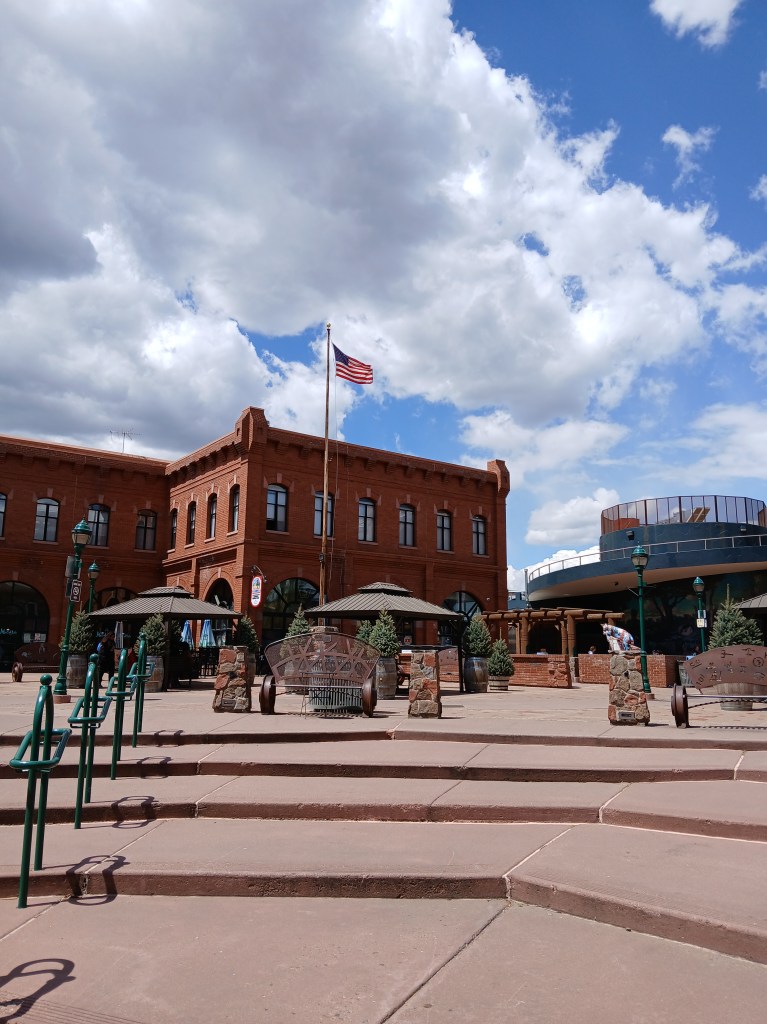
To my profound relief, Flagstaff is not the tarmac-and-desert wasteland that Phoenix was, but a place built for people. Half-hidden in a vast forest of ponderosa pines, it feels more like a town than the small city that it actually is. No city centre of high-rise glass and steel here, instead a town centre of blocky brick buildings against a mountain vista background, that somehow manages to simultaneously invoke images of cowboys and gunslingers, of 1950s diners and police chases, and of the American mountain wilderness, all tamed with cafés and restaurants and the occasional fresh coat of crimson paint. All expected, I suppose, from a semi-preserved 19th century city on what was once Route 66. Which is a very famous road. I am not clear on why it’s famous, even after looking it up, but I am assured that it is indeed very famous. More importantly, this city is somewhere with a sufficiently American soul that, for once, I can have a burger guilt-free, secure in the knowledge that this time, it’s an authentic part of the local cuisine. As I wander away from the restaurant, there’s a man playing a banjo on the town square.
Having wasted some more time at one of the hipstery cafes that Flagstaff’s large student population provides the city, then having finally checked into my motel (A motel! Like I’m on the run in a movie!), I go out to appreciate Flagstaff’s surroundings while there’s still light. There’s a quiet road that rises up from the streets to wind through the forest on a hill that overlooks the city.
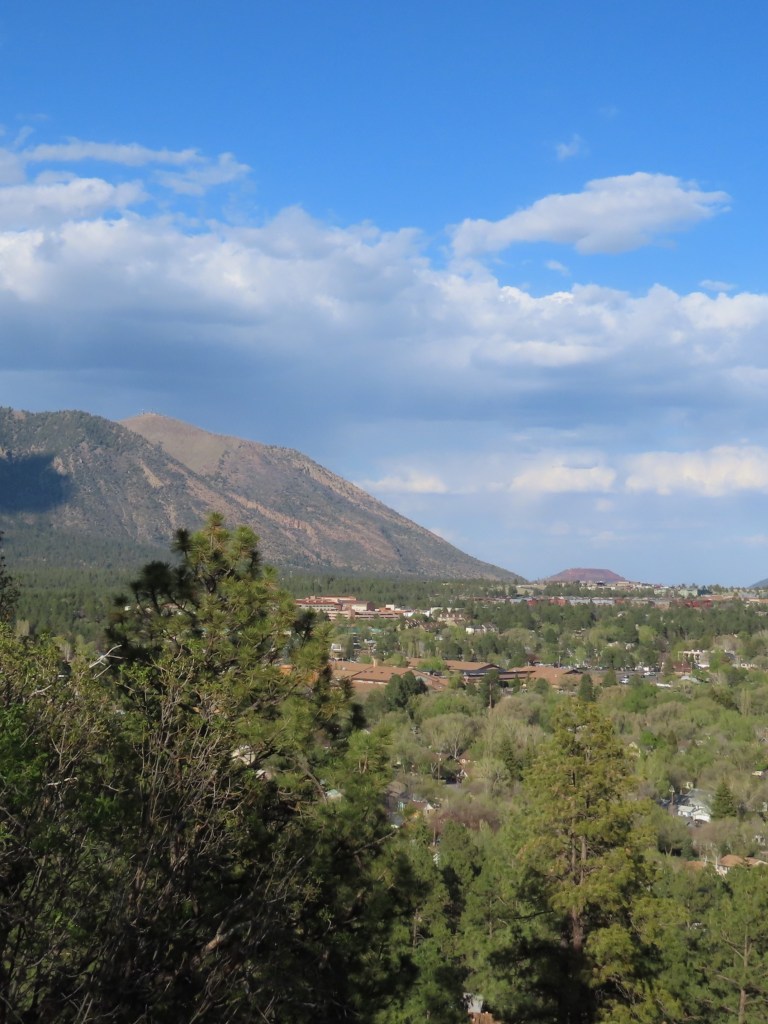
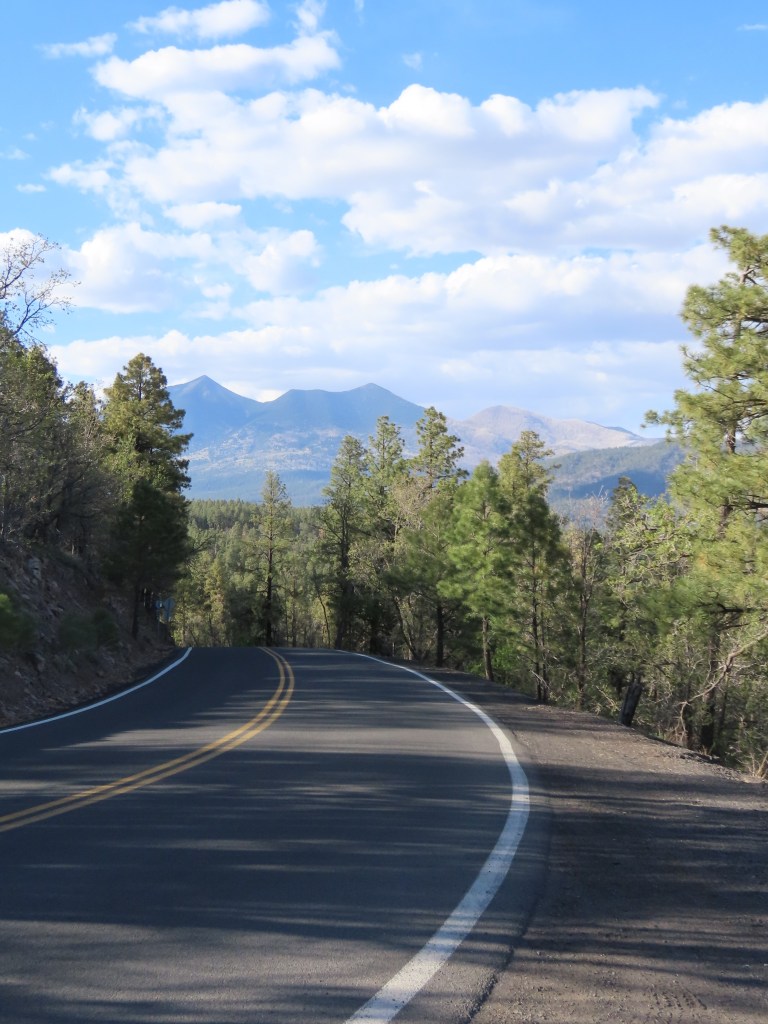
The houses I pass on the way are mostly charming wooden bungalows, equipped with porches and the occasional big American flag. They’re soon replaced by trees, trees, and more trees, lining a curving road. I follow it up the slope until I reach a bend in road from where I can see Flagstaff. More accurately, what I can see is more forest, climbing the mountains to the left of me and stretching to the horizon on the right. And in the middle, a city reduced to a village of semi-visible blocks by the tree cover.
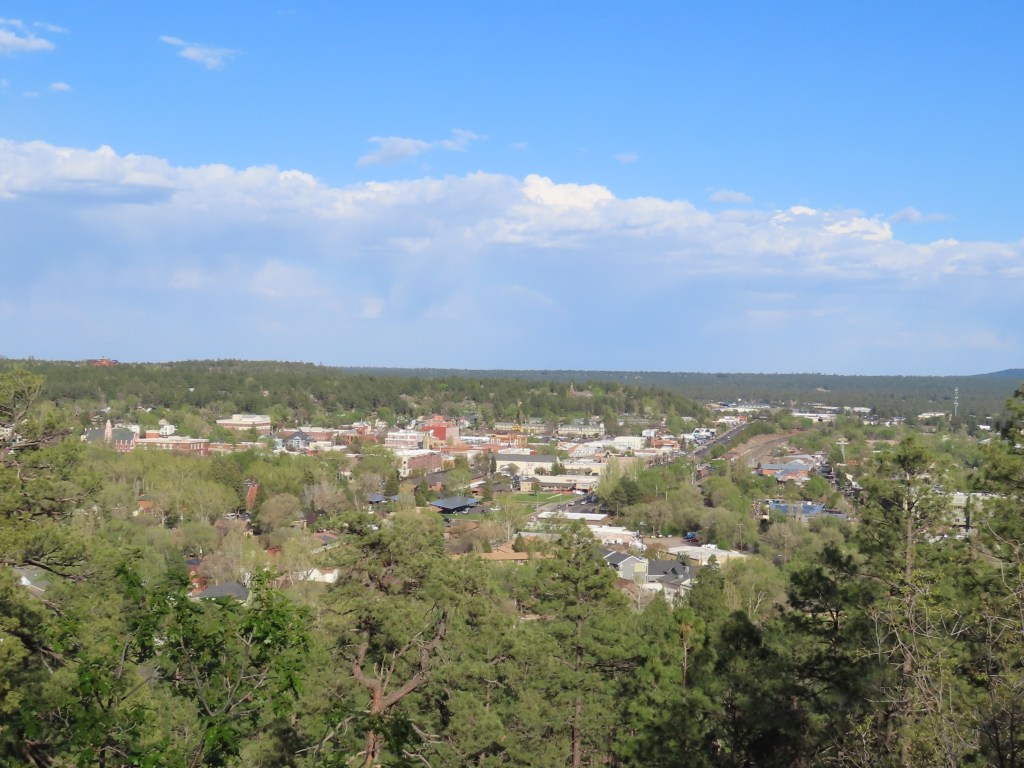
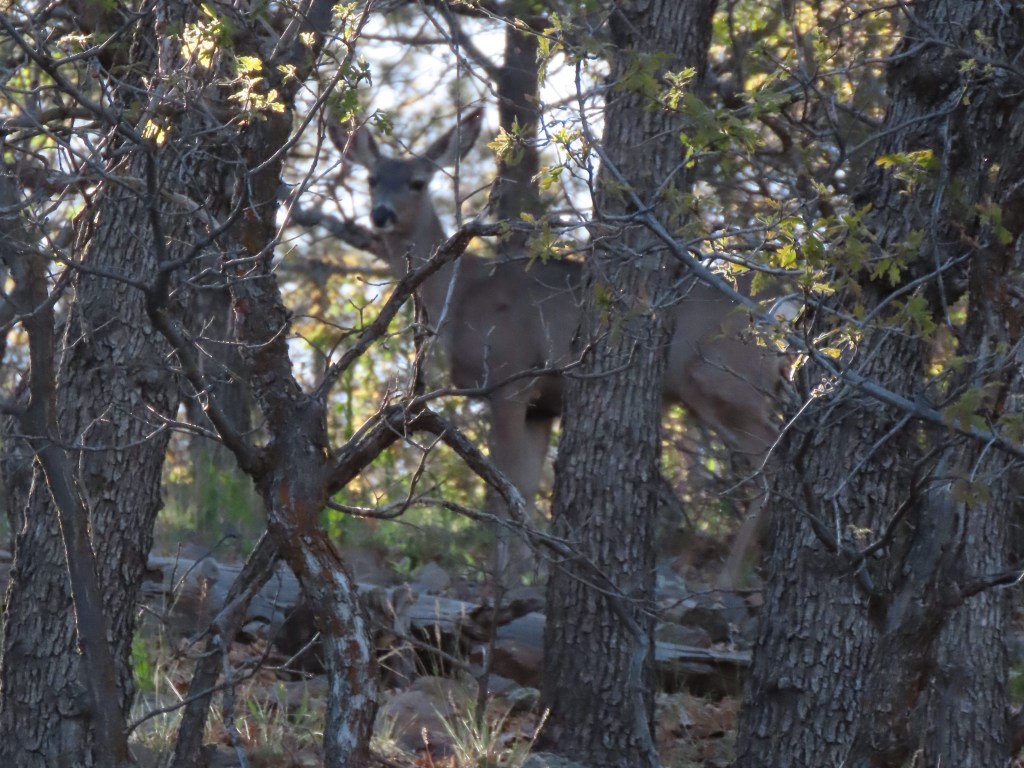
There are a few people around on this stretch of road, and a house I can half-see in the pines, but from behind the branches there’s also a deer gazing at me, as if to emphasise how tenuous civilization’s grip on this place is.
Day 3
First there was Flagstaff’s broad streets and its big cars, and then there was the tame, tree-lined trails with its incredibly fit-looking joggers on the outskirts, and now there’s forest with just me and the wildlife. Grey grasshoppers or locusts leap out of my path with every step. Everything about this place is unfamiliar. The widely-spaced trees are ponderosa pines, the bare earth of the trails is reddish-orange, and the grass is pale grey. I’ve never seen a forest like this before. So many people in the UK, saturated with American media, insist that the UK and the US are practically the same country. How could they explain this, the closest experience I’ve had to visiting another planet?

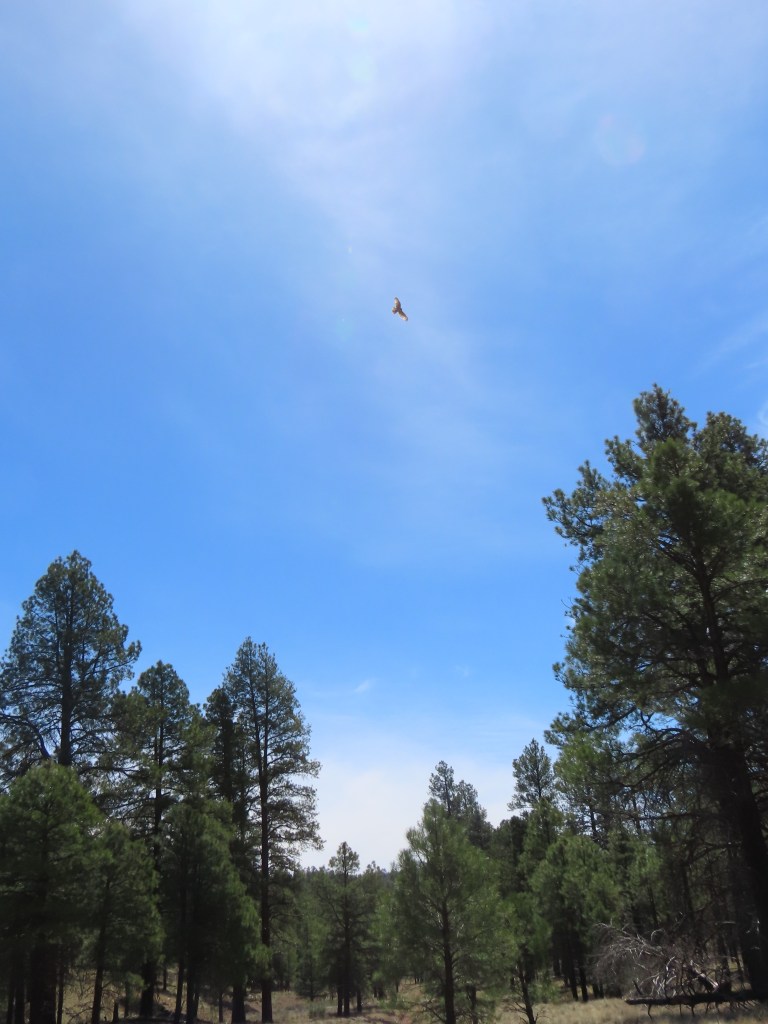
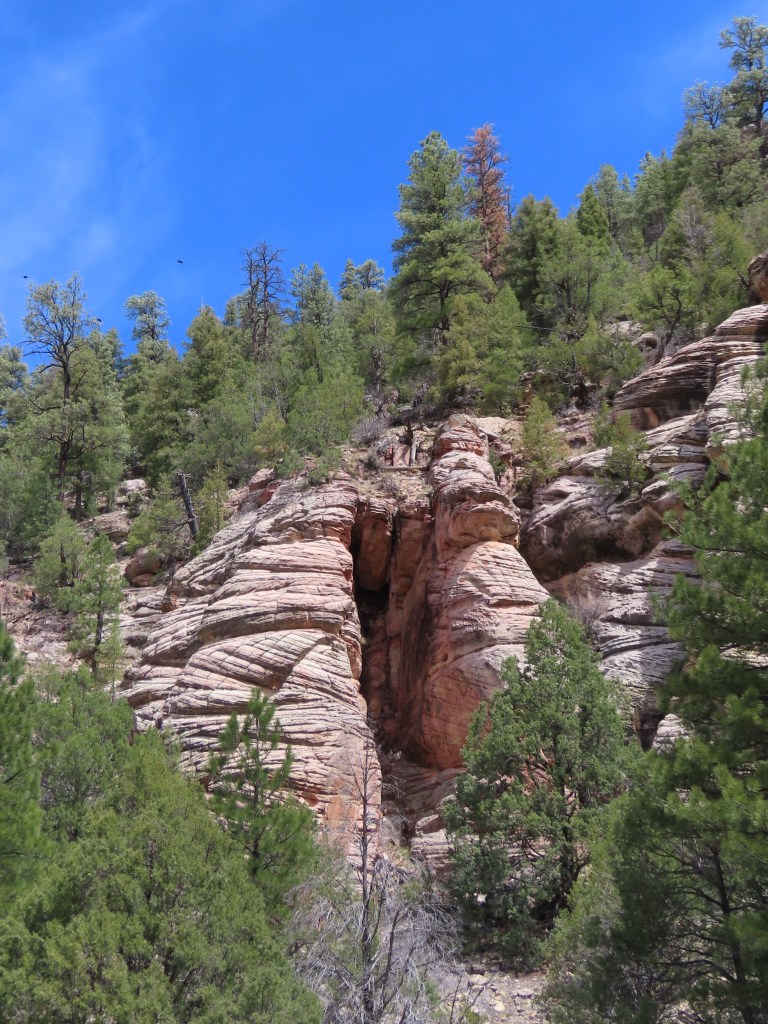
I think I can see a change in the landscape ahead. The trail was gently undulating over hills before, but now I can see the forest rising sharply above the pines in front of me. I emerge in another clearing of the silvery grass, and the path splits in two. To the right, a sign promises a lake, but to the left, to my surprise, is what was raising the forest up. Dramatic sand-coloured cliffs rise out of the ground to form a huge canyon.
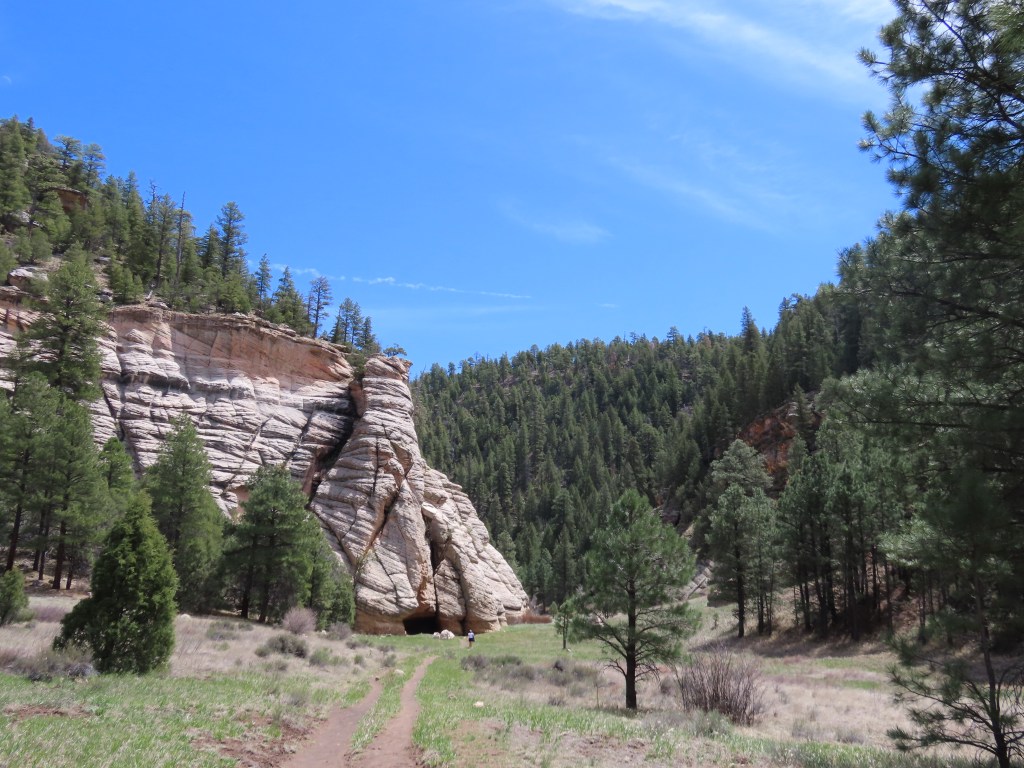
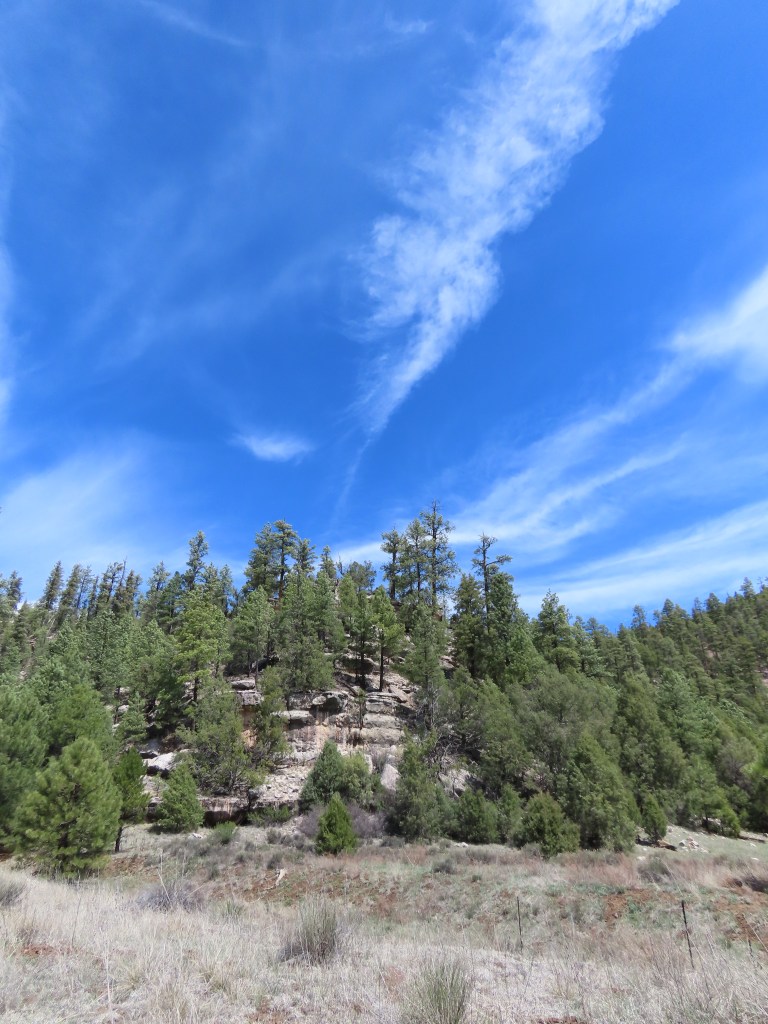
There are other hikers around now; I must have stumbled on a more popular trail. After waiting until the pair of young women ahead of me move on (I’m in the middle of nowhere – in my view, that means I’m allowed to be unsociable), I find an information board at the canyon entrance, welcoming me to Walnut Canyon. I’ve heard of this place, but I hadn’t realised that it was within walking distance of Flagstaff. The path through it is narrow, and even more hemmed-in by dense undergrowth. Then the path splits off to the side towards, if my eyes do not deceive me, a cave. A proper cave out in the wilderness! I’ve explored caves that were the results of mining attempts, and a natural cave that was converted into a huge temple filled with tourists, but this is the first proper one I’ve come across in the wild, so to speak. This one has clearly been visited by generations of hikers, given the graffiti on the walls, but as I edge closer to an opening to a larger chamber whose darkness is indifferent to the feeble light from my phone’s torch, I hesitate and remember that there are bears in this region. Also, if there’s any country where you’re likely of finding a crazed conspiracy theorist hiding in a cave with a stockpile of guns, it’s America.
This forest is criss-crossed with hiking trails, and whenever the path split I had been careful to take pictures of the direction I had come from so I could find my way back. Coming from a different direction, the path doesn’t quite look as I remember it, but I thought I recognised enough of it to assuage any worries. Those worries resurface as I climb a slope. I don’t remember one this steep earlier. I look around, and I’m confronted with a view, above the treetops, of an endless carpet of green stretching to the horizon. This, I definitely don’t remember. Despite how careful I was, I’ve gone the wrong way. But with the number of trails around here, I can hopefully rejoin the one back to Flagstaff quite easily.
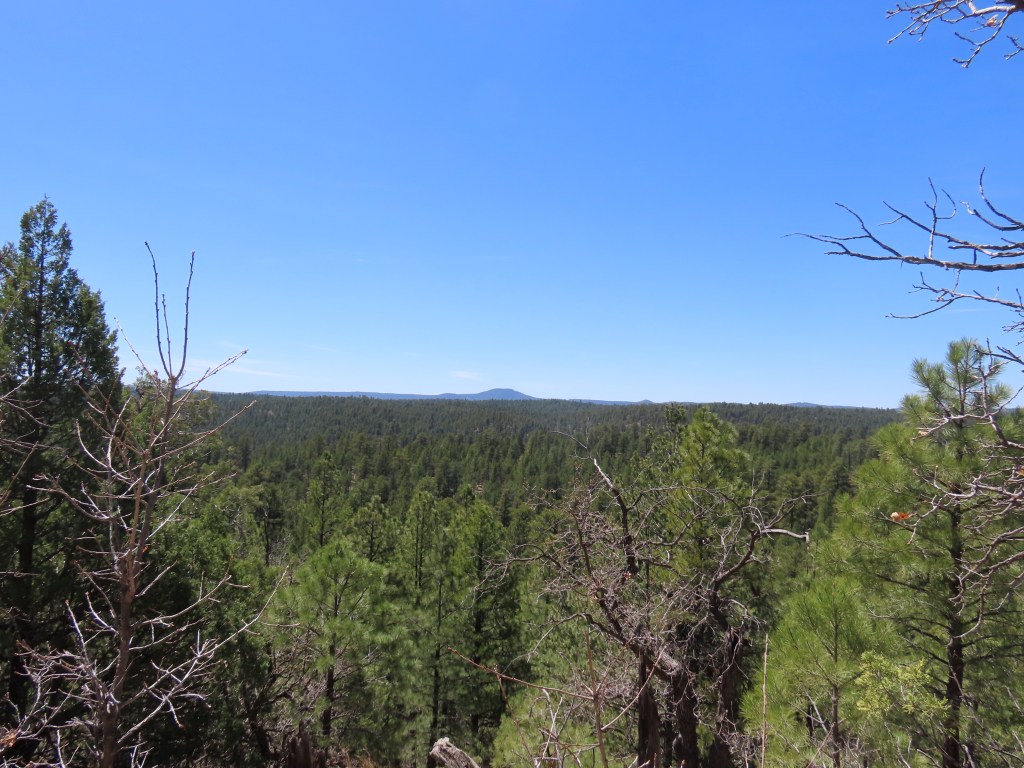
There’s a fence stretching through this patch of forest. That’s definitely unfamiliar. There’s also a sign, but as with the others on the trails, it’s too vague to be useful. It announces that the path leads to Walnut Canyon, but even if it’s accurate (which, even with my battered sense of direction, I don’t think it is), without being clear if it’s a direct route or which end of the canyon it leads to, it’s not much help. But my phone does have signal here, and I think the situation warrants some substantial data expenses. I check the map app, and while it mostly just shows my location as being adrift in a sea of green, I can see that I’m still quite a way off the trail back to town.
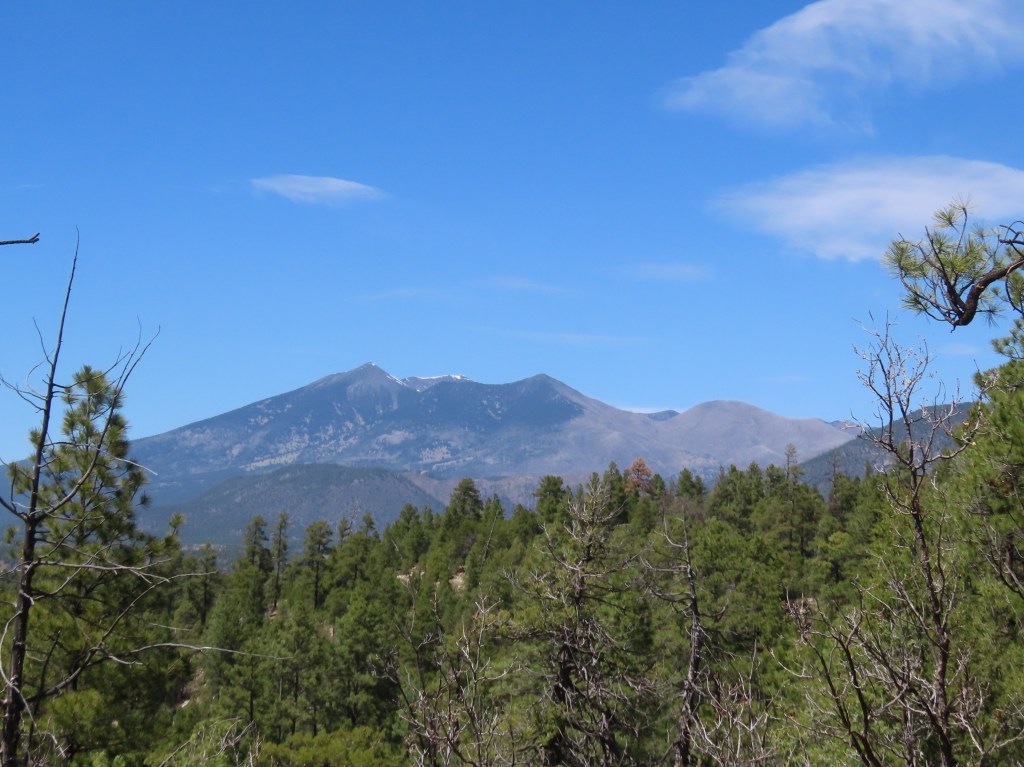
I’ve at least reached a point where I can see the mountains, and my compass confirms that they’re part of the range that I could see from Flagstaff. I now know in which direction I need to go, I just need to find a trail that leads there.
The path has all but disappeared among the rocks at the edge of the plateau I’m on, but before me, I can see the familiar cliffs of Walnut Canyon. I’m hit by a combination of relief that I’m no longer lost, and exasperated dread that I’m back where I started about two hours ago.
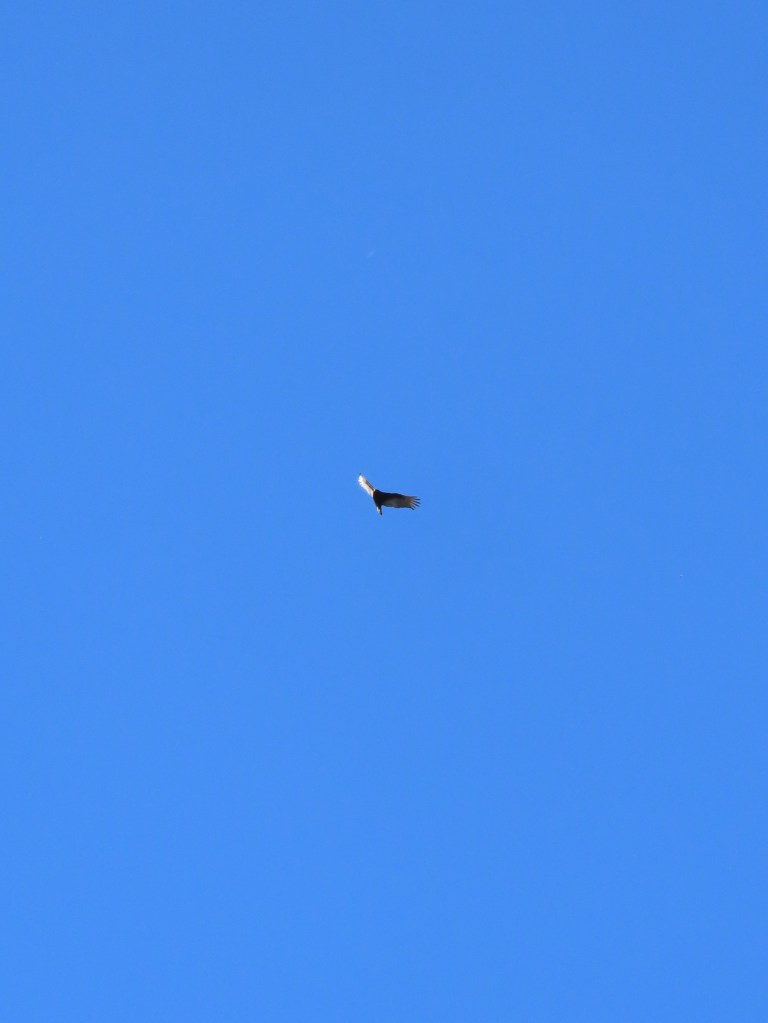
I had brought enough water for the hike, but not enough for the extra time I spent lost. I try to coax the last few drops out of my canteen, to at least wet my mouth. The occasional gust of wind cools me down, but also blows my hat off, pulling its strap around my neck. I wonder if the wind somehow making me more dehydrated. Then it occurs to me that, beneath the blazing sun, the large birds that I sometimes see overhead are vultures.
My mouth is now completely dry and I can barely even swallow. I realise that I’m starting to experience the same kind of thirst that tormented the explorers whose accounts I’ve read. There are signs of logging in this part of the forest, so I am getting closer to the city, but as well as the thirst and general exhaustion, the hours I’ve spent on my feet mean that each step is painful. I try to remember how close this part of the trail is to Flagstaff, convincing myself that I’m almost there, but each time I crest a hill, I find yet another slope that I need to drag myself up.
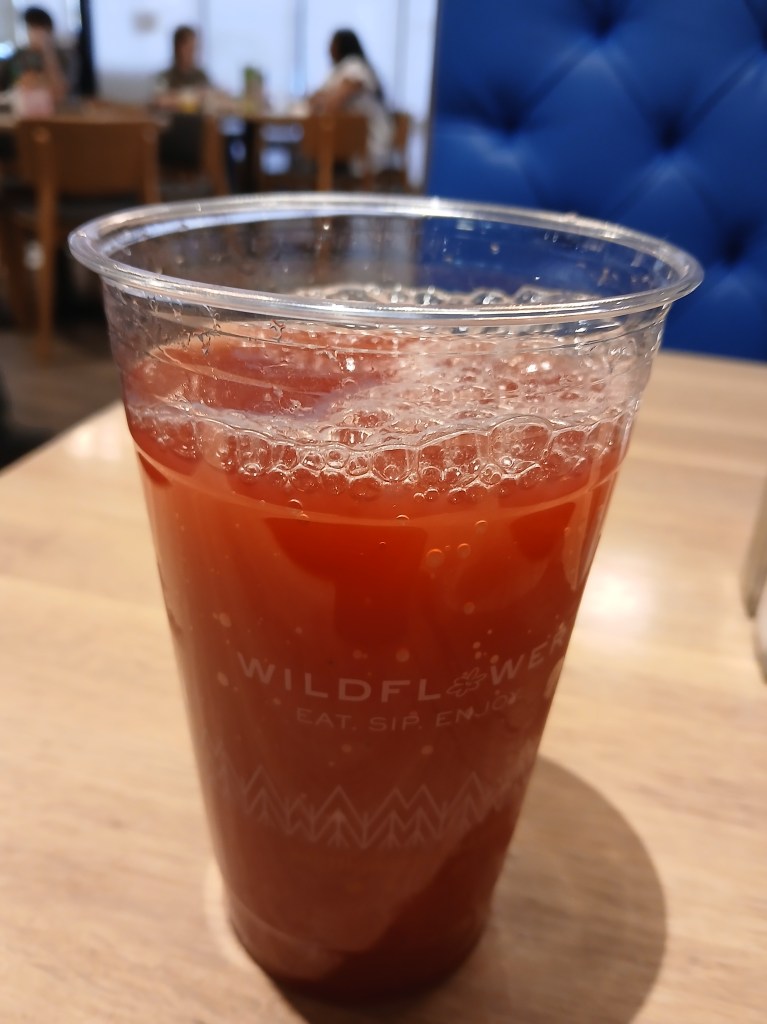
This place is somewhere where you can buy a big plastic cup, fill it with cold lemonade from a big glass dispenser, then go sit down. Right now, there is nothing that could fulfil my needs more. The food is nothing I would particularly seek out, but it’s relatively healthy, and I need to give myself one last burst of energy to stagger back to my motel.
Day 4
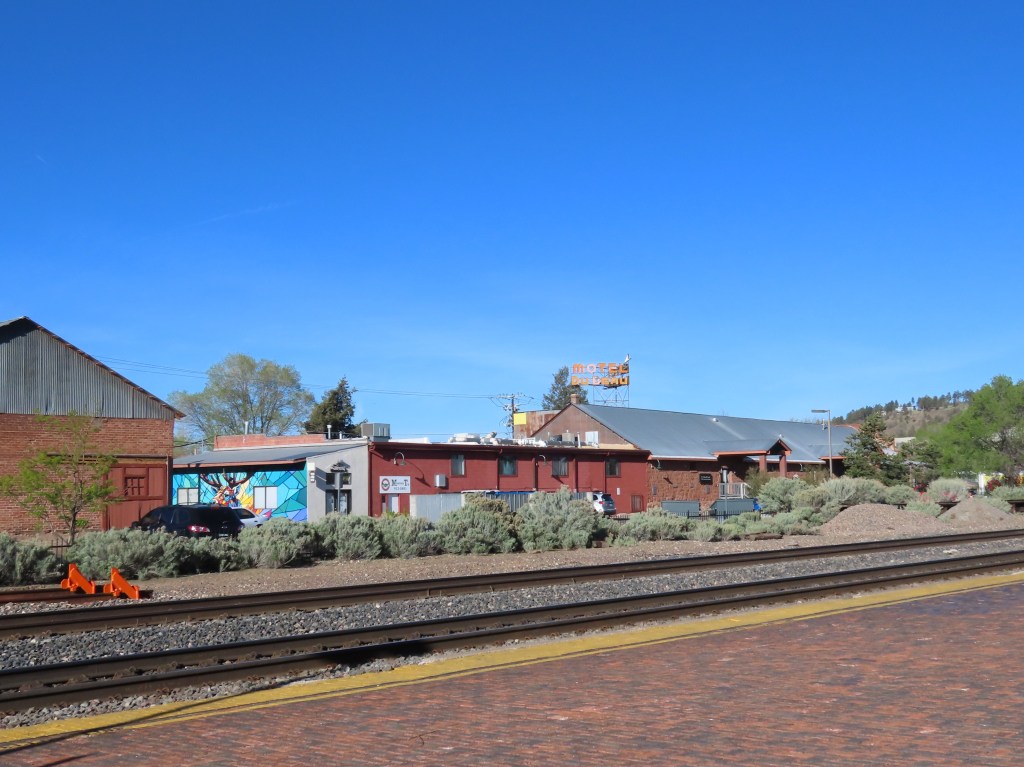
The morning in the American West is under an enormous blue sky, and I’m waiting outside a red-brick train station. I am dreading this a little bit, as I haven’t recovered from yesterday, but I suppose I’ll just have to take it easy. An elderly man with a pleasant voice asks me if I’m waiting for the shuttle bus, and I politely say, ‘Yes. Shouldn’t be too long now,’ in a carefully-calibrated combination of friendliness and brevity that makes it clear that I’m not interested in conversation without giving offence. It seems to work. Looks I’ve developed an important skill.
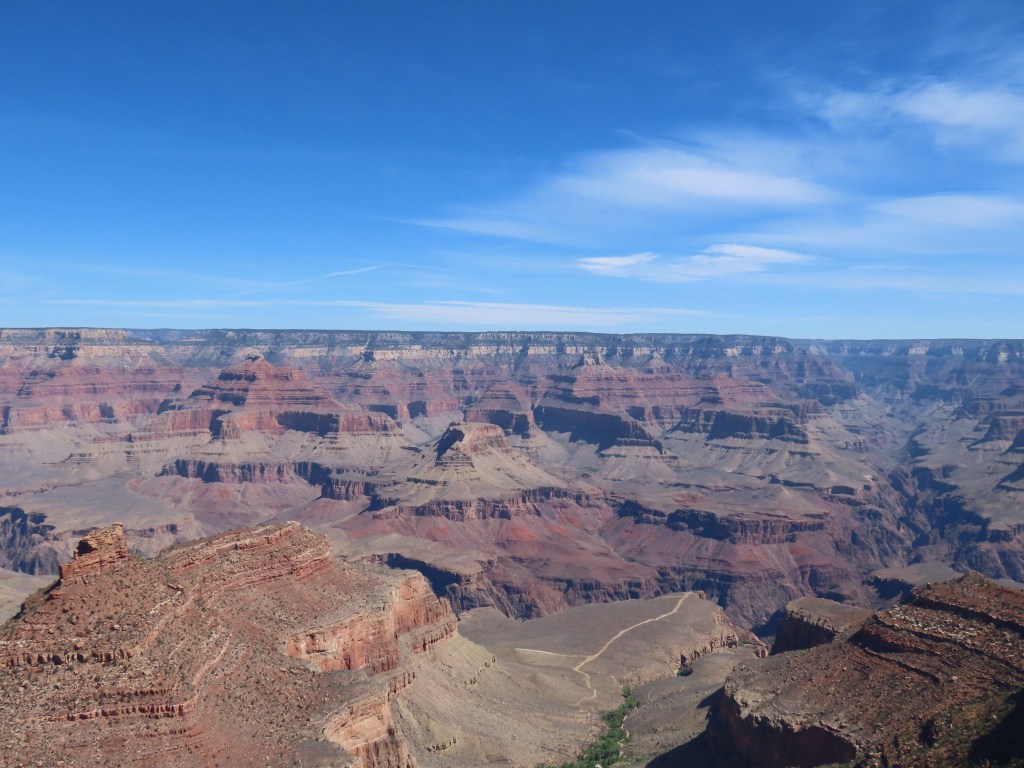
It’s the Grand Canyon. I’ve seen the pictures, I know what to expect. But still, there is no way to be prepared for the first time you approach the rim and it sweeps into your vision. The scale is impossible is fully comprehend. The opposite rim is so far away that it’s behind a blue haze, and below that, there are cliffs upon cliffs upon cliffs, each the height of Walnut Canyon’s towering walls or higher. I have to stare at them for a while before my mind can start to compute how deep the canyon is, never mind how broad it is.
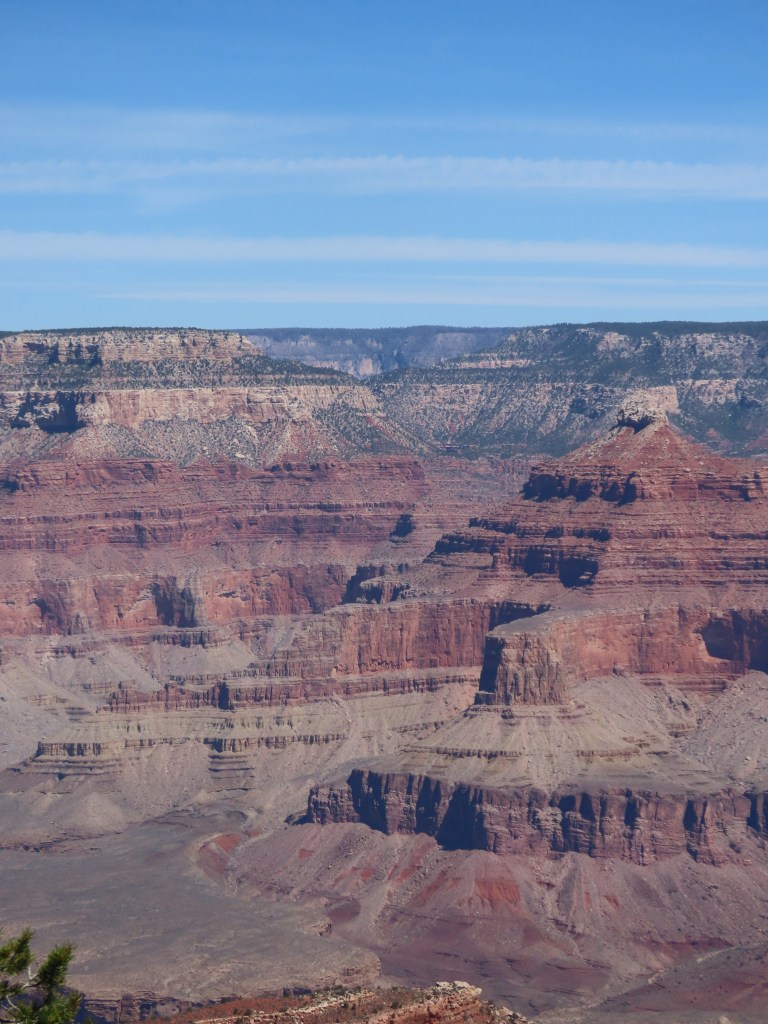
It might be a cliché, but it really is unmatched for sheer otherworldliness. There’s some vegetation on the cliff below me, but beyond that, there’s just endless expanse of bare rock does seem well and truly Martian.
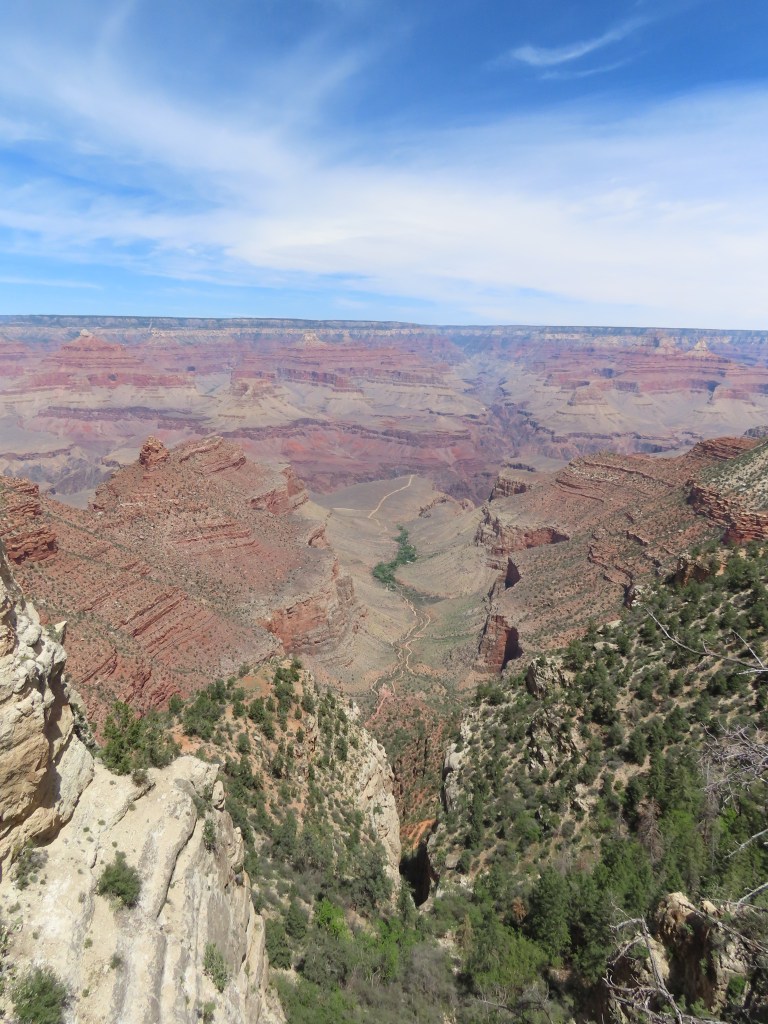
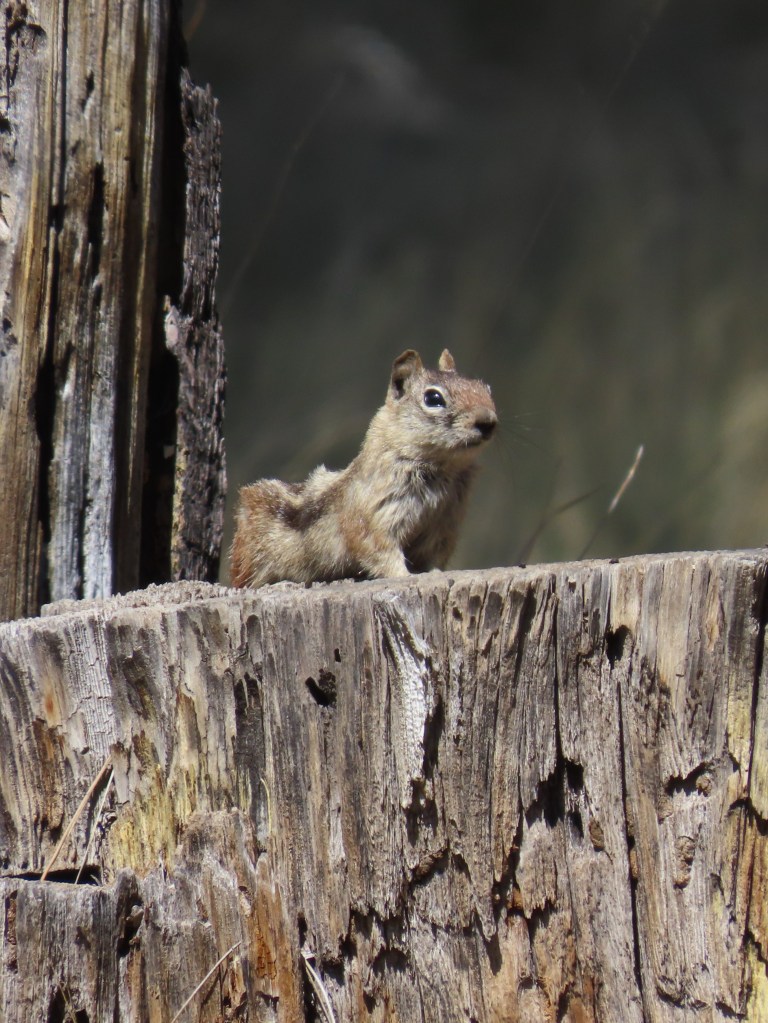
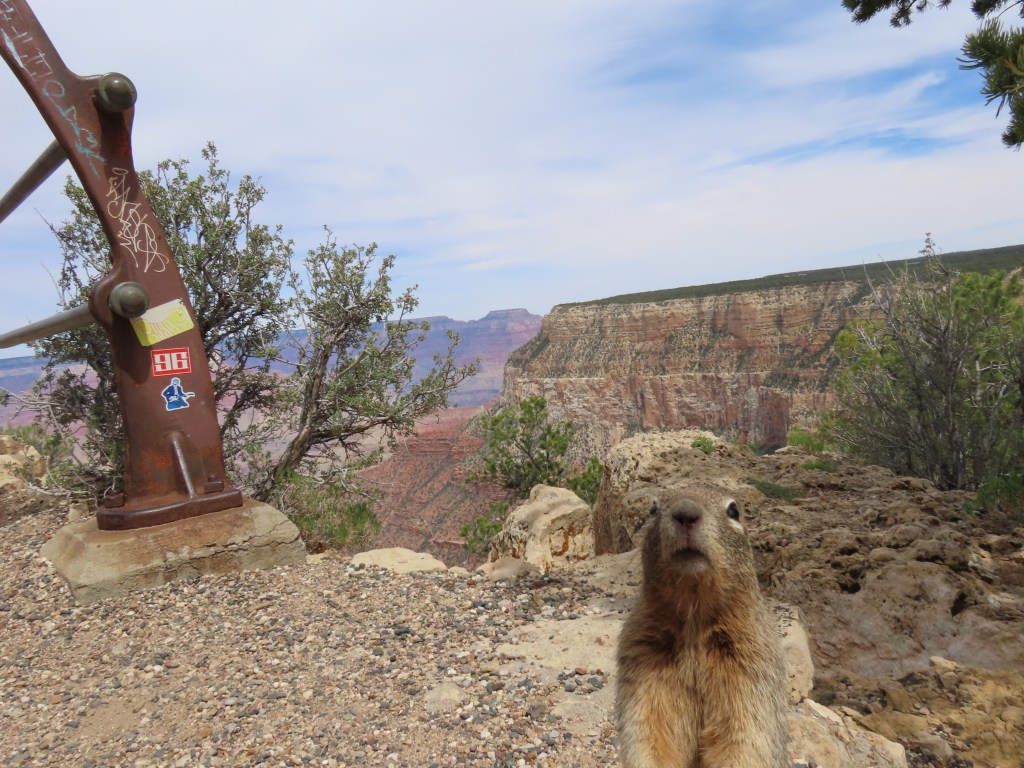
I had been intending to hike a bit, to get away from the crowds of the Grand Canyon Village and maybe descend down one of the paths into the canyon, but the pain caused by yesterday (which includes some very sensitive chafing) means that all I can do is go to a semi-functioning shop in the midst of a powercut to get lunch, then hobble along the paths beside the village. With a lot of long sitting breaks, I manage to at least reach another viewpoint, where a ground squirrel, clearly used to being fed by tourists, comes up to me with all the expectation of someone sitting down at a restaurant table. I am presented with two unethical options: give them some of the dried fruit I have in my pocket, which would probably be safe for them to eat, but would cause them to become further reliant on humans for food, or, alternatively, kick the entitled little bastard into the canyon. Magnanimously, I decide to do neither.
I get an email from Greyhound that tells me that the bus tomorrow will be “244 minutes late”. Fuming, I check if I can still catch a connection in Phoenix to Ajo. Turns out that I could, but I’d arrive almost at midnight. I decide that I simply cannot be bothered with the faff and stress of this, and book a minibus to Phoenix with a much simpler itinerary in mind. I wonder if being more comfortable with expense than faff is a sign of ageing.
Day 5
The new plan, though expensive, is working smoothly. I walked from the motel to the bus station, caught a bus to the transport company’s office (when I wasn’t sure how to pay the fare on an American bus, the driver very kindly told me not to bother), where I got on a minibus to Phoenix’s airport. There, I had lunch and wasted some time with a large cold drink before going to the taxi rank. The taxi driver – an East African, I think – did not seem too familiar with the city, but he eventually got me to the bus interchange. A thankfully stress-free alternative compared to my original plan, which would involve trying to find bus stops in this desolate city. All I have to do now is wait a while.
To my surprise, it’s a minibus that arrives. As the other passengers clamber onboard, I ask the driver if this is the bus to Ajo. He says yes, and asks me if I have a reservation. I do not. I thought that this was going to be an ordinary bus. The driver explains to me that passengers need to make a reservation, or just hope that the minibus has a free seat, which this one does not. He goes on to explain that my only hope is to wait for the next minibus, which is in three hours, and hope that they’ll have a free seat. He is sympathetic and acknowledges that the website does not explain any of this, which I appreciate, but still, my predicament sinks into my head like a stone. This is Phoenix, and this interchange, which I’m going to be stuck on for the next three hours, is an island among its motorway-like streets, miles away from any hotels. In the middle of a city, and in the middle of nowhere. And the whole time I’ll be adrift here, I’ll be praying that once the next minibus arrives, which will be at night, it’ll have a seat, or I’m really in trouble. The fact that, even if it does turn up with a free seat, I’ll be arriving in Ajo at almost midnight, which I spent all that money on trying to avoid, does not help.
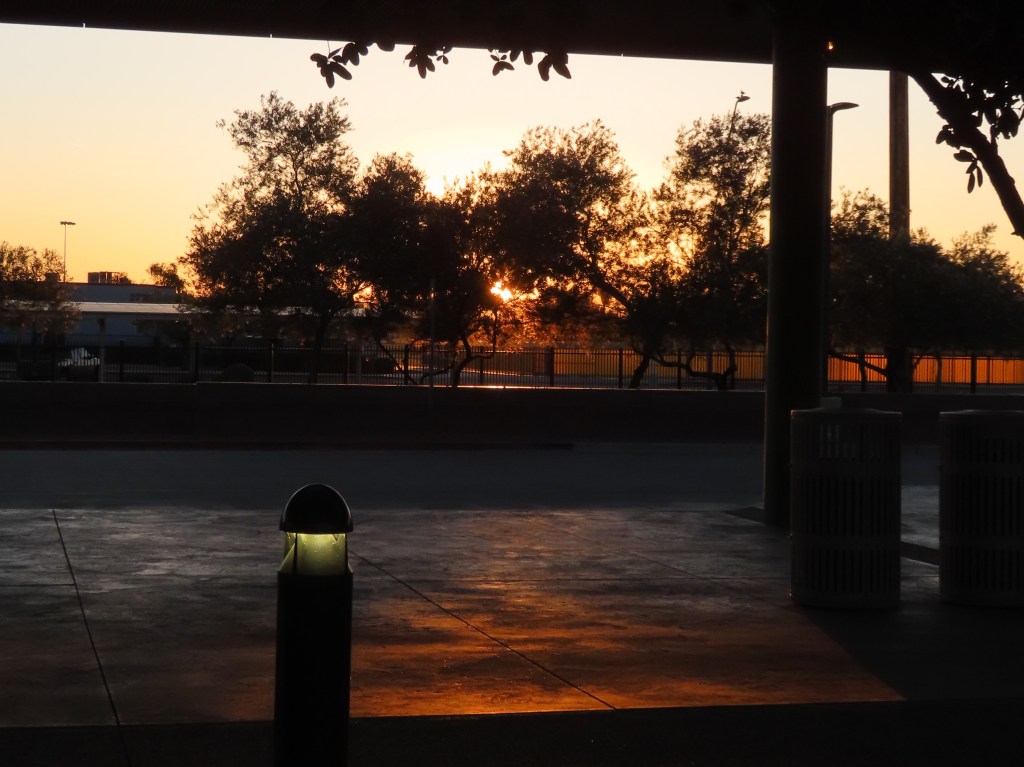
Despite being miles away from anything resembling a busy street, the bus interchange’s isolation turned out be not as complete as it first appeared, as it was near what movies and TV have taught me is one of those classic features of American life: a mall. It didn’t completely alleviate the sense of isolation, though, as it was basically quite a small and somewhat sub-standard shopping centre. Too stressed to have a proper meal there, I just had a smoothie, despite being a little alarmed by the sign in the shop that said, “no refunds”. What had the smoothies been doing to people that made them ask for refunds?
I spent the rest of the three hours trying to work out what I was going to do if the minibus didn’t have a space for me, and decided that my best chance would be to take a combination of buses (I thought I knew which ones) to the city centre, go to the one hostel that I know of, and beg them for a room. But thankfully, there was no need. The minibus turned up with plenty of room, and is trundling through the darkness to Ajo. Well, it had plenty of room when I got on in Phoenix, anyway. Now I’m sitting next to a bandana-wearing old hippie who boarded in a nondescript town with a bag, a guitar, and, inexplicably, a pool noodle, before settling down to watch videos on his phone without earphones.
Day 6
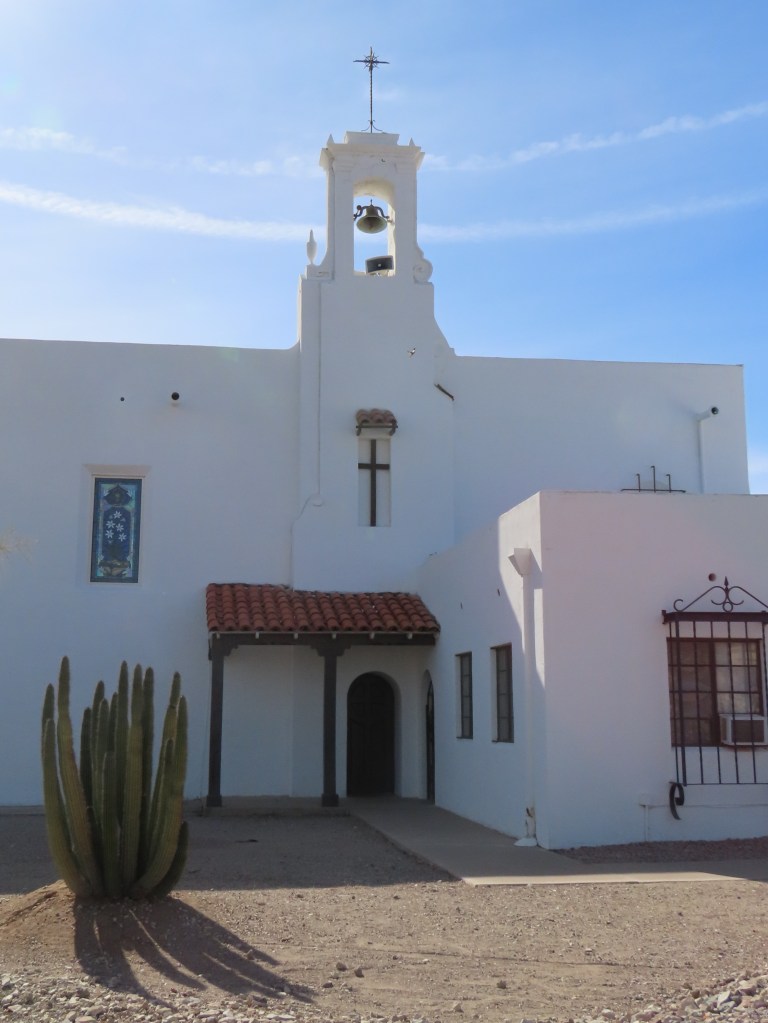
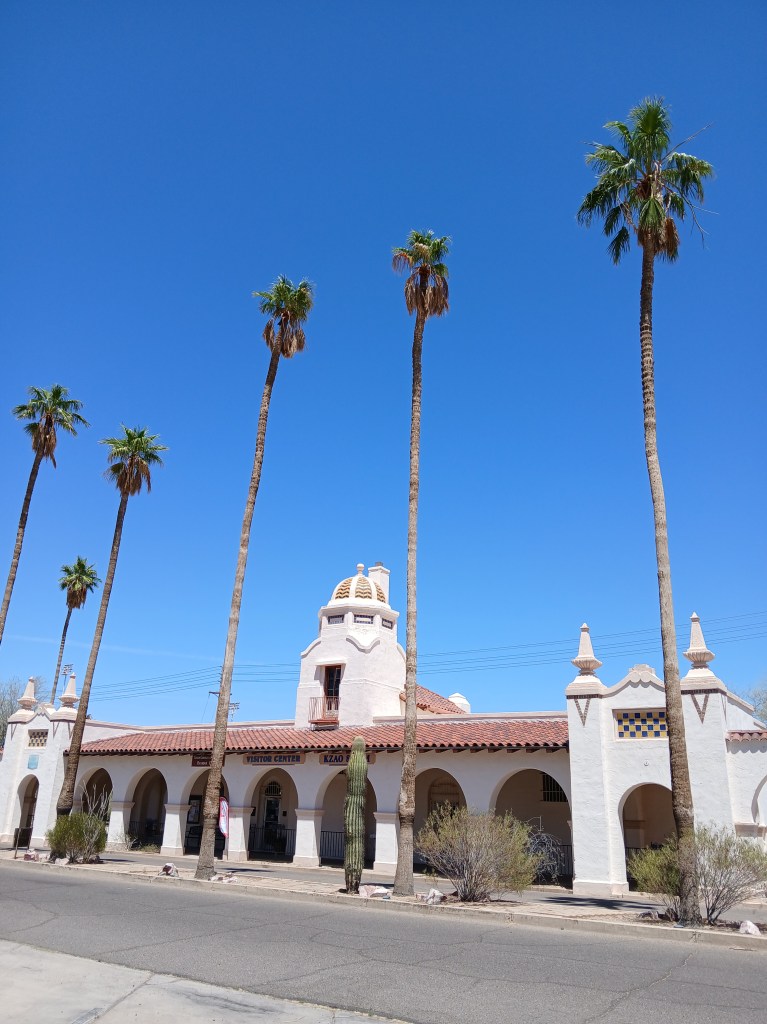
I step out into the dust of the desert town of Ajo, and in my mind’s ear, hear the jingling of spurs on my boots. This is a completely different kind of landscape to Flagstaff, yet still equally capable of setting off Western fantasies in my head. Maybe even more so. The cacti, terracotta roofs, and whitewashed old churches of the town plaza keeps making part of my brain think that I’m here to rescue some Mexican villagers from bandits.
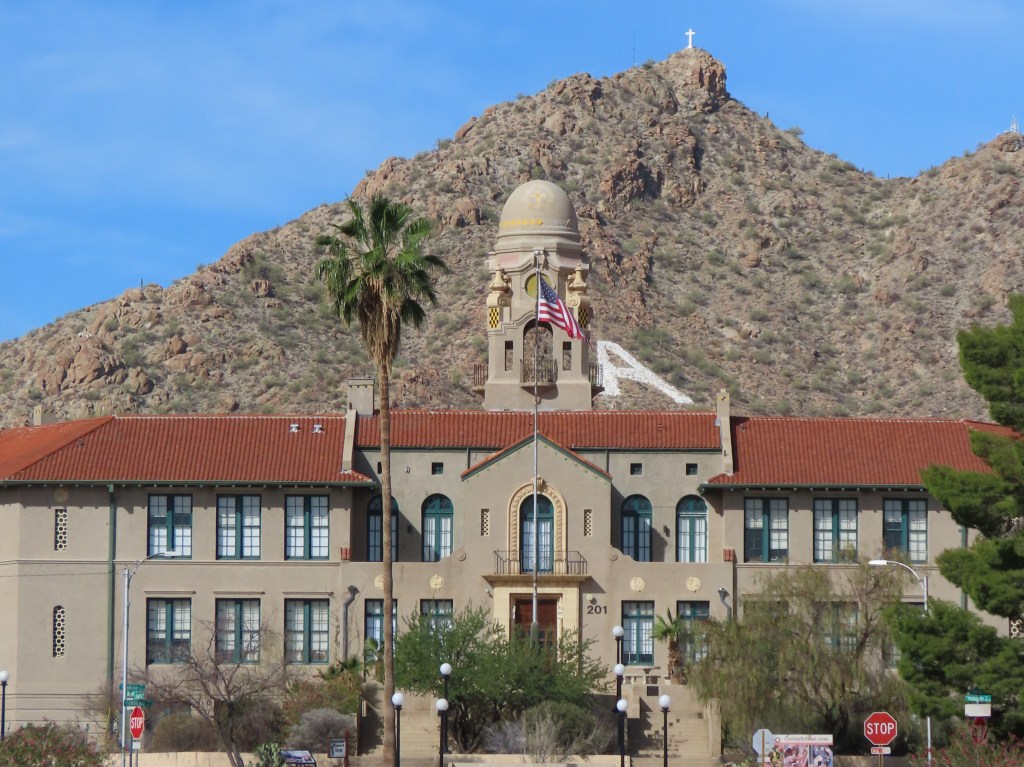
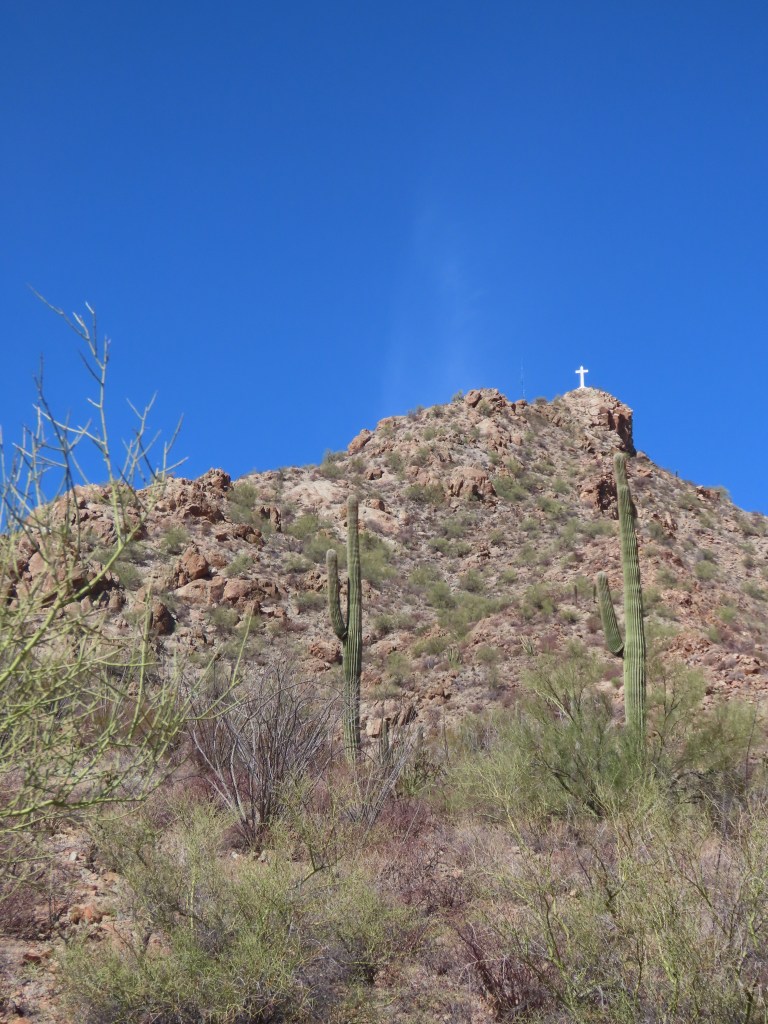
I make my first attempt to wander out into the desert before the sun ascends any further. I walk up the streets that climb up the town’s low, craggy mountain. It has a white cross perched on its peak, and its slopes covered in cactuses, shrubs, pylons, and a huge, white “A” carved into the dirt, like a budget version of the Hollywood sign. During my online reconnaissance, it looked like there were hiking trails all over it, but up close, amidst the thorny vegetation, there are myriad “Keep Out” signs. I try to keep following the road, but it soon curves around a cliff with a barrier on the other side, with no room for pedestrians. In any case, the sun is becoming intense, and the cloudless sky is turning a deep and profound shade of blue. Time to retreat to shade and air-conditioning.
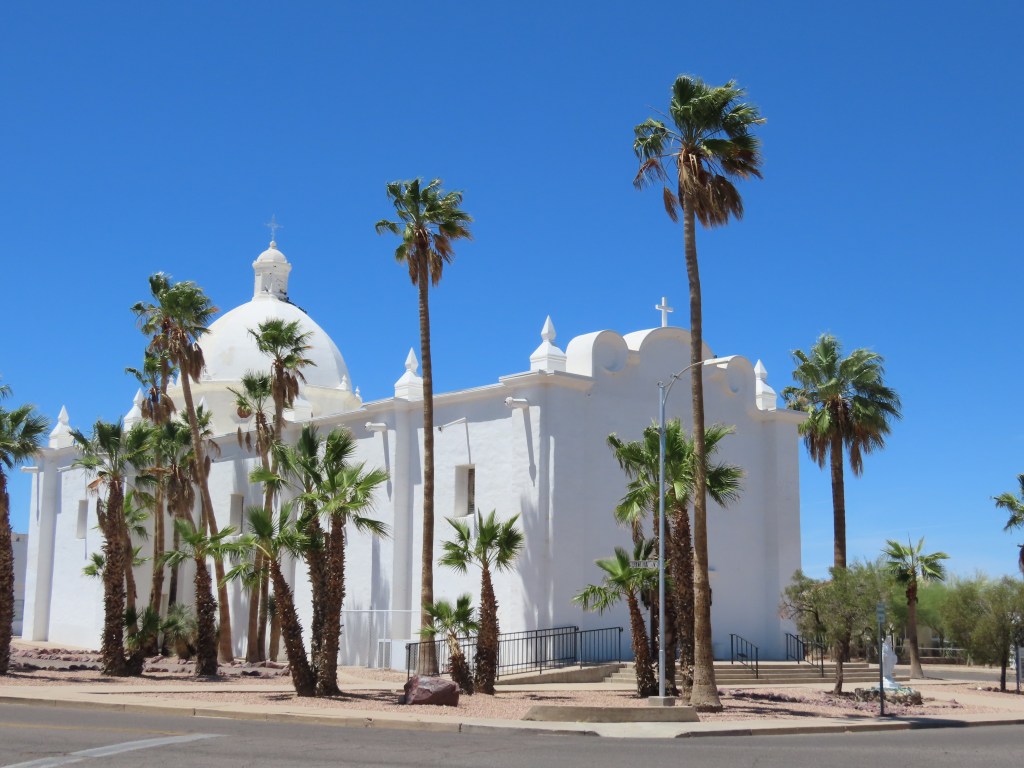
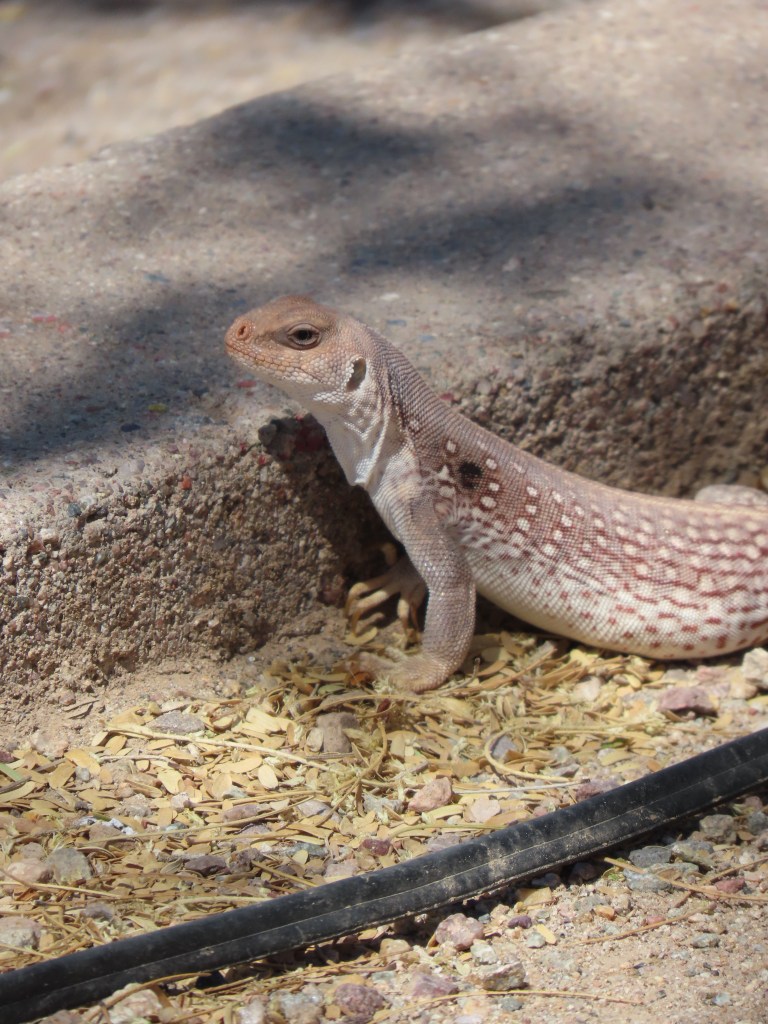
After a dinner of mashed burger salad, I try to reach the desert again, this time while it’s being turned gold by the setting sun. I walk through the streets of bungalows, each with either a garden of desert plants or a yard of bare concrete. I notice that lot of them have their gates open, and a lot of them contain furious barking dogs. Inevitably, I eventually come across one that has both, forcing me to change course to avoid a black dog in the road that’s staring at me in a distinctly unfriendly way. I head up a slope above the streets again, and, yet again, reach a road that’s hemmed in with a cliff and a barrier. Looks like it’s just not possible to explore the desert on foot from Ajo. At least there’s a nicer a view from up here, made up of layers: the cacti and shrubs in front of me, then the somewhat ramshackle town below, the craggy mountains on the horizon, and then a sky swirling with vultures and wispy clouds.


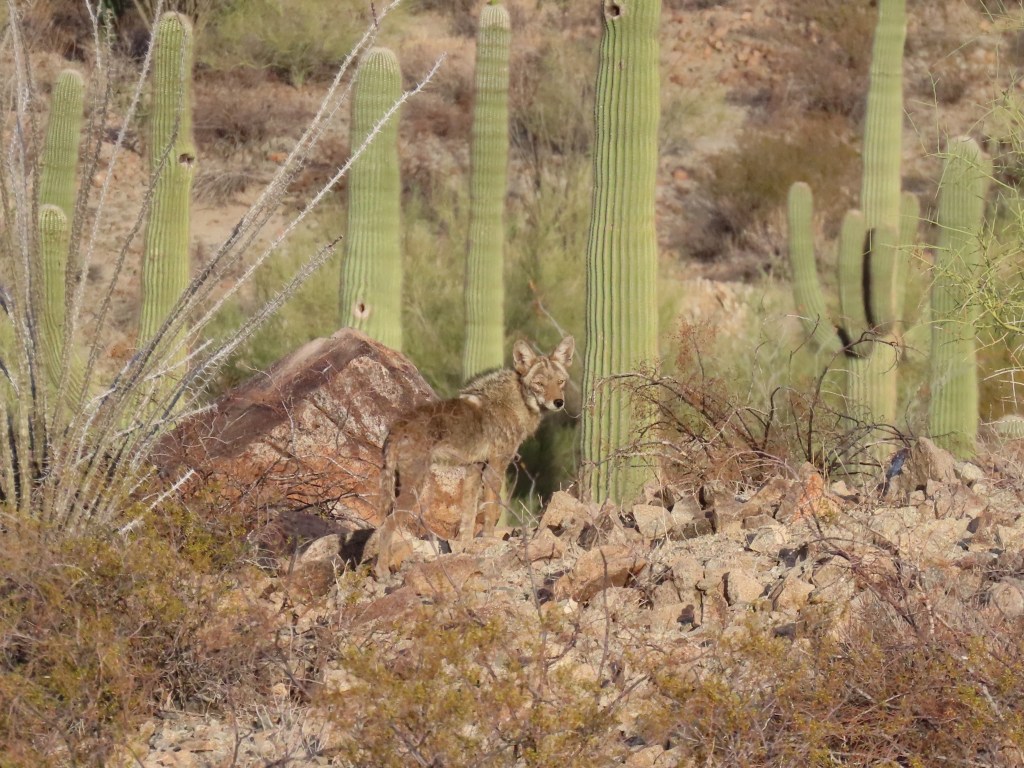
I glance down at the town, and to my surprise, see a pack of grey-black, pig-like creatures snuffling around in someone’s garden. These are peccaries, also called javelinas. I’ve seen enough logos depicting them to get the impression that they’re the town’s unofficial mascots, but I hadn’t realised that they’re so common that they’re found in people’s gardens. Then, to my even greater surprise, a coyote comes trotting up the dirt road behind them. It strikes me that if I was less familiar with wildlife, I really could have mistaken it for wolf. It disappears for a while, then reappears, crossing the road in front of me as the yelping cry of another coyote rings out from the crags. Once among the cacti, it turns to look at me, and I eye it carefully as I walk past. Coyotes have been known to attack people, but those were larger specimens further north. I think.
Day 7
The bus stop in Ajo barely looks like one, with just a crooked sign, but this is definitely the right place. There are other people waiting here: a Native American mother and son, I think, who have brought folding chairs with them. An elderly Hispanic lady on a scooter is exchanging gossip with them very, very loudly, Spanish occasionally slipping into her speech in between questions such as, ‘WHAT KILLED HIM? LIFE?’.
The journey back to Phoenix is long, and I lose another hour or so waiting for a taxi at the interchange, having to call for another one after the one I booked didn’t turn up. Given Phoenix’s sterile unfriendliness, I was looking forward to staying in a youth hostel, which, in my experience, are large, lively, friendly places. But when the taxi finally pulls up in front of the address, it’s just a house in a residential street, the only things marking it out being the sign on a nearby telegraph pole and the keypad on the front gate. I had been sent the passcode, but once I get in, I realise that there’s no reception desk. There’s a common room with walls covered in maps and posters, containing a sofa and musical instruments to try to give it a fun, friendly atmosphere, but no other guests. Apart from a black cat in the garden, the whole building is silent and deserted. It is, needless to say, deeply unsettling.
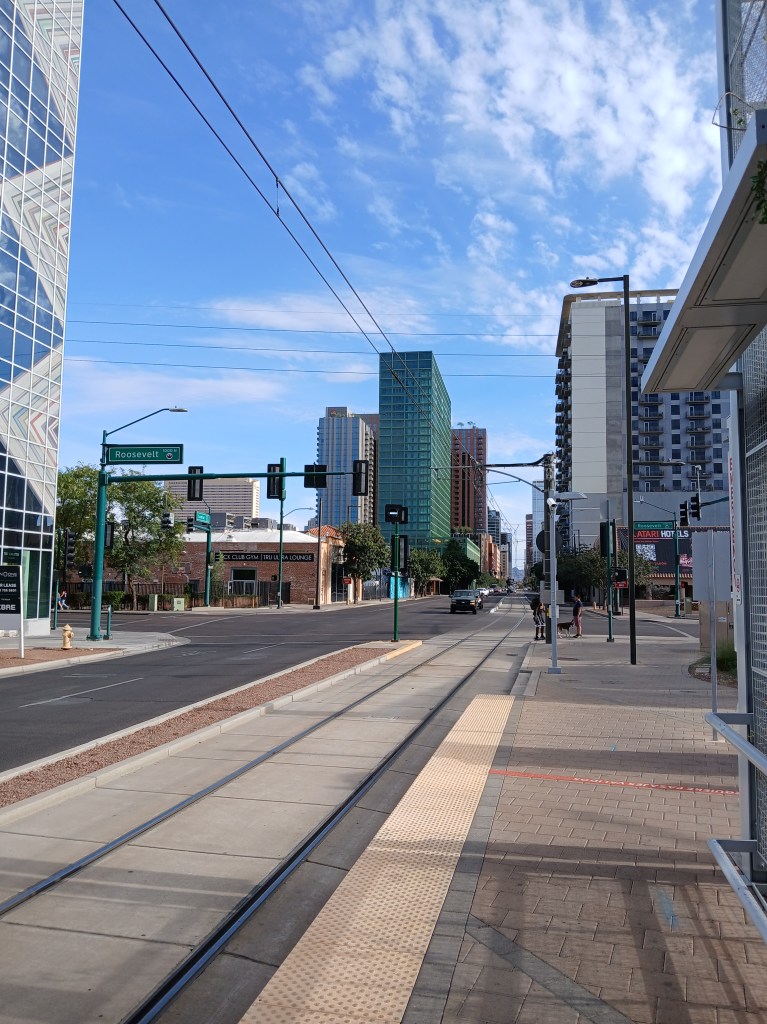
I see some of downtown Phoenix on my way to the nearest metro station. There is some nightlife here, it turns out, although with so much unnecessary distance between places here, I can’t imagine that a bar crawl here would be much fun. Not that I find pub crawls fun anyway. It takes ages, even with the “light rail” system (which covers very little of the city), to reach a restaurant that specialises in frybread. It’s a distinctly American food – a flatbread of deep-fried dough, invented by Native Americans improvising with the rations that the government gave them on the reservations. The people running this restaurant are, as a sign above the busy counter proclaims, members of the Tohono O’odham. I get a “frybread taco”, filled with beans, cheese, and lettuce, which comes with a little pot of salsa, but ultimately, it’s just too stodgy, and I only manage half of it before setting off on the long route back to the deserted hostel.
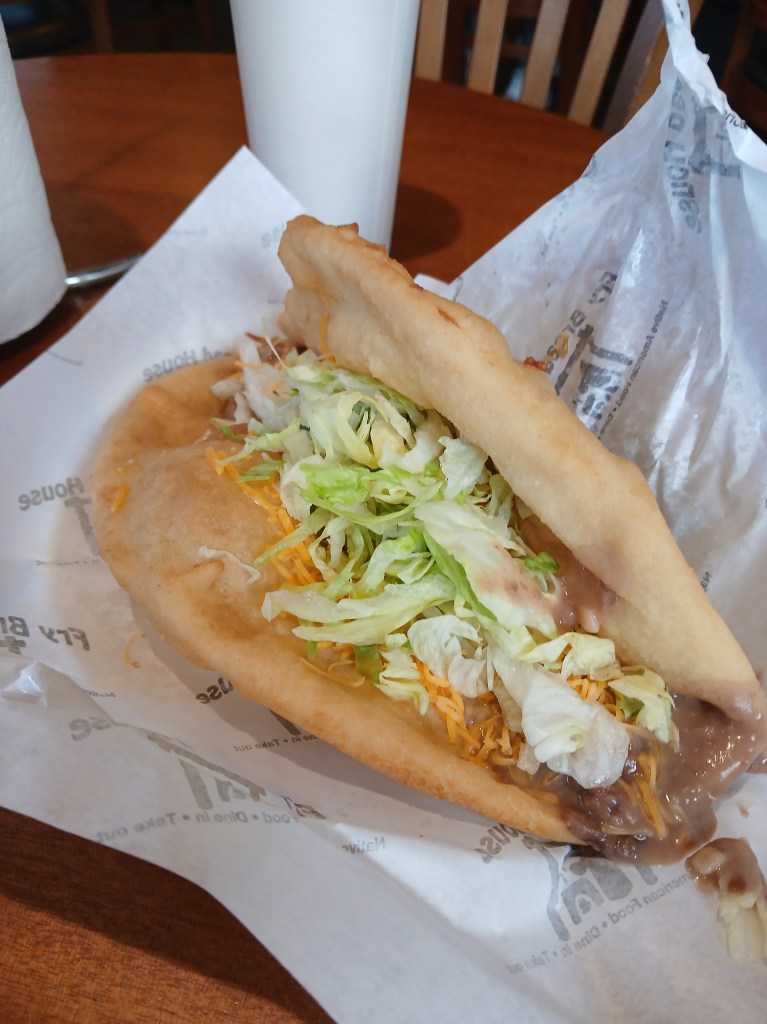
Day 8
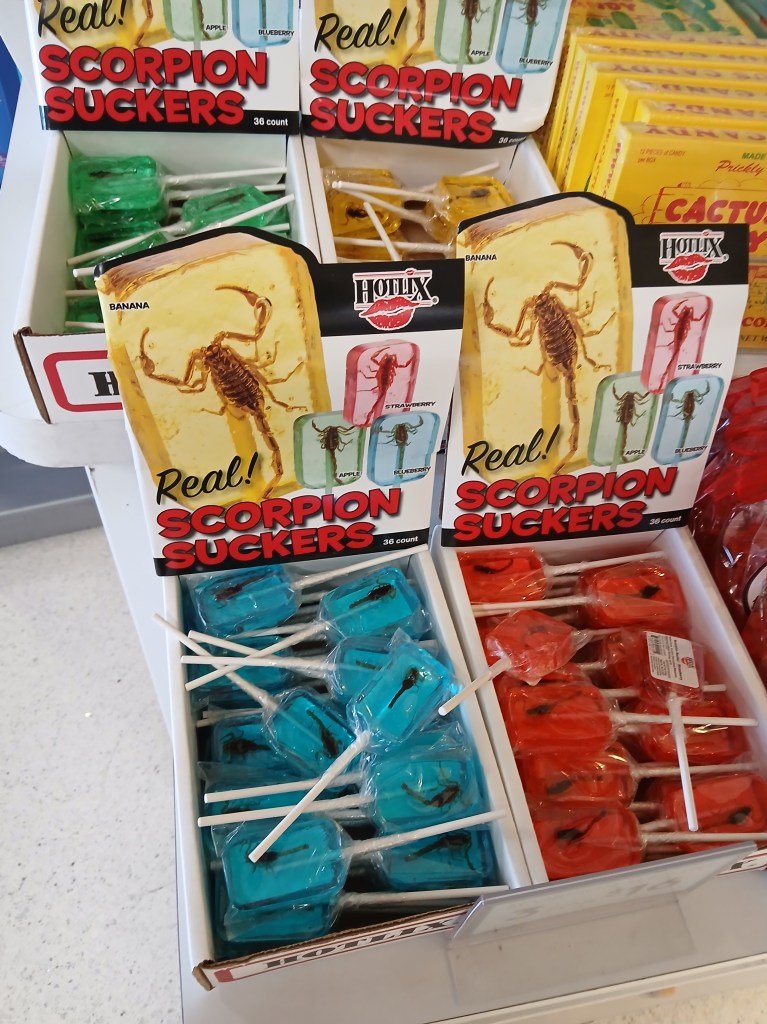
As a parting gift from Arizona, Phoenix Sky Harbor Airport’s shops offer a range of desert-based treats, including lemonade made with cactus fruit, which I get, and a lollipop with a scorpion in it, which I do not. I am tempted, but when I look at the ingredients, “scorpion” is the only one I recognise, and there’s a warning an about potential “laxative effects”. Probably not the best thing to have before boarding a plane, then.
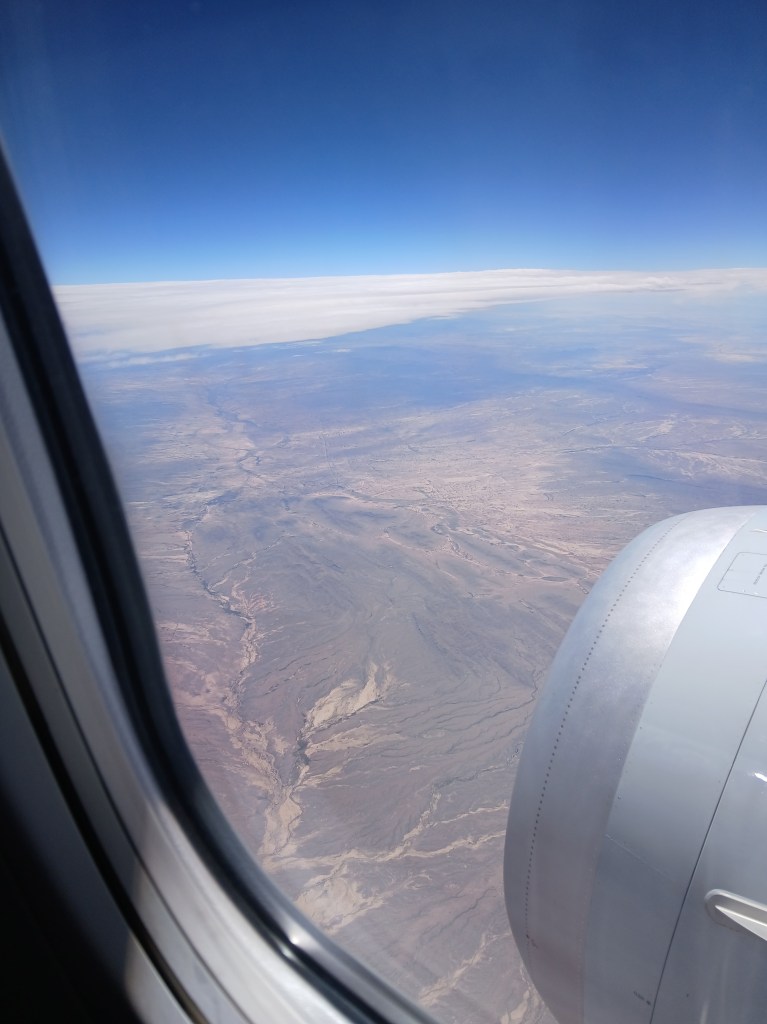
Culturally and linguistically speaking, Mexico City should be much more alien to me than Phoenix. But through the window of the taxi from the airport, I see an almost comfortingly normal city, where the buildings are actually next to each other instead of having vast unnecessary gaps. In a strange way, I’ve missed these kinds of streets, with their hot, battered pavements and faint smell of diesel.
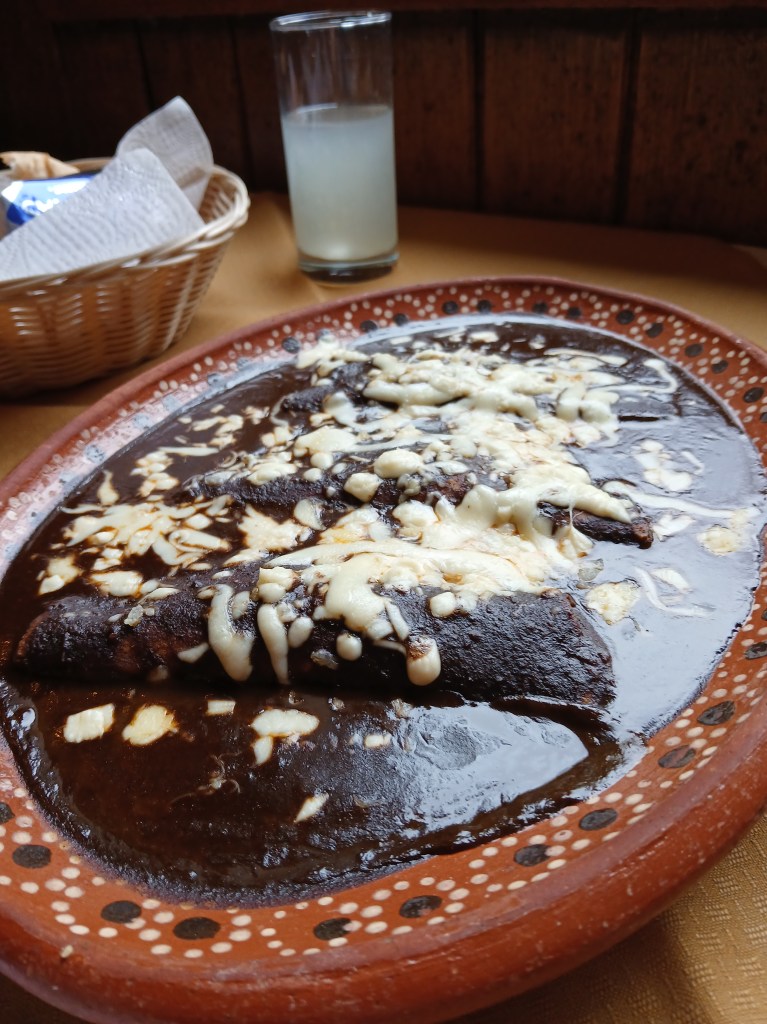
The hotel takes me by surprise. It’s a fancy hotel. As in an actual, proper, fancy hotel, where a man in a uniform takes my luggage to my room. I need to check if this is definitely the right place and if I’ve paid for it. It even has a courtyard with a fountain in it. There’s a restaurant here too, one that serves chicken enchiladas in the Puebla style, which is covered in mole – a thick, chocolate chili sauce. As introductions to Mexican cuisine go, it’s a bit of a baptism by fire.
The “fire” being the indigestion that my feeble gringo digestive system is almost certainly going to inflict on me over this.
Day 9
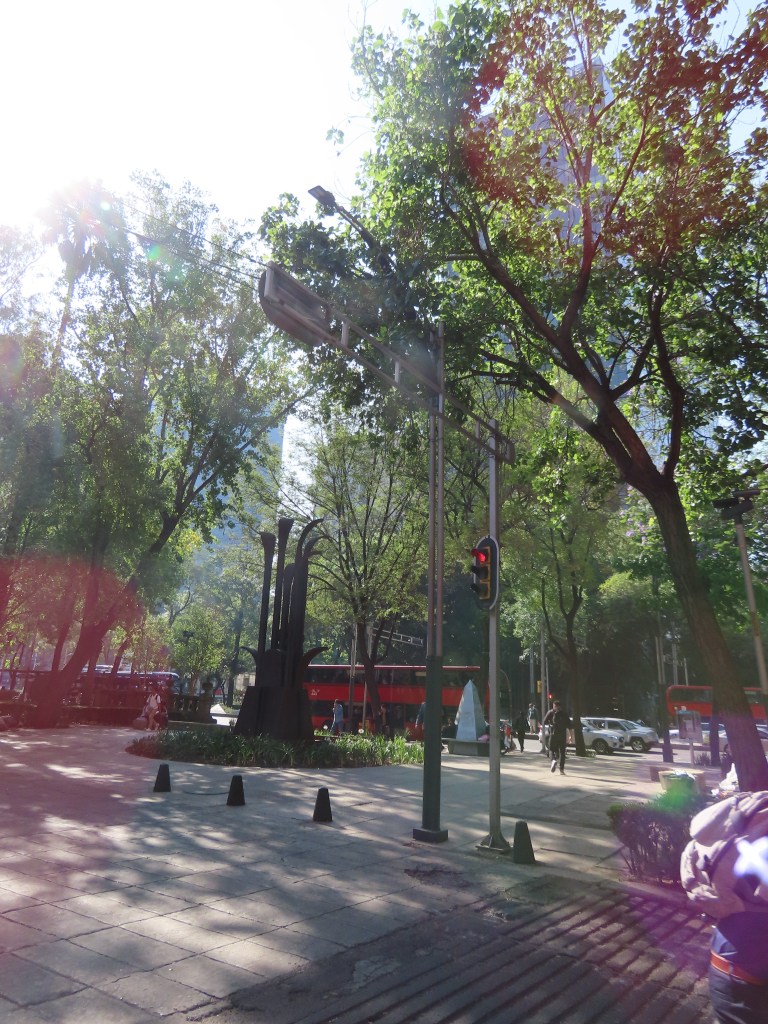
I am aware that all the museums in Mexico City are closed on Mondays. I found that out before I got on the plane, but, inevitably, after I had booked everything. But there’s still my main intention in Mexico City: to find a vantage point from where I can see the active volcano just outside the city – the gloriously-named Popocatépetl. Usually, the chances of succeeding are low, thanks to the weather and Mexico City’s infamous smog, but it’s morning and the sky is clear, so maybe there’s a chance today? First place to try, according to a quick online search, is a hill in Chapultepec Park (Nahuatl, Mexico City’s original native language, generates some wonderful names), which covers a sizeable chunk of the city centre. The route is simple enough: from the hotel through a street made dark by tree canopies and masses of electrical cables overhead, then onto a huge thoroughfare, running through the city like a straight artery. Well and truly bustling between shining skyscrapers, the street (It seems to be too big for the term. Is it an avenue? A boulevard?) alternates between tarmac clogged with cars and motorbikes, and pavements with pedestrians, trees, and the occasional statue. Then it all suddenly opens up, and I am in front of Chapultepec Park’s green gates. They’re closed, and there doesn’t seem to be anyone in the park but guards. Confused, I walk up the fence and try to work out what’s going on. Am I too early? Then I spot the opening hours sign. The entire park is also closed on Mondays.
Nonplussed and dejected, I walk back to the hotel. On the way, I pass a large roundabout, and notice that even the trees on the opposite side of it are starting to be obscured by the haze of pollution. If I can barely see across a street, then I’m certainly not going to see across a city. No volcano for me.
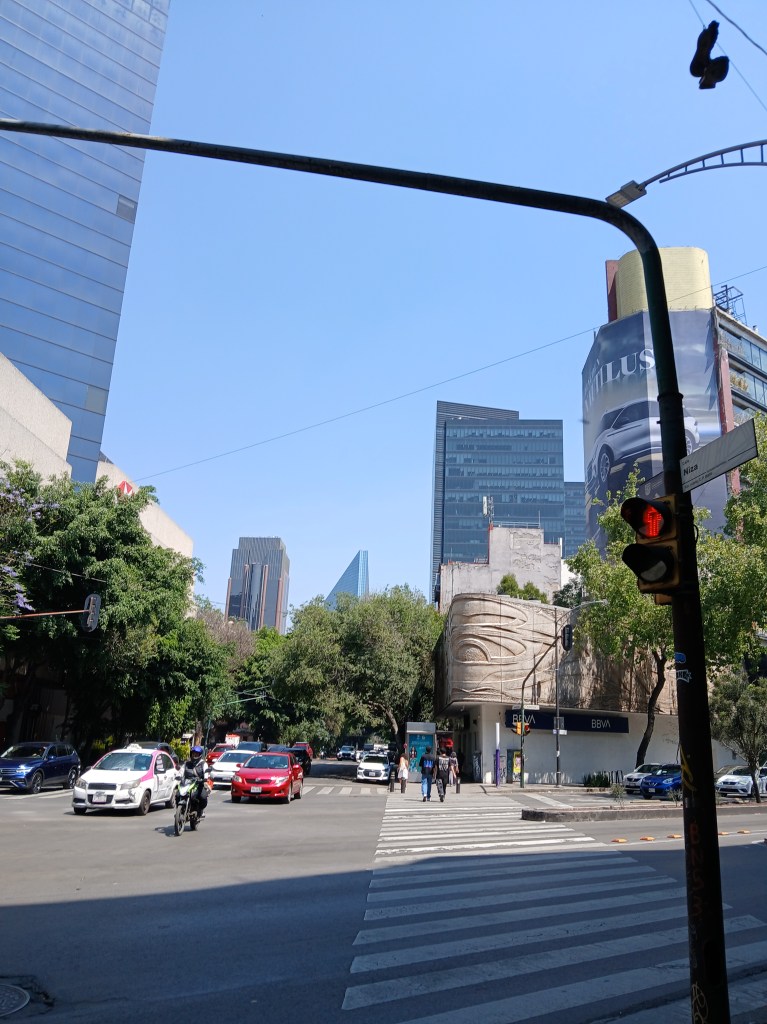
The only other option for exploring I can think of is to catch some underground metro trains to the Zócalo; Mexico City’s plaza since Aztec times, when the city was a fraction of its current size, an island in a now-drained lake, and called Tenochtitlan. I had read that there are sometimes performances from cultural revival groups there, and while there is one group in elaborate costumes and body paint standing around among the tourist stalls, today the plaza is filled with workmen, barriers, and big white tents. I’m uncertain what it’s being set up for – a political rally, maybe.
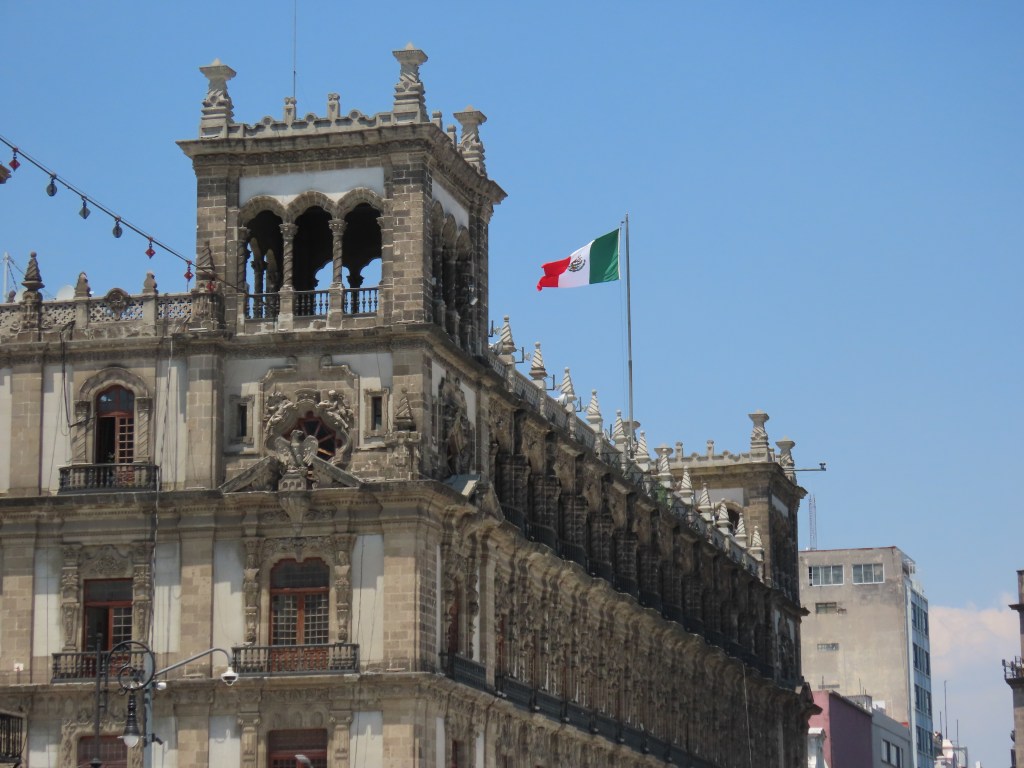
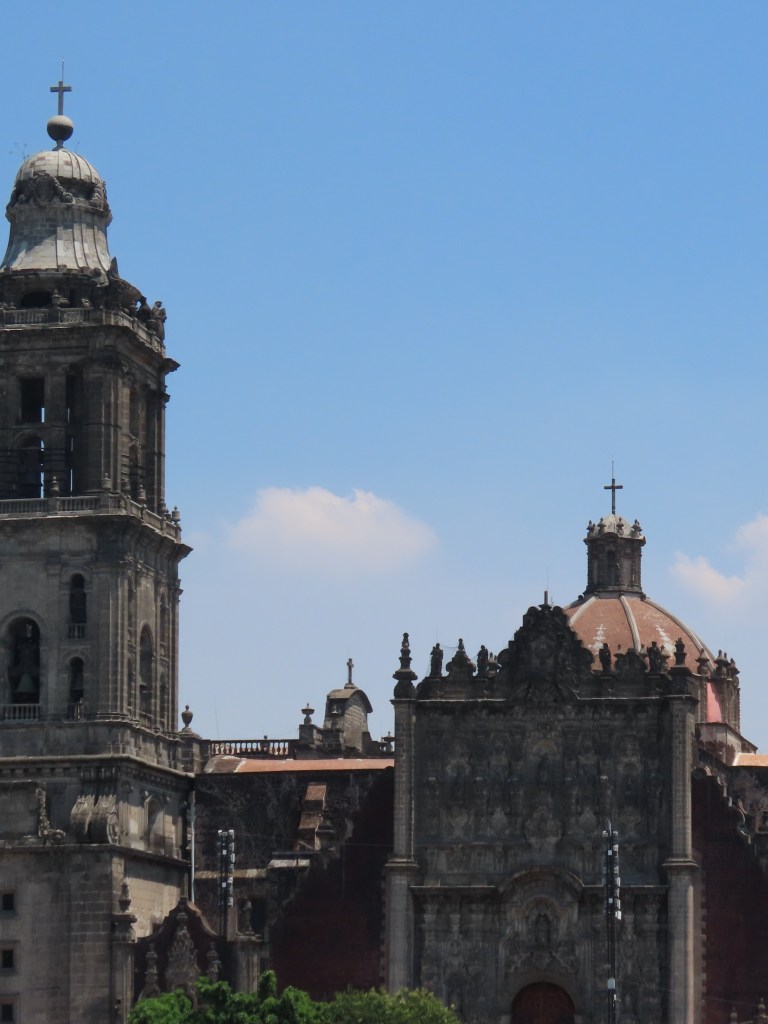
The Zócalo is dominated by a grey and quite grim-looking cathedral at its centre, but in the corner lies the ruins of the Templo Mayor, the main pyramid-temple of the Aztecs. The museum holding the artefacts that were found during the excavation is closed, of course, but there’s a walkway overlooking an expanse of stone platforms and steps, populated by sculptures, including large, fearsome-looking serpents.
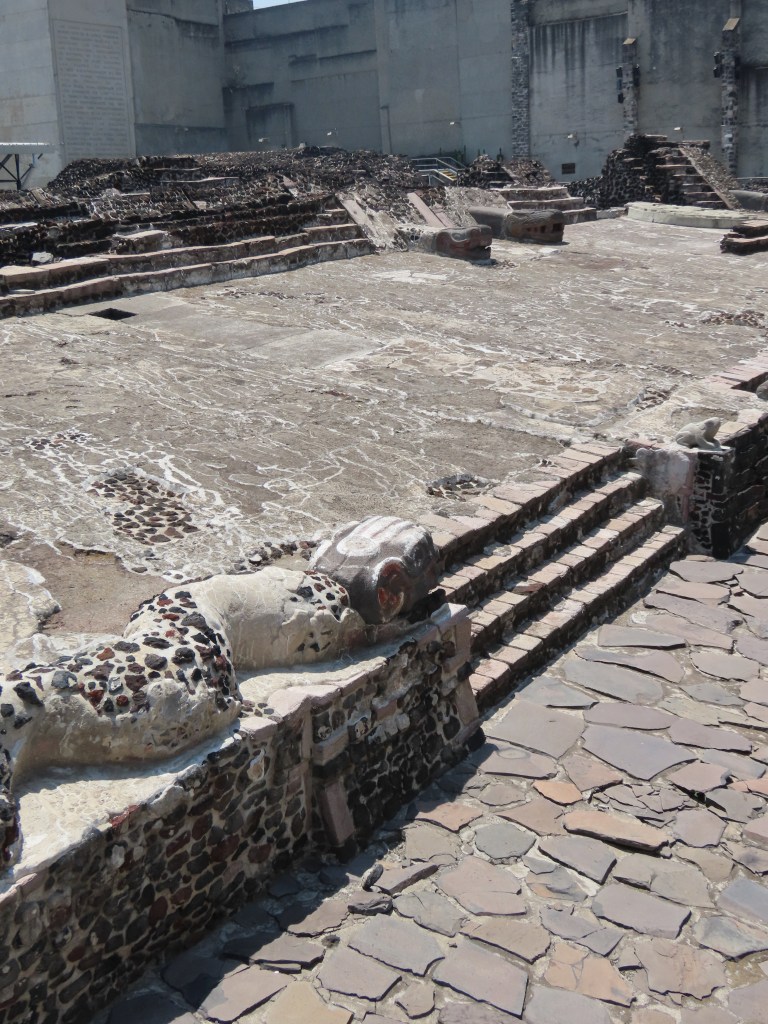
This is where Aztecs fed their gods with human blood, by cutting the hearts out of living victims. It would have seen countless sacrifices, the shrine at its summit would have been covered in blood, and condemned victims would have been dragged up the steps beneath me, but it occurs to me that for most of the people living here at the time, it would have been just…there. A landmark that was just another part of the city. I gaze at the sun reflecting off its stone surface, and wonder if an Aztec also stared blankly at the same stones while trying to listen to someone boring talk.
One of the young men at this bubble tea place speaks English, which is just as well, given the sheer number of questions about how I want my bubble tea and what I want in it. Having finished the interrogation, I sit down and catch a glimpse of myself in a mirror. I am undeniably carrying some extra weight, and do not look like a fit young man who’s capable of handling adventures. Depressed by the realisation, I resolve that I will do something about this. Then I pick up my strawberry bubble tea with tapioca pearls and cookies-and-cream ice-cream mixed into it.
Day 10
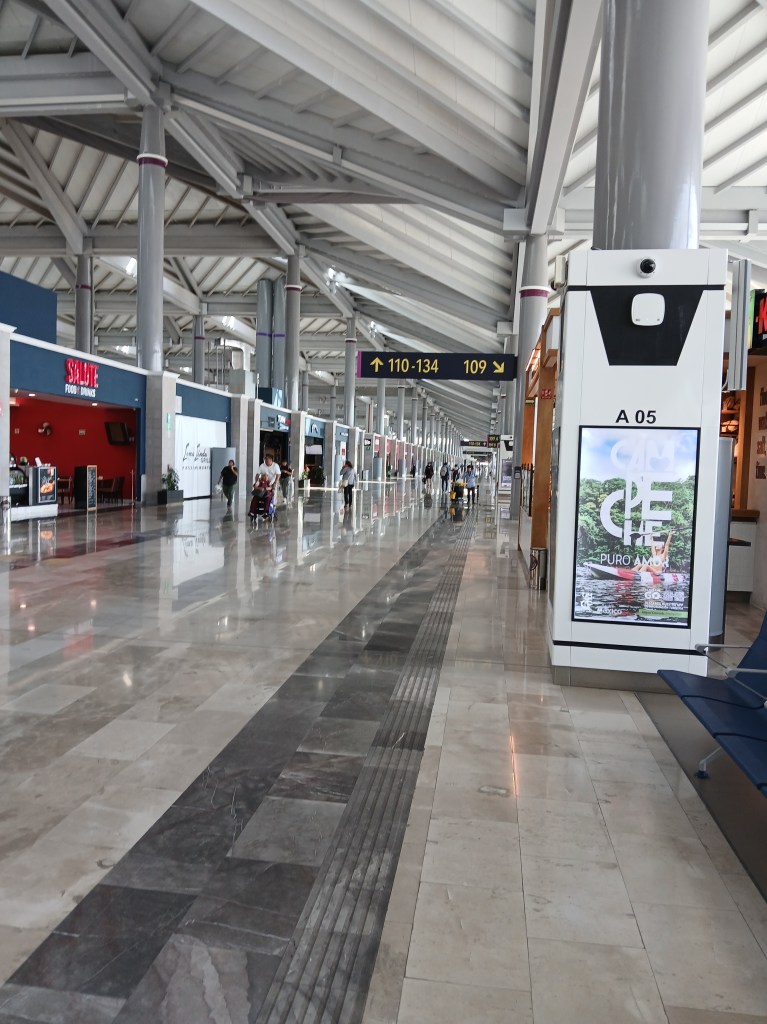
Felipe Angeles Airport is an odd place. It’s very new, which is why there are no direct public transport links with the city and I had to get a taxi. It’s also quite large, very well-equipped with a range of restaurants, and the toilets are incredibly elaborate, with wall-length pictures of locations in Mexico and even a picture of a twilight sky on the ceiling. But the whole place is half-empty. I wonder if this is just the slow popularity growth of new infrastructure, or if I’m standing in a huge white elephant of steel and glass.
At first glance, Palenque is the tourist destination that I expected. Colourful and busy, with taxis everywhere, and “PALENQUE” spelt out with big, multicoloured letters in the plaza. But after a while, it sinks in that there few visible tourists here. Other than the colourful plaza and the taxis, it seems to be just a conventional Mexican town for most part.
Hanging around waiting for check-in time at the hotel is always annoying, but it’s particularly no fun in tropical heat with a heavy rucksack. Thankfully, the receptionist at the hotel, who can’t speak English, lets me check in early. I eagerly open the door to my room, immediately zone in on the remote for the air-con, and press the button. To my dismay, nothing happens. Plus, there’s no wi-fi. And the light doesn’t work. It dawns on me that there’s no electricity.
I go downstairs and, with my rudimentary Spanish, point this out to the receptionist. I get the impression that even if he could speak English, he still wouldn’t be hugely helpful. Luckily, there’s someone else at the desk who is both more helpful and has enough English to explain that there’s a power cut in the centre of town and that the electricity should return in an hour or so. It would have been helpful if I had been told this before I was standing around baffled in a hot, dark room.
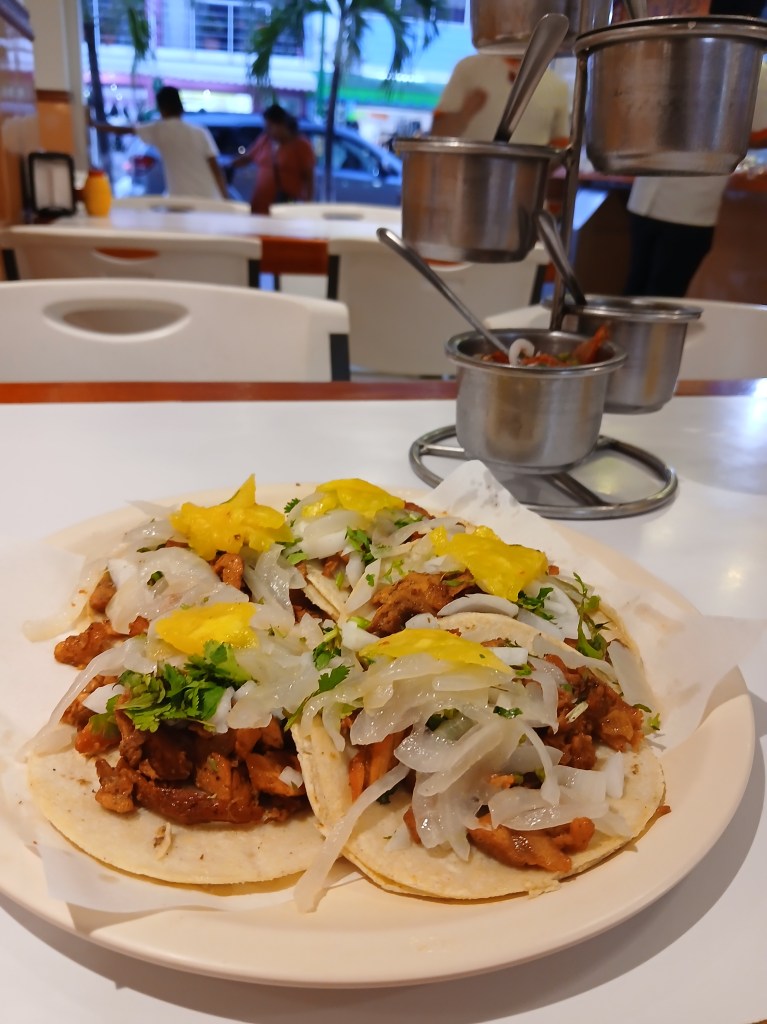
There’s nothing particularly interesting about Palenque itself, but there is a straightforward, workaday taqueria near the hotel where I can have a proper Mexican taco. A combination of both adventurously trying local cuisine and gorging on fast food that suits me to the ground. Taco al pastor is the standard version, and mine comes with adobo pork (flavoured in a vinegar-based marinade) topped with onions, coriander, and a slice of pineapple, accompanied by little pots of salsa. My exotic fast food hopes are dashed as the whole ensemble proves to be just too sweet.
Now full of disappointing taco, I wander the streets under a purple-hued twilight sky. Music from a stage and the screeching of birds coming in to roost for the night compete for domination of the plaza. I wonder what the significance of the red handprints on the “PALENQUE” sign is. Maybe they’re something to do with the local native people, maybe something to do with the fact that the road to the south from Palenque is effectively a no-go zone due to bandits.
Day 11
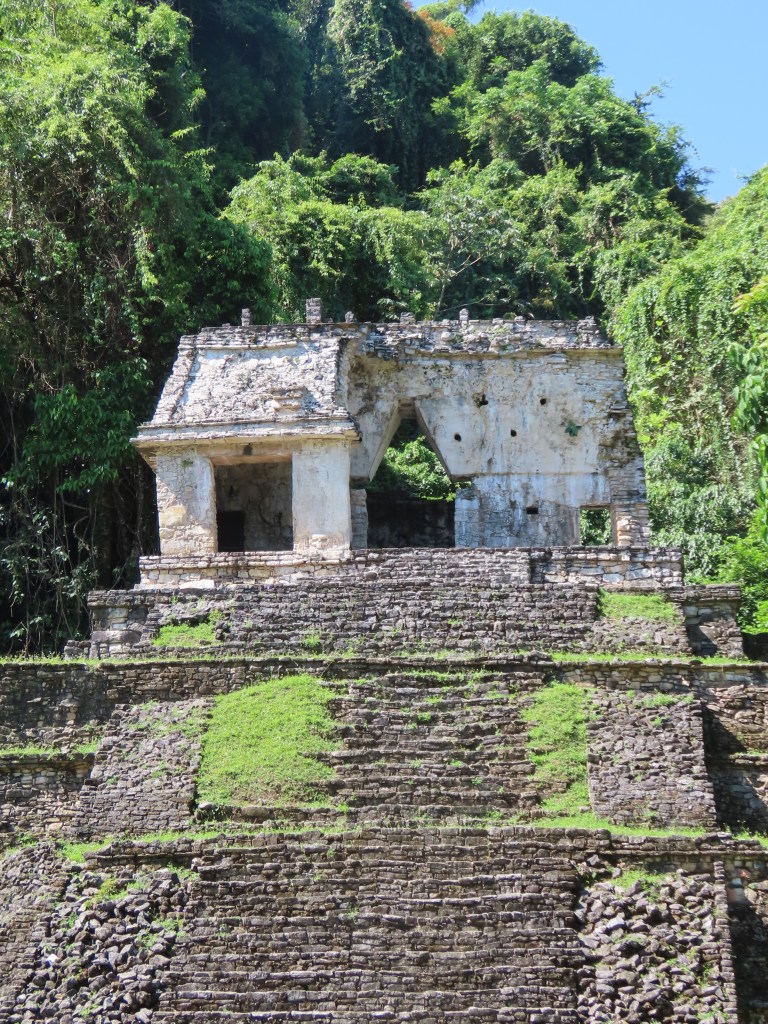
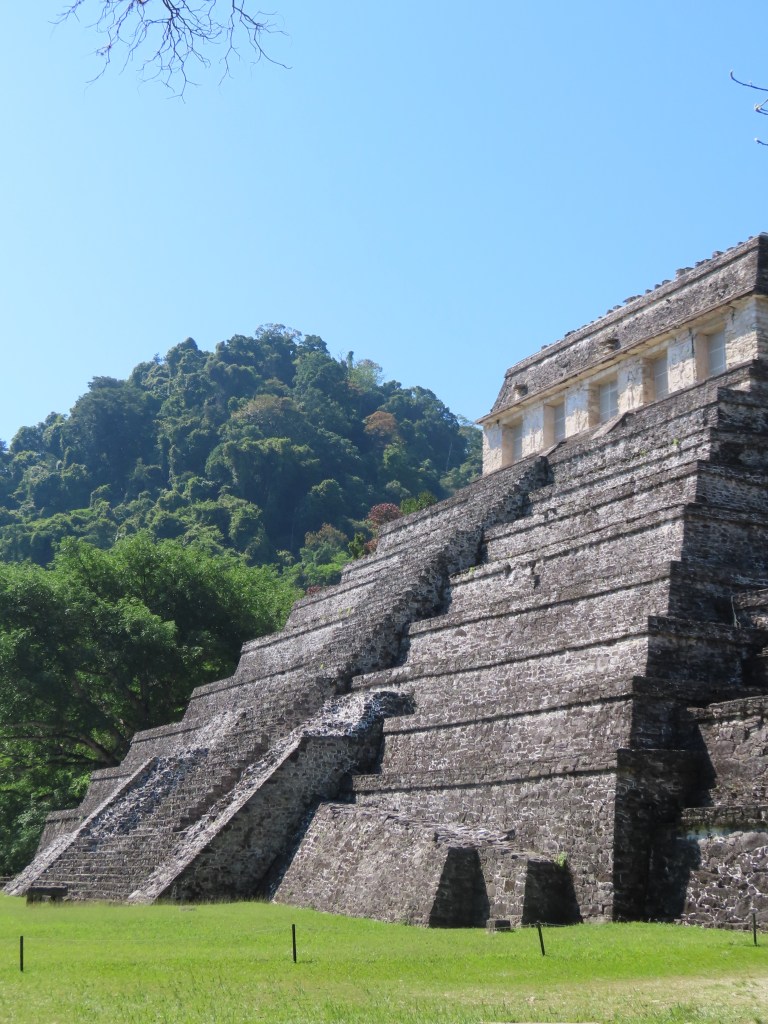
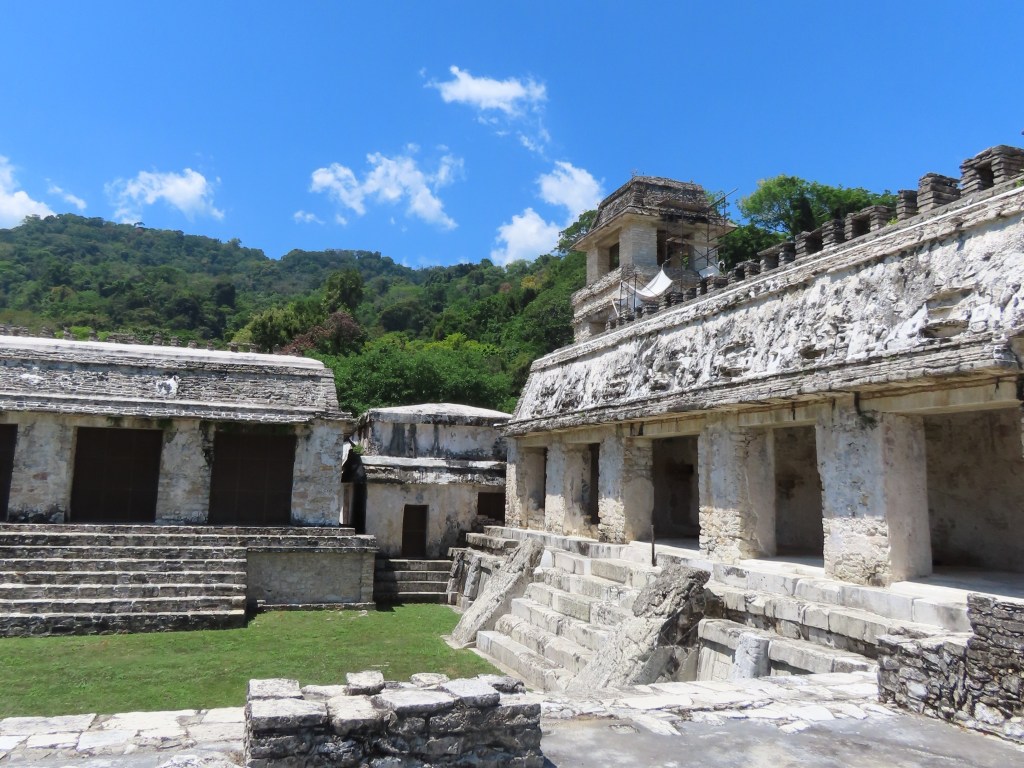
There’s Palenque, the likeable but ordinary town that I’m staying in, then there’s Palenque, which is what I came for. My first glimpse of it is a row of towering pyramids of pale grey. Once, they would have been looming out of the jungle, but now the jungle has been cut back to the background, exposing the massive stone testaments to a lost city’s existence. The pyramid-temples are to the right of me, and to the left is a sprawling palace, situated on a platform that raises it to almost the height of the pyramids. A tower jutting out of the stone nest raises it even higher. Between the two is a steady stream of tourists – the whole place is too large and open for the path to be crowded – and locals selling trinkets from blankets that have been laid out on the grass. Efforts to squeeze the maximum economic yield out of the site for the local communities stretch from the colectivo (public transport minibus) to the entrance, where visitors need to buy tickets to both the archaeological site and the national park that it’s in, to these souvenir sellers. Given Mexico’s mixed Spanish-native heritage, many of the locals may well be descendants of the Mayans who lived here before abandoning it over a thousand years ago.
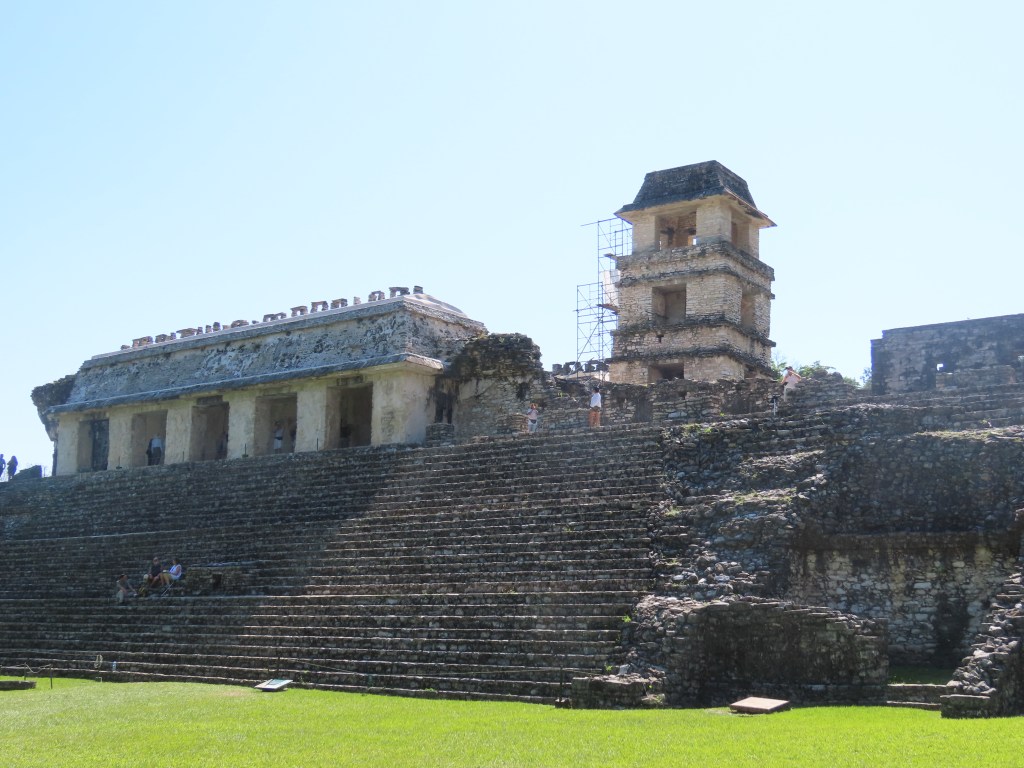
The whole site is large enough to leave the other tourists and souvenir vendors behind quite easily. Once I’m among the smaller temples, it’s quiet enough that I think I can hear the distant roar of howler monkeys.
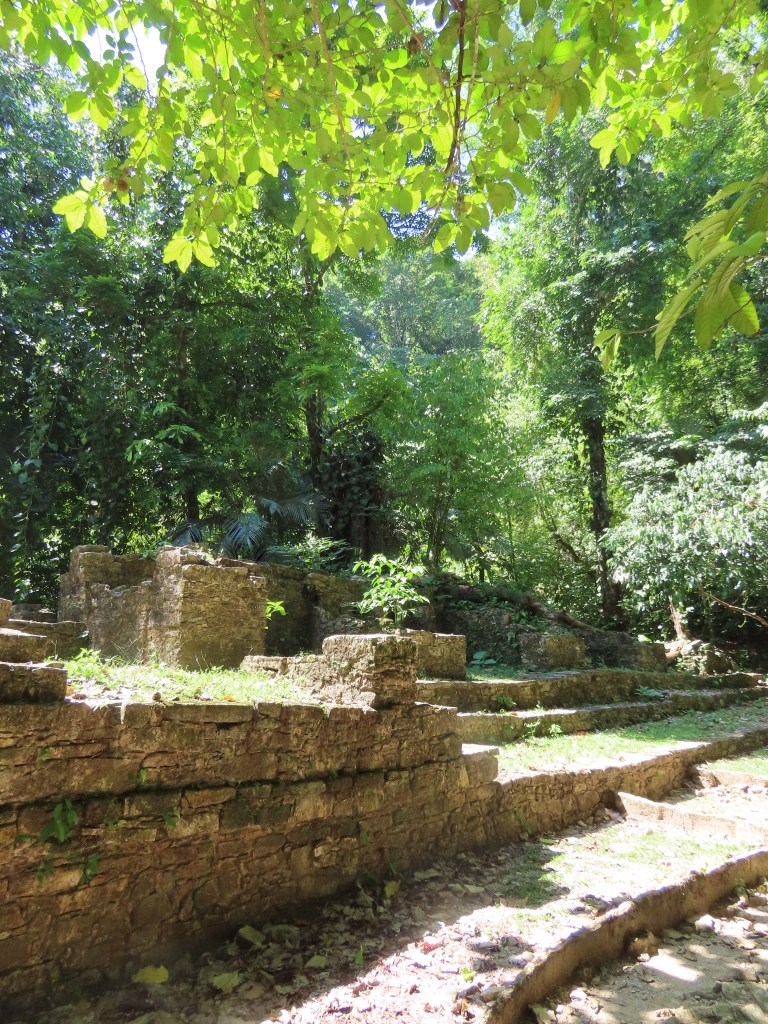
Along a steep path that is well and truly in the jungle, the ruins become just plain walls. I’m out of the temples zone now; these must be the places where people lived and worked. The path is steep enough that I dread having to go back up later, but, in the spirit of exploration, I keep going until I reach the bottom.
Now it’s ridiculous. This place is already a lost city in the jungle, and now there’s a waterfall and a rickety rope bridge? What kind of Indiana Jones fantasy is this?
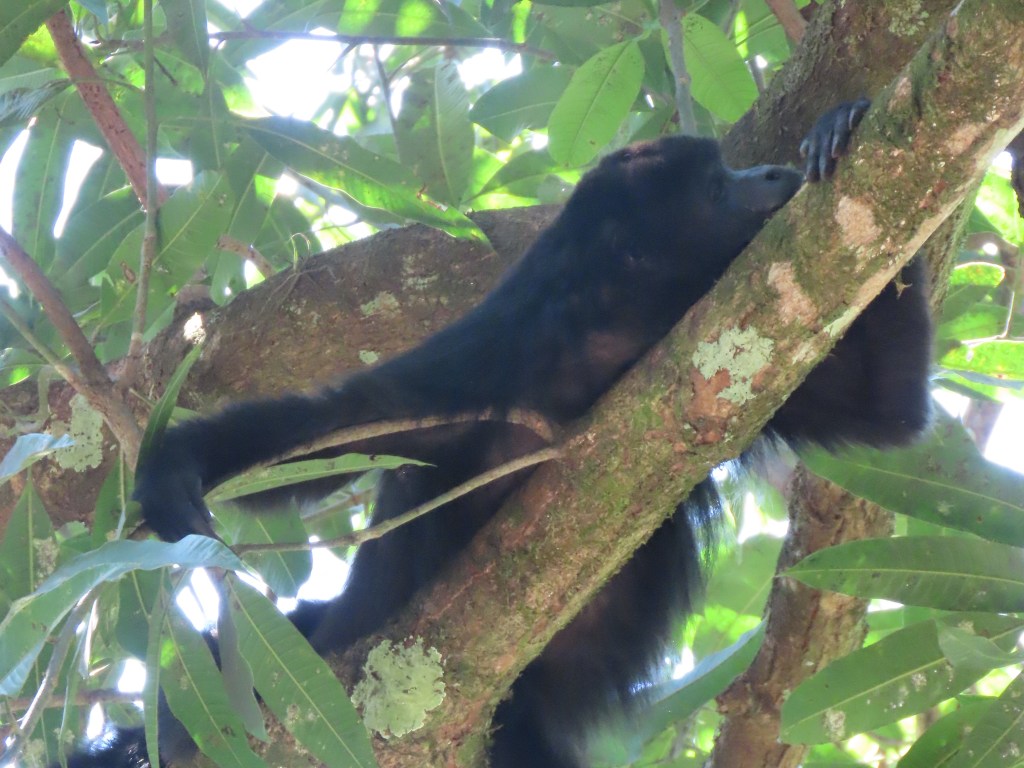
Tired from the climb back up the jungle path to the temples, I sit in the shade of a tree. After a while, I notice something dark on top of a branch of another tree. It might be just a shadow or something, but I pick up my camera and zoom in on it. I immediately confirm three things: that it’s a howler monkey, that it’s very definitely a male, and that the tree has gained some extra “hanging fruit”. Despite the visceral surprise, I get up and walk up to the tree. The monkey is fast asleep, having managed to find a position where a branch is supporting each limb, apart from one arm that’s folded in front of his face. His tail flicks lazily. I feel a pang of envy. Oh, to be a contented monkey asleep in the sunshine.
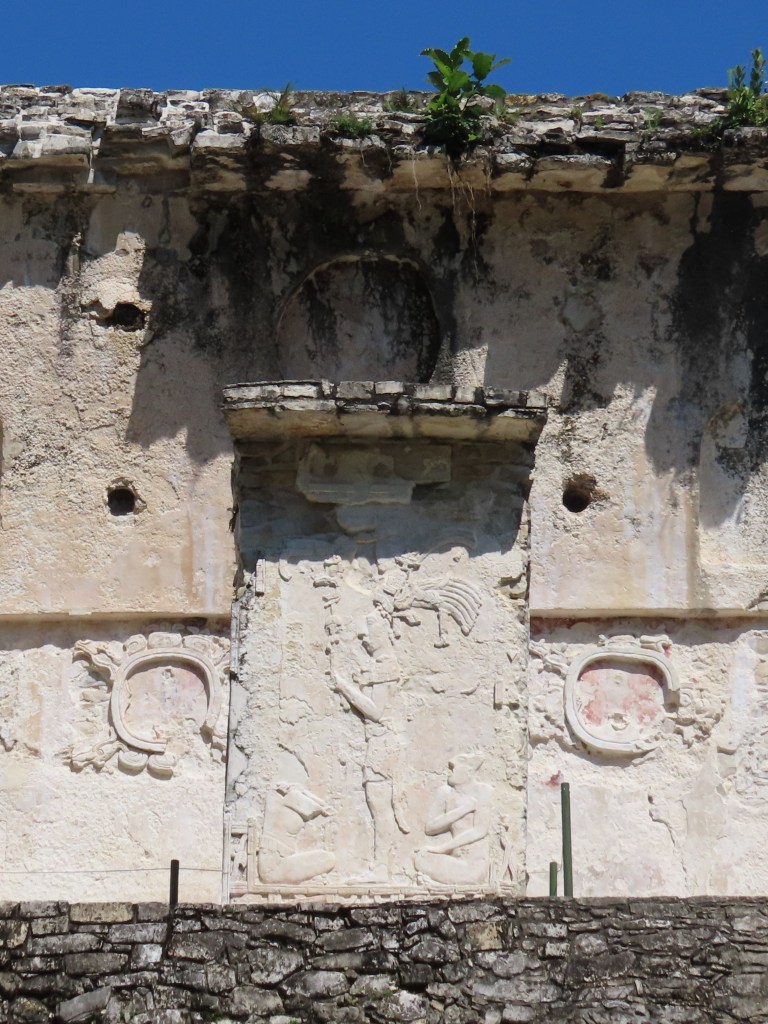
I should have a closer look at this palace. I ascend the narrow steps carefully, up to the weathered reliefs of figures who have been reduced to just outlines. The ones on the other side of the palace are in much better condition, clearly showing rulers in enormous elaborate headdresses and carrying staffs, surrounded by people kneeling in submission. Those rulers are gone. The state they belonged to, the political system that they dominated, all the subjects who ever knelt before them or paid them respect, all gone, and the great city that was their kingdom and home deserted and left to the trees.
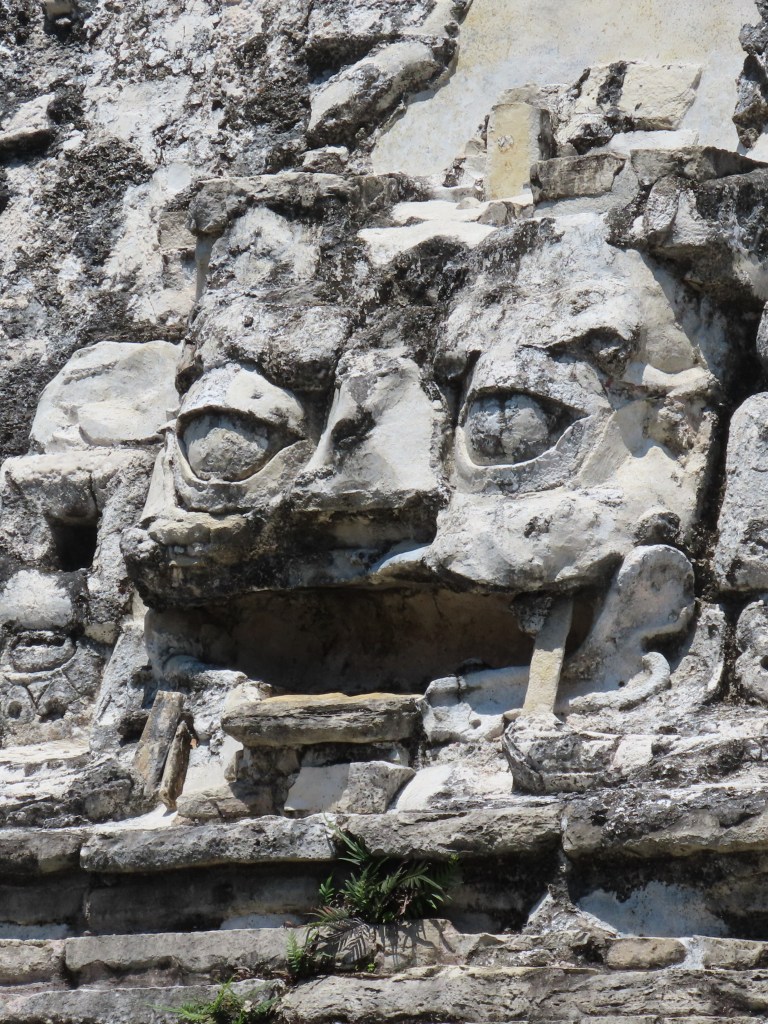
No-one knows for sure why so many of the Mayan city-states were abandoned. Based on a half-remembered documentary, the most plausible explanation that I’m aware of is that, in a region without rivers, they were reliant on the local cave-pools – cenotes – for their water, which proved insufficient to cope with population growth. In the palace courtyard, I pause to take in the carvings – human figures, hieroglyphs, stylized faces of jaguars with their fanged mouths agape – and the verdant jungle rising up behind it. I wonder if someone – a priest, a noble, or a royal; someone who lived here – saw the same view over a millennium ago, in all its former glory, and, having seen it countless times, just wondered which hat they were going to wear the next day.
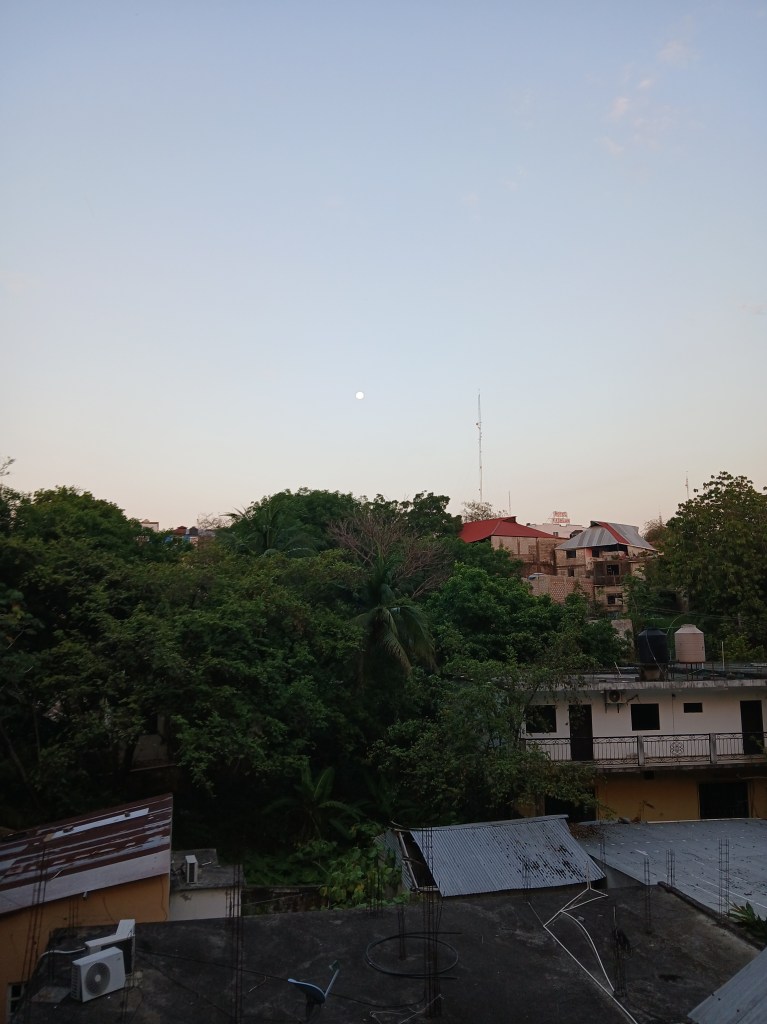
I feel strangely content walking through the bustling town as night steadily falls. Maybe it’s because the heat is lessening, maybe it’s because I’m starting to feel at home in the tropics. Eventually, after crossing a bridge over a small, forested ravine, I reach the restaurant that I was looking for. It’s in a much nicer part of town, I notice, with paving slabs instead of tarmac, and more greenery. In fact, from what I can see, this part of town – it’s called La Cañada – has a lot more hotels and restaurants. Fancier ones, too. Once I get a table and sit down, I can hear some English drifting from other tables and from people walking in. So, there are foreign tourists here. I had found it odd that there were so few gringos in Palenque, but now I realise that they’re all here, in La Cañada.
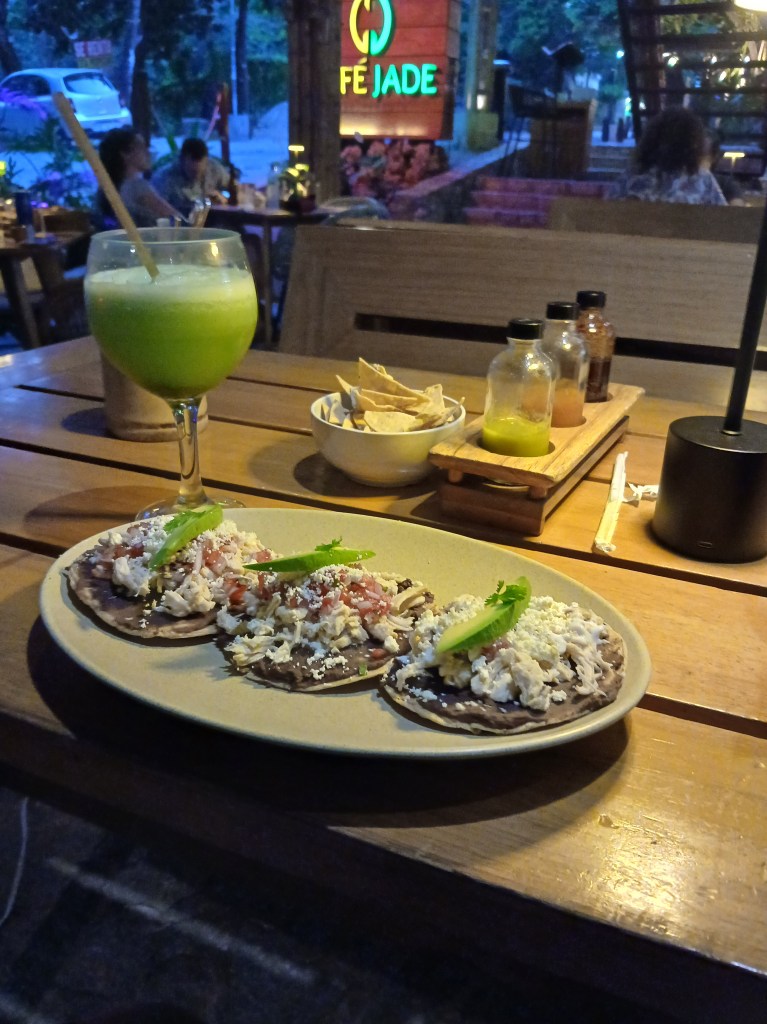
It gives me a strange sense of pride. These people have probably been staying in much grander hotels in this tourist quarter, and getting a taxi or maybe a tour to the ruins, but I had stayed with domestic tourists in town, struggled through with my inadequate Spanish, and caught a colectivo to the ruins, along with people who worked there. Still, it’s nice to sit somewhere vaguely cool and have some tostadas (toasted tortillas with toppings – your classic alliterative dish).
Day 12
I’m getting ready to leave, when, out of my usual abundance of caution, I check my train ticket again. I freeze when I realise, at the bottom of the ticket, it says that boarding time is between 30 and 45 minutes before departure. I thought this was just going to be an ordinary train, but given that there’s a boarding time as well as a baggage allowance, it must be more like the Eurostar, with something closer to airport procedures. Even if I get a taxi now instead of the one I had arranged, I still can’t reach the train station in time. I grab my bag and rush downstairs. I’ll just have to go now and try to beg them to let me on board.
Palenque’s abundance of taxis makes getting one easy, at least. I hurl myself into the back, and spend the journey in profound tension. Even seeing scarlet macaws fly overhead doesn’t lessen it. I arrive, pay the taxi driver as quickly as possible, and rush in. The train station is ordinary, my ticket is accepted without question, and I board the train with plenty of time to spare. No-one even checks my baggage allowance.
I have no idea what the boarding time on the ticket was referring to, or why it was necessary to give me some grey hairs.
There was a reason why I thought this train might be atypical: this is the brand-new Tren Maya, Mexico’s first passenger train service in years. It was designed to distribute tourism away from just the party centre of Cancun and across the Yucatan Peninsula, but I’m the only person in my carriage. There are other passengers in the other carriages; I saw them at the station, but I heard only Spanish. As the train zooms through the southern Mexican countryside, stopping at stations that are sometimes in the middle of nowhere, I see few foreign tourists, a great deal of police, and a not-inconsiderable number of locals. A lot of them take pictures of the train as it pulls in, and at one point there’s even a group of schoolchildren cheering. Even if the train fails to boost tourism in southern Mexico as it’s supposed to, at least the locals will appreciate having some infrastructure. Speaking as someone from west Wales, I’m quite jealous.
As the train nears Mérida, I start worriedly trying to remember when exactly I booked the car to pick me up. Did I do the sensible thing and book it ten minutes after the train is supposed to arrive, or did I optimistically believe in the punctuality of this shiny new service and book the car at precisely the arrival time? Either way, we’re still in the middle of nowhere, and it doesn’t look like we’ll make it on time. Whenever there’s signal, I message the driver who’s supposed to pick me up, trying to keep him updated. Some twenty minutes after the train was supposed to arrive, the view of trees outside the window finally gives way to the concrete of a station. I grab my bag and rush off the train. Hurrying down the stairs, I call the driver to find out where he is. He says he’s next to the “wooden chairs”, but I can’t see any. In fact, I can’t see any of the things that the driver says he can see. It dawns on me that I’ve got off on the wrong station.
After a lot of back and forth between the me, the driver, and a kindly station worker, the driver agrees to come get me from the station (at not-inconsiderable expense, of course), which is thankfully not too far from Mérida. When he arrives, he turns out to be a somewhat shy and informative young man. Judging by his name, he is of Ashkenazi Jewish descent himself, but when a lizard runs across the road, he tells me its local Mayan name. He also tells me that the Yucatan, being out of the way of the drug routes heading north, is the safest region of Mexico, and that this is the hottest time of the year here. I had read in a guidebook that May was supposed to be the last month before it gets uncomfortably hot, but given that the sun is starting to set and it’s still over 30 degrees, I think I’ll accept the driver’s expertise.
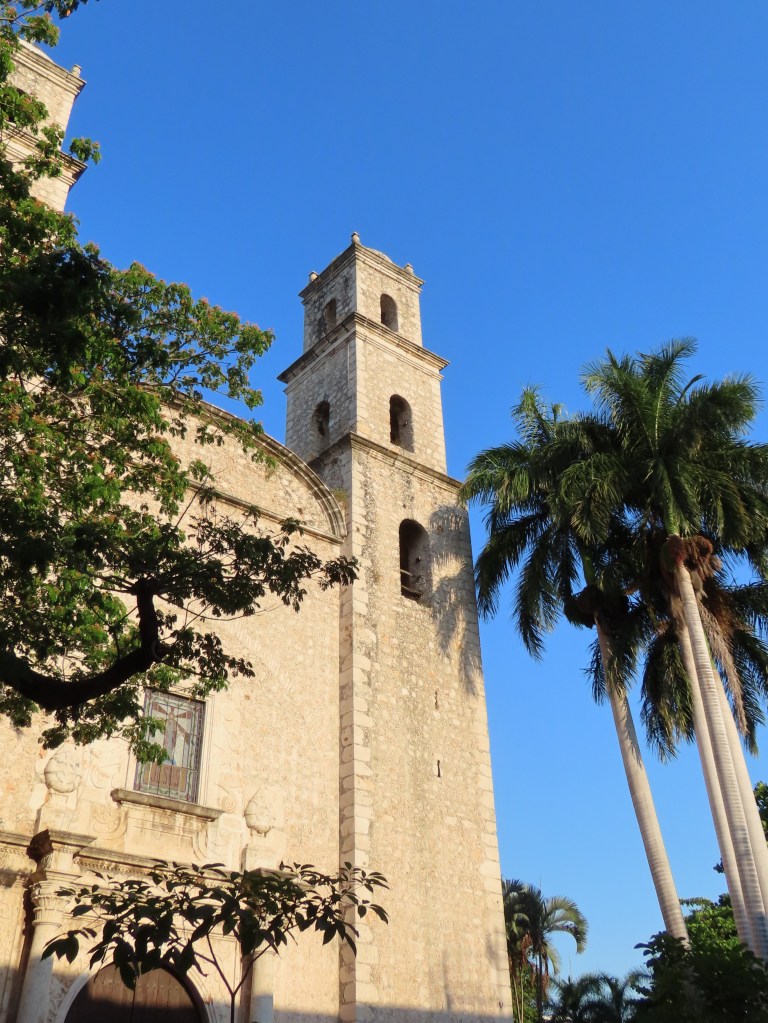

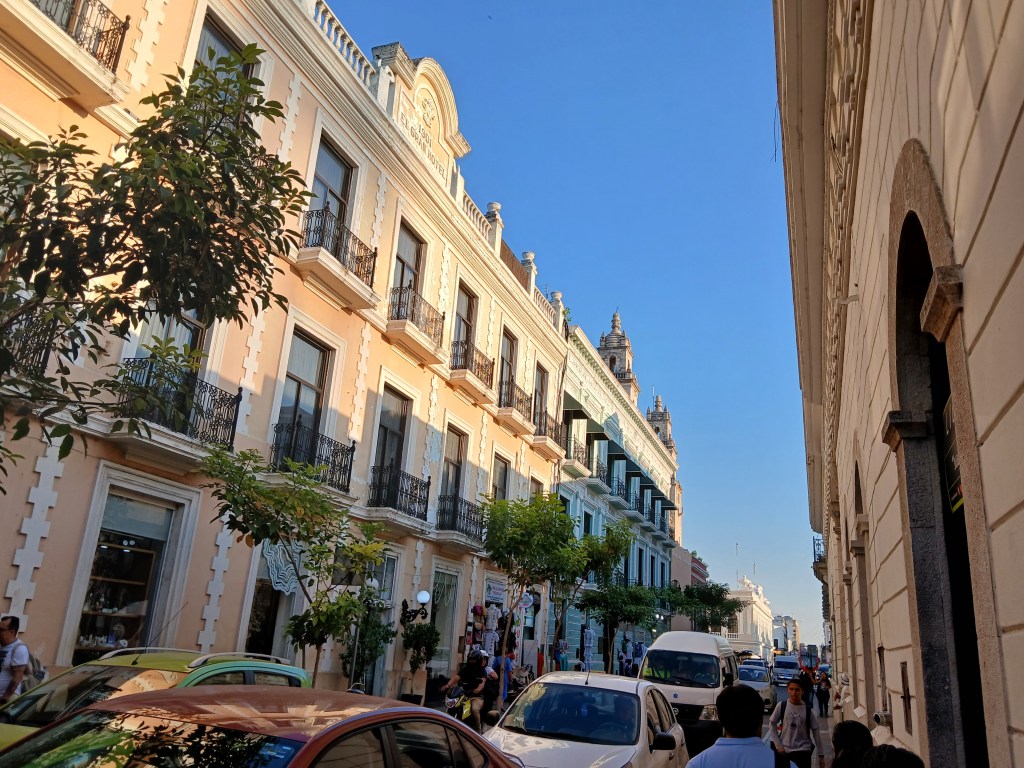
I’m staying in Mérida because it’s a natural stop between Palenque and my next destination. It seemed nice enough from what I read about it, but after checking into the hostel – a proper youth hostel, with a pool and a bar – I go out and get a surprise: Mérida is very, very pretty. I’m wandering streets of pastel walls that look straight out of a European capital, lit by the amber sunset. The churches – at least one of which I know was built out of masonry taken from a Mayan temple – seem plucked out of a charming, cobblestoned medieval town and then dropped in front of some palm trees. This is all a bit of a shock to me, but given how many other tourists are here, I’m apparently behind the curve. Despite the crowds, the golden sunlight shining through the trees in the parks onto the flowers and painted walls is…not unmagical, I suppose.
Day 13
The whole time I had been in Mexico, I had been dreading what is known as “Montezuma’s Revenge” – the food poisoning that befalls practically all foreign visitors to Mexico, named after the Aztec emperor who was usurped by the conquistadors (his real name was actually Motecuhzoma).
Oh, he is certainly having his revenge now. But what did I ever do to him?
I can’t work out what I ate to bring this on, but the tamale I had last night was a bit lukewarm, like it hadn’t been freshly cooked. I didn’t enjoy it either – a tamale is made of corn dough with a filling and steamed in a corn husk, and steamed corn is a miserably mushy affair. The consequences, if it was the tamale that set off my current inner turmoil, are, of course, so much worse. It’s uncomfortable, but manageable for now, and I can handle the train journey to Tulum, which becomes much busier with both foreign and domestic tourists as we get closer to Cancun. There’s a bright spot as the train pulls into Tulum’s station, which in the rainforest outside of town, and I spot a monkey – a spider monkey, I think – in the trees.
The hostel is another youth hostel, the kind of place where the first member of staff to greet me is in a string bikini. I knew that I’d be staying in a hut and I had seen a picture of it, but I’m a bit taken aback by how threadbare it looks up close. The conical roof is covered in some kind of black material, but it’s recognisably corrugated iron, and the door is the kind of wooden, ill-fitting thing with a heavy padlock that I’d associate with a farm’s tool shed. The only concession to the heat is a small fan mounted on the wall. But, in my current state, none of this is quite as awkward as the fact that I’ll have to use the shared toilets.
Day 14
I had hoped to go the jungle south of Tulum and maybe to the beach, but for now, I should confine myself to one of Tulum’s main attractions, which is yet another set of Mayan ruins. This time, though, it’s by the sea, so I’m not being completely repetitive. It’s the combination of ruins and white-sand beaches that draws the tourists by the hordes.
I manage to catch a colectivo and then walk past carparks, tourist information booths, a man with a monkey, the ticket office, the gates, a stretch of rainforest, and the toilets before finally stepping through a gap in Tulum’s ancient town walls that serves as the entrance.
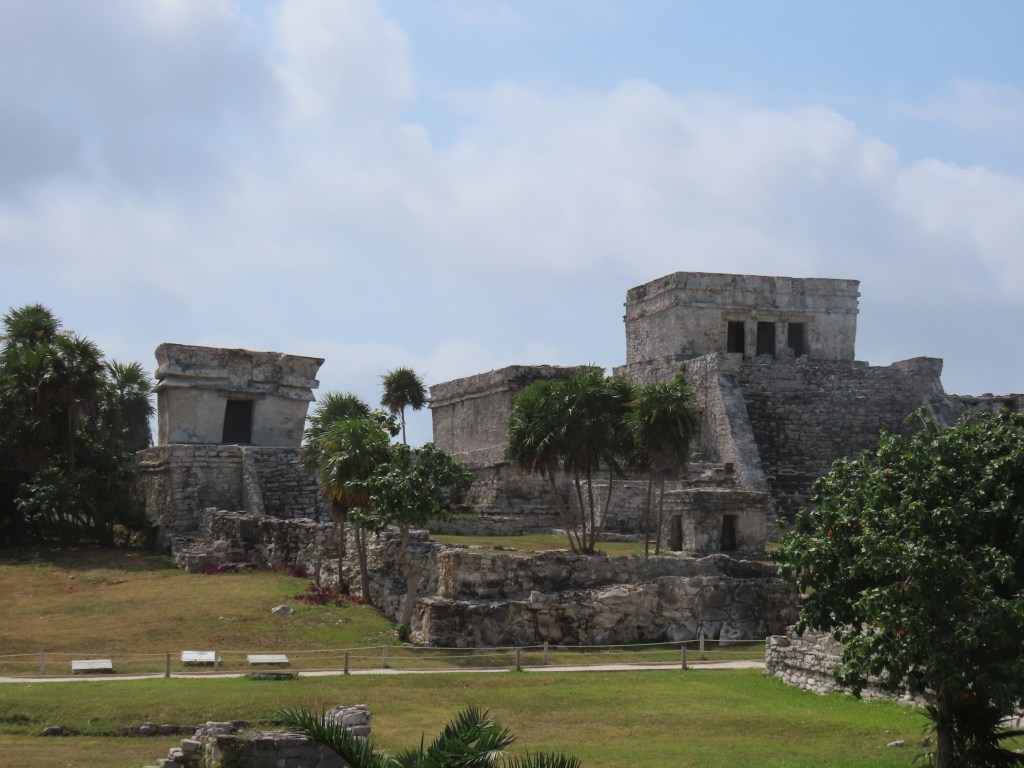
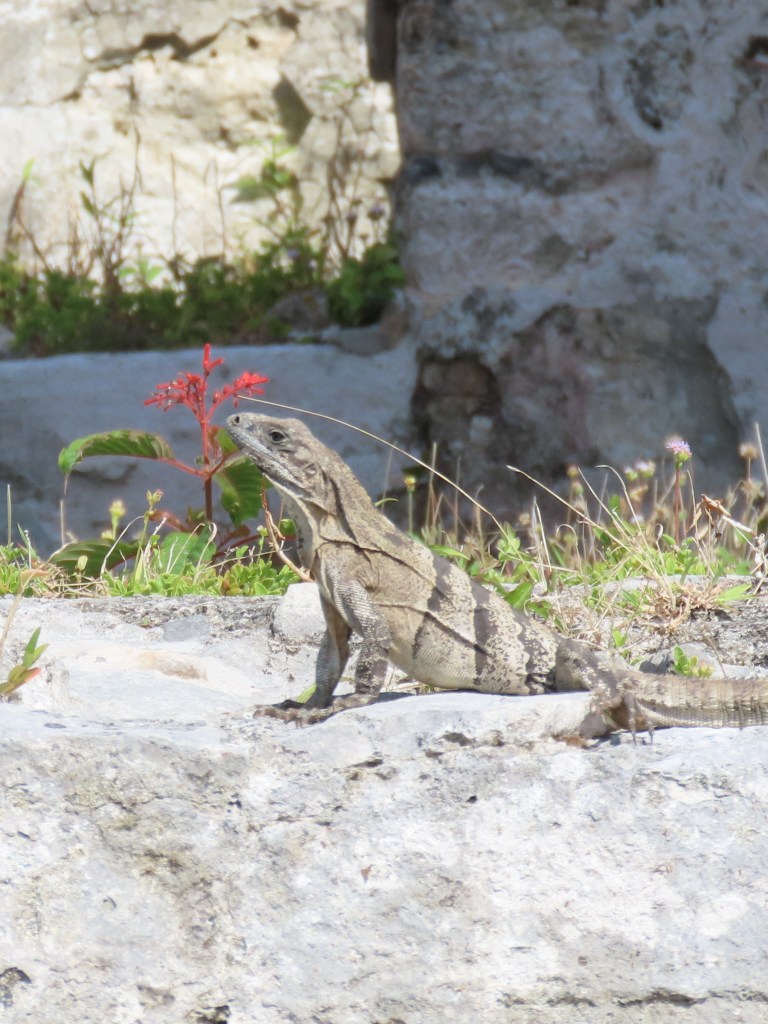
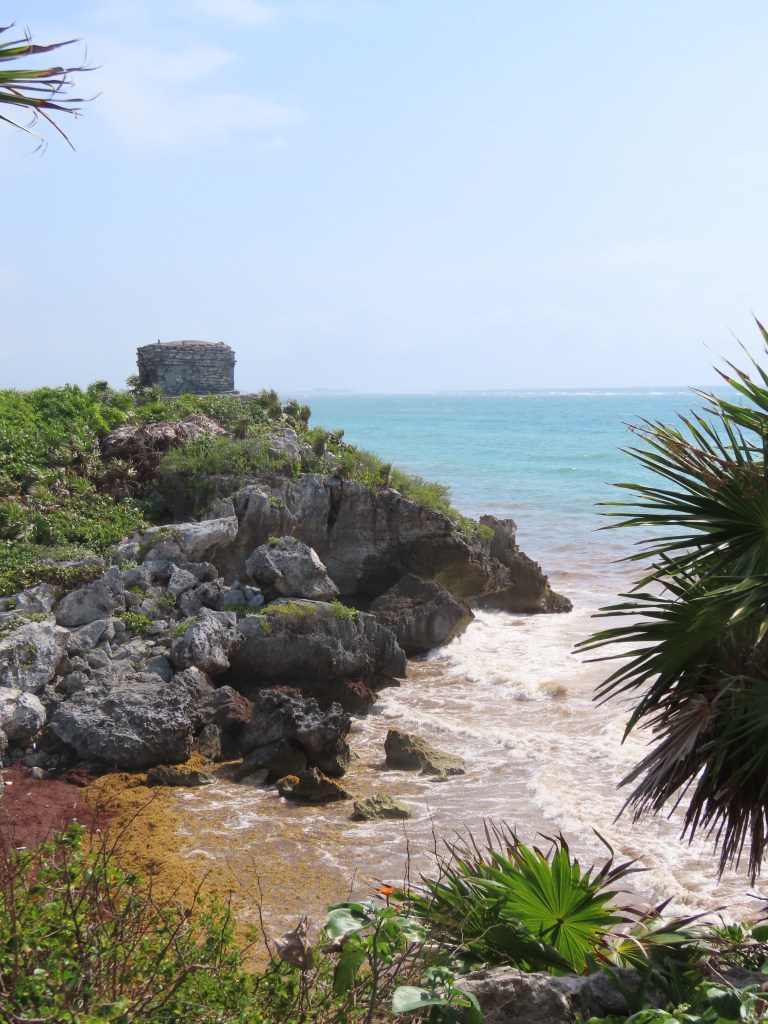
More like an abandoned town than a lost city, the site is much smaller and less elaborate than Palenque. No pyramids in the jungle here, just low, blocky buildings with the occasional row of columns, interspersed with small trees. It’s also much busier. The whole place is absolutely infested with tour groups and the kind of tourists who have very poor spatial awareness. It takes a while for me to notice the other infestation: iguanas. They’re large, but grey and mostly motionless. After spotting the first one, it slowly sinks in that all over the ruins, some of the stones have tails.
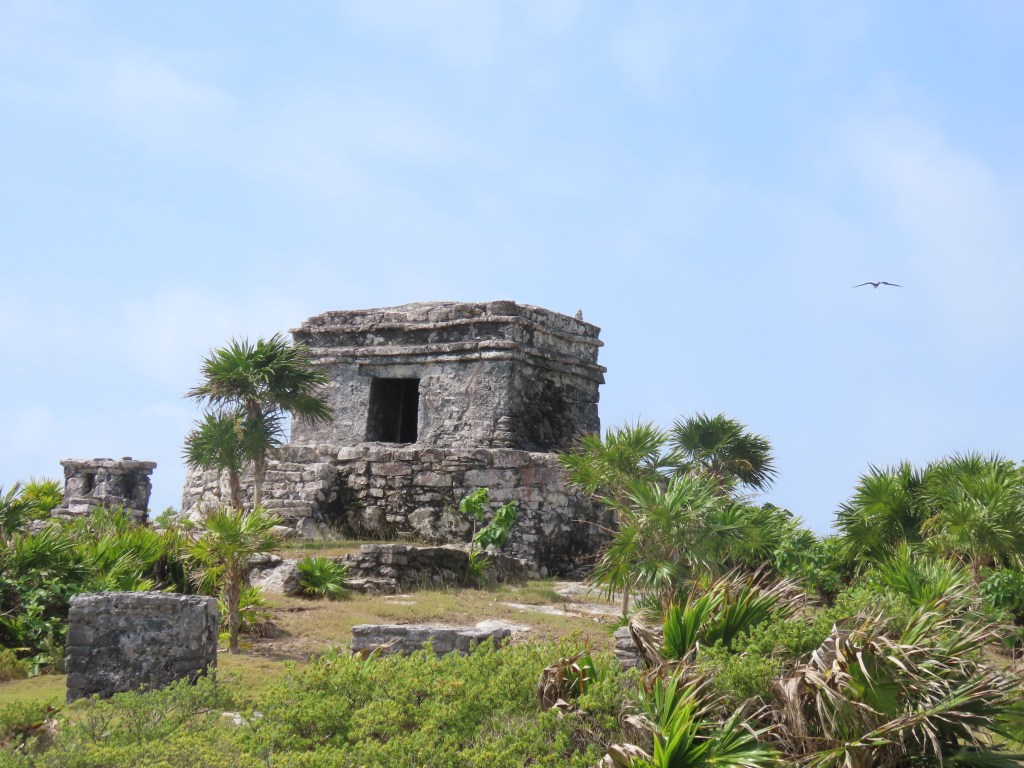
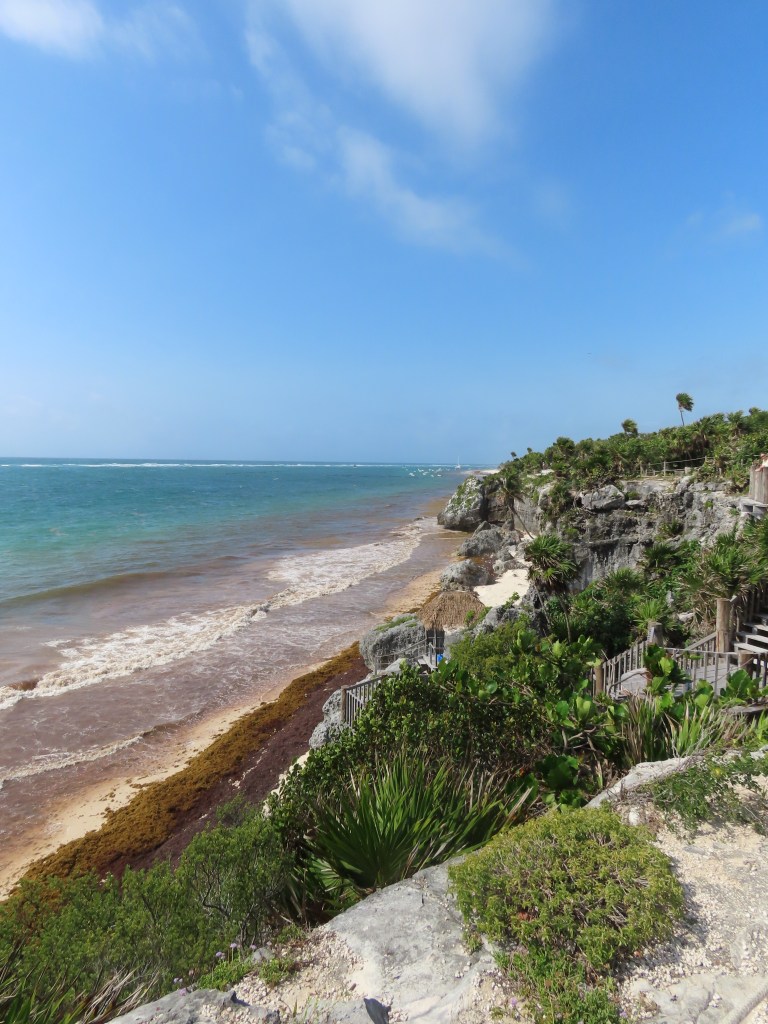
From between the tour groups, in front of the lively blue sea, I can see the pale sand of Tulum’s beaches. Well, a bit of them anyway. They’re mostly covered in swathes of reddish-green seaweed. The sight makes me a little more glum. I think they’re piles of sargassum seaweed, which is seasonal, making them another example of how I’ve mistimed this. I notice that there are stairs leading down to the beach. I consider going down to the sea, even if it is just to be among the seaweed, but the increasing abdominal discomfort is telling me that it’s time to head back.
I forgot my hat in the colectivo back to town, but at this point I’m resigned to these things happening to me. After trying to recuperate in the hostel, which mostly consisted of just sweating, I resolved instead that I’ll go to the beach when the sun starts setting. It’ll be cooler, I’ll hopefully feel better, and I get a tropical beach sunset, maybe some jungle too.
Of course that was far too optimistic. The stomach cramps have become so painful that just walking streets to find dinner is a challenge. The beach will just have to be another thing to remain unticked on the list.
Day 15
I board the coach to the airport with thoroughly mixed feelings. There was so much here that I missed out on, thanks to illness and general bad luck, but I also desperately want to be out of this constant tropical humidity that renders me permanently either wet or sticky. The coach has air-conditioning and a heavily-censored version of Jurassic World on a TV, and I don’t feel too ill at the moment.
On the way to Cancun’s airport, we pass through Playa de Carmen, another resort town. On a street, I see an elderly tourist couple pointing at something, then the woman’s hand covering her mouth in shock, and then I see police tape, the police officers themselves, and on the ground, a body-sized shape covered with a tarpaulin.
The Yucatan is the safest part of Mexico.

